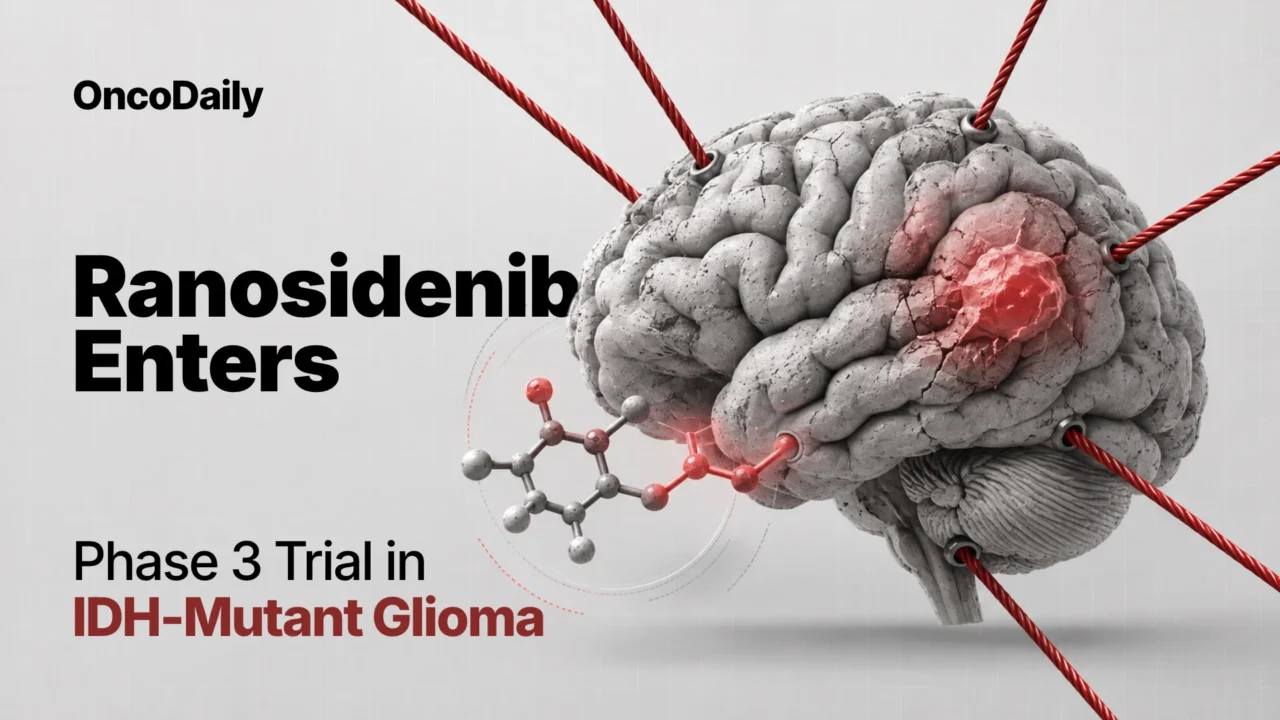
A new targeted treatment for brain tumors is entering a critical stage of clinical development. HUTCHMED has launched the Phase 3 RANOVA trial of ranosidenib (HMPL-306), an investigational oral therapy designed to target genetic mutations that drive the growth of certain gliomas.
The study will evaluate whether ranosidenib can delay disease progression in patients with Grade 2 glioma following surgery, potentially offering another treatment option for patients with these slow-growing but persistent brain tumors.
The company announced the trial’s initiation on November 23, 2026, confirming that the first patient received treatment on November 20.
What Is Ranosidenib, and How Does It Work?
Ranosidenib is an investigational targeted therapy designed to inhibit two mutated enzymes, IDH1 and IDH2, which play an important role in the development of certain brain tumors.
Under normal conditions, IDH enzymes participate in cellular metabolism. However, when mutations occur in the IDH1 or IDH2 genes, they can trigger the abnormal production of 2-hydroxyglutarate (2-HG), an oncometabolite that interferes with normal cell differentiation and contributes to tumor development.
Ranosidenib is designed to inhibit both mutant enzymes, potentially suppressing the biological processes that support tumor growth.
According to HUTCHMED, targeting both IDH1 and IDH2 may also help address certain mechanisms of acquired resistance associated with switching between the two mutant enzyme forms. However, whether this approach provides an additional clinical benefit remains to be established.
Inside the Phase 3 RANOVA Trial
The RANOVA study (NCT07912398) is a randomized, double-blind, placebo-controlled, multicenter Phase 3 trial taking place in China.
Approximately 210 patients are expected to participate.
The trial focuses on patients diagnosed with Grade 2 astrocytoma or oligodendroglioma carrying an IDH1 or IDH2 mutation. Participants must have residual or recurrent disease following surgery and must not have previously received other anticancer treatments.
Patients will receive either oral ranosidenib or placebo. Those initially assigned to placebo may switch to ranosidenib after disease progression has been confirmed by an independent review committee, provided they meet the crossover criteria.
The study’s primary endpoint is progression-free survival (PFS), assessed through independent review using Response Assessment in Neuro-Oncology (RANO) 2.0 criteria.
Other outcomes being evaluated include:
- Time until another treatment intervention is required
- Tumor growth rate and objective response rate
- Overall survival
- Treatment safety and tolerability
- Patient-reported quality of life
The trial is led by Professor Jinsong Wu of Huashan Hospital, Fudan University, and Professor Xiaohui Ren of Beijing Tiantan Hospital, Capital Medical University.
Why IDH-Mutant Glioma Is an Important Target
Although Grade 2 gliomas are generally slower-growing than high-grade brain tumors, they can recur or progress over time, frequently requiring additional surgery, radiotherapy, or chemotherapy.
For some patients, particularly those with favorable clinical characteristics, treatment after surgery may initially involve observation rather than immediate additional therapy. This creates an important clinical question: Can targeted treatment delay tumor progression and postpone the need for more intensive interventions?
IDH mutations are especially relevant because they are present in approximately 70%–80% of Grade 2 and Grade 3 gliomas, according to figures cited by HUTCHMED. By specifically targeting these mutations, researchers aim to interfere with a molecular driver of the disease rather than relying exclusively on conventional cancer treatments.
The Growing Role of IDH Inhibitors in Brain Cancer
Ranosidenib enters a field already transformed by the development of IDH-targeted therapies.
In August 2024, the U.S. Food and Drug Administration approved vorasidenib (Voranigo) for eligible patients aged 12 years and older with Grade 2 IDH-mutant astrocytoma or oligodendroglioma following surgery.
That decision followed the Phase 3 INDIGO trial, which demonstrated a significant improvement in progression-free survival compared with placebo.
The approval established IDH inhibition as an important therapeutic approach for selected patients with lower-grade glioma.
Unlike vorasidenib, however, ranosidenib remains investigational. The RANOVA trial will need to establish its own efficacy and safety profile, and there are currently no head-to-head clinical data demonstrating that one treatment is superior to the other.
What Comes Next?
With the first patient now treated, RANOVA represents an important milestone in HUTCHMED’s development program for ranosidenib.
The trial is designed to generate evidence that could support a future regulatory submission in China if its results are positive.
Beyond progression-free survival, the study’s evaluation of time to next intervention and quality of life may provide valuable insight into whether ranosidenib can help patients delay additional treatments while preserving their daily functioning.
For now, the central question remains unanswered: Can ranosidenib offer another effective targeted treatment option for patients with IDH-mutant glioma?
The Phase 3 RANOVA study will help determine whether this investigational therapy can translate its molecular rationale into meaningful clinical benefit.
Read further on OncoDaily: HUTCHMED’s New Investigational Agent Shows Activity Across 55 Tumor Cell Lines