






Every year on November 22, International Ewing Sarcoma Awareness Day brings attention to one of the rare cancers affecting children, adolescents, and young adults.
The day is dedicated to raising awareness of Ewing sarcoma, encouraging early recognition of its symptoms, supporting patients and their families, and highlighting the need for continued research and improved treatment options. International Ewing Sarcoma Awareness Day serves as a reminder that rare cancers deserve greater visibility, timely diagnosis, and access to specialized care.
The FDA Oncology Center of Excellence (OCE) highlighted CURE ID, a free platform developed by the FDA and the National Institutes of Health’s National Center for Advancing Translational Sciences (NCATS). The platform collects real-world experiences with existing medications used for new purposes, an approach known as drug repurposing.
Through CURE ID’s Rare Cancer Initiative and Sarcoma Pilot Project, patients, caregivers, and healthcare professionals are encouraged to share their experiences with treatments that have worked, as well as those that have not. These insights may help researchers identify potential treatment approaches and guide future clinical trials for rare cancers, including Ewing sarcoma.
What Is Ewing Sarcoma?
Ewing sarcoma is a rare, aggressive malignant tumor that develops primarily in bones, although it can also arise in soft tissues surrounding bones.
The disease was first described in 1921 by American pathologist Dr. James Ewing, after whom it was named.
Ewing sarcoma most commonly affects children, teenagers, and young adults, although it can occur at any age. It frequently develops in the pelvis, femur (thigh bone), ribs, and other bones.
At the molecular level, Ewing sarcoma is characterized by specific genetic alterations, most commonly a fusion between the EWSR1 and FLI1 genes. This alteration contributes to abnormal cell growth and tumor development.
Unlike some cancers associated with environmental exposures or lifestyle factors, Ewing sarcoma has no clearly established modifiable risk factors. The genetic changes responsible for the disease typically arise in tumor cells rather than being inherited from parents.
When Persistent Pain Deserves Attention
One of the challenges of Ewing sarcoma is that its early symptoms may resemble common injuries or musculoskeletal conditions.
Symptoms can include:
- Persistent or progressively worsening bone pain, sometimes more noticeable at night
- Swelling or a palpable mass near the affected area
- Reduced mobility or difficulty walking
- Unexplained fever, fatigue, or weight loss in some patients
- A fracture occurring through bone weakened by the tumor
These symptoms are much more commonly caused by noncancerous conditions. However, persistent, unexplained, or worsening symptoms warrant medical evaluation, particularly when pain is accompanied by swelling.
Diagnosing and Treating Ewing Sarcoma: What Patients Should Know
Early and accurate diagnosis plays an important role in managing Ewing sarcoma. Because its symptoms can resemble those of common injuries or other bone conditions, identifying the disease may require several diagnostic tests and evaluation by specialists experienced in treating bone and soft tissue tumors.
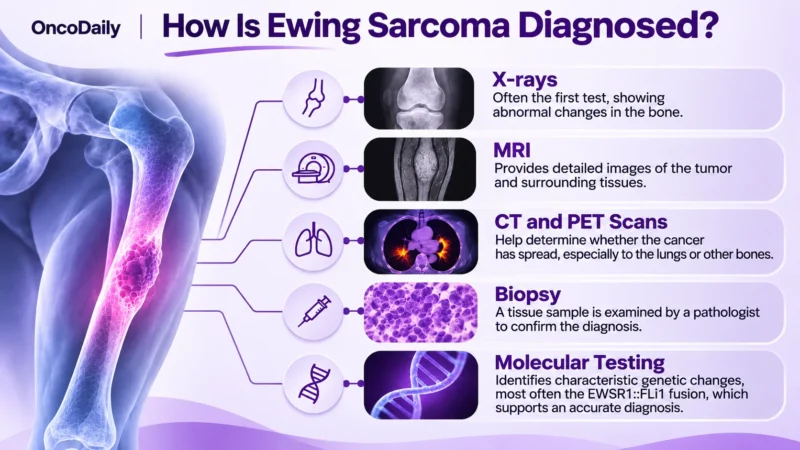
How Is Ewing Sarcoma Diagnosed?
Diagnosis usually begins with a medical examination and imaging studies to identify the tumor and determine its location and extent.
- X-rays: Often the first imaging test used when a bone tumor is suspected. They can reveal abnormal changes in bone structure.
- Magnetic Resonance Imaging (MRI): Provides detailed images of the tumor and surrounding tissues, helping specialists assess its size and local extent.
- CT and PET Scans: May be used to evaluate whether cancer has spread to other parts of the body, particularly the lungs and other bones.
- Biopsy: A tissue sample is collected and examined by a pathologist to confirm the diagnosis. The biopsy should be planned by a specialist team to avoid interfering with future treatment.
- Molecular Testing: Helps identify characteristic genetic alterations, particularly the EWSR1::FLI1 fusion, supporting an accurate diagnosis.
What Are the Treatment Options?
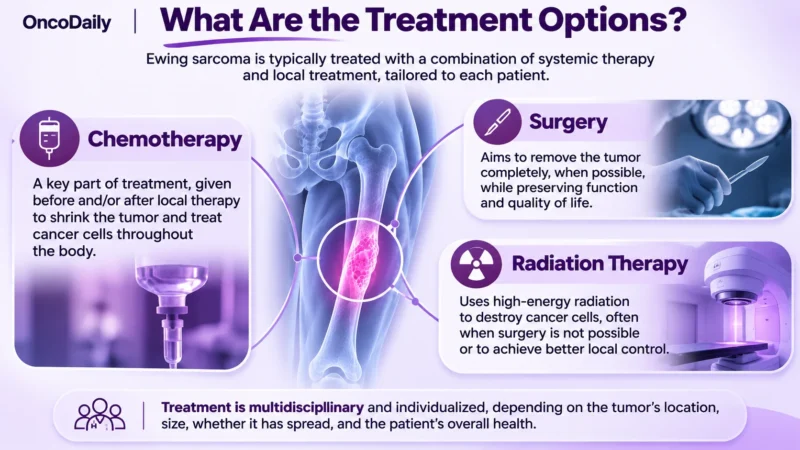
Treatment for Ewing sarcoma typically combines chemotherapy, surgery, and/or radiation therapy. The treatment plan depends on the tumor’s location, size, whether the cancer has spread, and the patient’s overall health.
Chemotherapy: Systemic chemotherapy is a central component of treatment, even when the tumor appears localized. It is generally started before surgery or radiation therapy to shrink the tumor and treat cancer cells that may have spread elsewhere. A commonly used regimen includes vincristine, doxorubicin, and cyclophosphamide alternating with ifosfamide and etoposide (VDC/IE).
Surgery: When feasible, surgery aims to remove the tumor completely while preserving as much function as possible. The decision depends on the tumor’s location and whether it can be safely removed.
Radiation Therapy: Radiation may be used when surgery is not possible, when complete removal cannot be achieved, or in selected situations where additional local treatment is needed.
Treatment for Recurrent or Metastatic Disease: When Ewing sarcoma has spread or returns after treatment, management becomes more challenging. Options may include additional chemotherapy, selected local treatments, and participation in clinical trials investigating new therapeutic approaches.
Ewing Sarcoma Symptoms: What Are the Warning Signs?
The early symptoms of Ewing sarcoma can be difficult to recognize because they often resemble common injuries, growing pains, or other musculoskeletal conditions. However, persistent or worsening symptoms should not be ignored, particularly in children, adolescents, and young adults.
The most common signs and symptoms include:
- Persistent Bone Pain: Pain near the affected bone is often the first symptom. It may become more severe over time, sometimes worsening at night or during physical activity.
- Swelling or a Noticeable Lump: Swelling, tenderness, or a palpable mass may develop around the tumor, particularly when it is located near the surface of the body.
- Difficulty Moving or Walking: Tumors affecting the pelvis or lower limbs may cause limping, reduced mobility, or discomfort during everyday activities.
- Unexplained Fever and Fatigue: Some patients experience fever, tiredness, or a general feeling of being unwell.
- Unintentional Weight Loss: Weight loss without an obvious explanation can occur, particularly in patients with more advanced disease.
- Bone Fractures: In some cases, the tumor weakens the affected bone, increasing the risk of a pathological fracture.
Awareness Can Make a Difference
International Ewing Sarcoma Awareness Day is more than an opportunity to recognize a rare cancer. It is a reminder of the importance of listening to patients, recognizing persistent symptoms, and ensuring access to specialized care.
For patients and families, greater awareness can encourage timely medical evaluation and provide access to reliable information and support. For the oncology community, it reinforces the need for continued research, collaboration, and innovation.
Rare cancers should never mean limited attention. Every patient deserves access to accurate diagnosis, effective treatment, and hope for a better future.
You can also read: Methotrexate for Osteosarcoma: Uses, Benefits and Side Effects

Written by Mane Hovhannisyan, Editor at OncoDaily.