Valsamo Anagnostou, Co-Director of Thoracic Oncology Precision Medicine Center of Excellence and Division of Upper Aerodigestive Malignancies, shared on LinkedIn:
“Here’s our latest, introducing landmark molecular response as an early predictor for immunotherapy.
Building on years of work within Hopkins Thoracic at the Johns Hopkins Kimmel Cancer Center, our group found that a single blood draw after three to nine weeks on immunotherapy was as accurate as repeated blood sampling in predicting therapy response.
How important is the baseline (pre-treatment) ctDNA measurement?
Relying on two time points and a fractional reduction from baseline misses individuals with undetectable ctDNA at both time points and those who may have missed a baseline blood draw.
Single-timepoint molecular response is more feasible and equally sensitive for predicting therapy outcomes.
This work was made possible by support from the FDA Oncology Center of Excellence and the Johns Hopkins Bloomberg School of Public Health Center of Excellence in Regulatory Science and Innovation (CERSI).
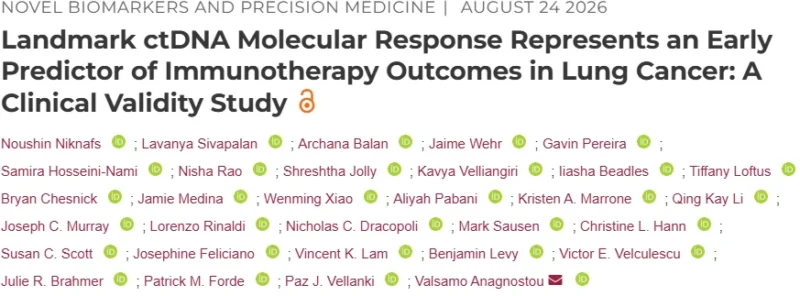
Title: Landmark ctDNA Molecular Response Represents an Early Predictor of Immunotherapy Outcomes in Lung Cancer: A Clinical Validity Study
Authors: Noushin Niknafs, Lavanya Sivapalan, Archana Balan, Jaime Wehr, Gavin Pereira, Samira Hosseini-Nami, Nisha Rao, Shreshtha Jolly, Kavya Velliangiri, Iiasha Beadles, Tiffany Loftus, Bryan Chesnick, Jamie Medina, Wenming Xiao, Aliyah Pabani, Kristen A. Marrone, Qing Kay Li, Joseph C. Murray, Lorenzo Rinaldi, Nicholas C. Dracopoli, Mark Sausen, Christine L. Hann, Susan C. Scott, Josephine Feliciano, Vincent K. Lam, Benjamin Levy, Victor E. Velculescu, Julie R. Brahmer, Patrick M. Forde, Paz J. Vellanki, Valsamo Anagnostou.
Read The Ppenaccess Article in American Association for Cancer Research Clinical Cancer Research.”
You can also read: Lung Cancer Immunotherapy: Real-World Survival and Costs in France