
Immune checkpoint inhibitors (ICIs) have fundamentally altered the therapeutic landscape of advanced and metastatic lung cancer. Randomized clinical trials have established substantial and durable survival benefits across multiple treatment settings, leading to the widespread incorporation of PD-1/PD-L1 blockade into routine clinical practice.
However, the population-level impact of this therapeutic transition extends beyond efficacy alone. As immunotherapy is implemented across unselected patient populations, two questions become increasingly relevant: how much of the survival benefit observed in clinical trials translates into routine practice, and what are the healthcare costs associated with this improvement?
The study “Impact of immunotherapy on overall survival and healthcare costs in advanced/metastatic lung cancer: A real-world study in France,” by Adrien Rousseau, Astrid Foix-Colonier, Joël Luu, Stéphanie Foulon, Benjamin Besse, V. Valentine Laizet, Khalil-Jonathan Jewiti-Rigondza, Alaeddine Sidhom, Nahla Nacef, Aline Gauthier, Monia Ezzalfani, and Julia Bonastre, addresses these questions through a nationwide analysis of French healthcare data.
By comparing patients treated during the immunotherapy era with propensity score-matched historical cohorts from the pre-immunotherapy period, the investigators evaluated changes in overall survival (OS), healthcare resource utilization, and direct healthcare expenditure associated with the introduction of ICIs into routine lung cancer care.
Why Real-World Evidence Matters
The survival benefit of immune checkpoint blockade in advanced NSCLC has been demonstrated across several pivotal randomized trials.
Long-term pooled analyses of CheckMate 017 and CheckMate 057 demonstrated a 5-year OS rate of 13.4% with nivolumab versus 2.6% with docetaxel in previously treated advanced NSCLC. In first-line disease, KEYNOTE-024 reported median OS of 26.3 months with pembrolizumab versus 13.4 months with chemotherapy in patients with high PD-L1 expression.
Combination strategies further expanded the population benefiting from immunotherapy. KEYNOTE-189 demonstrated median OS of 22.0 months with pembrolizumab plus platinum-based chemotherapy versus 10.7 months with chemotherapy alone, while KEYNOTE-407 reported median OS of 17.2 versus 11.6 months, respectively, in advanced squamous NSCLC.
These studies established the efficacy of ICIs under controlled trial conditions. Yet clinical trial populations do not fully represent patients encountered in routine oncology practice.
Patients with substantial comorbidities, impaired performance status, symptomatic central nervous system disease, or other adverse clinical characteristics are frequently excluded or underrepresented in randomized studies. Consequently, real-world effectiveness may differ from trial efficacy, making population-based analyses essential for understanding the actual clinical impact of immunotherapy.
A Nationwide French Healthcare Analysis
The investigators performed a retrospective observational analysis using the French National Health Data System (SNDS), which covers up to 99% of the French population.
The database captures demographic characteristics, hospitalizations, outpatient healthcare utilization, reimbursed medications, medical procedures, high-cost drugs, and mortality, allowing treatment outcomes and healthcare expenditure to be evaluated at a national level.
Patients receiving pembrolizumab, nivolumab, or atezolizumab between 2017 and 2020 constituted the immunotherapy cohorts.
These patients were compared with historical controls treated between 2012 and 2016, before widespread reimbursement of immune checkpoint inhibitors in France.
Because metastatic disease can be incompletely characterized using administrative coding alone, the investigators constructed two historical populations:
ADVANCED, representing patients classified as having advanced lung cancer according to diagnostic and treatment criteria, and METASTATIC, comprising patients with recorded metastatic disease who received systemic chemotherapy.
Separate analyses were performed for patients receiving immunotherapy in the first-line (L1) and second or later-line (L2) settings.
Controlling for Differences Between Treatment Eras
Because patients were not randomized, propensity score matching was used to reduce measurable differences between the immunotherapy and historical cohorts.
Matching incorporated clinical and demographic variables available within the database, including age, sex, Charlson comorbidity index, diabetes, brain metastases, medication use, and the interval between lung cancer diagnosis and systemic treatment initiation.
For second-line analyses, additional methodological adjustments were introduced to address survivorship bias, ensuring that historical control patients had survived sufficiently long to theoretically reach the corresponding treatment line.
Following matching, measured baseline characteristics were well balanced between groups.
The first-line populations had a mean age of approximately 65 years, approximately 67% were male, more than 80% had a Charlson comorbidity index ≥5, and approximately 16% had documented brain metastases.
More Than 30,000 Patients Treated With Immunotherapy
The scale of the analysis represents one of its major strengths.
Overall, 31,053 patients fulfilled criteria for inclusion in the immunotherapy cohorts.
The historical populations included 47,762 patients classified as having advanced disease and 40,137 patients classified as having metastatic disease.
Within the immunotherapy population:
- 15,118 patients received ICIs in the first-line setting.
- 15,935 patients received ICIs in the second or subsequent line.
These cohorts were subsequently matched to corresponding historical control populations.
First-Line Immunotherapy and Overall Survival
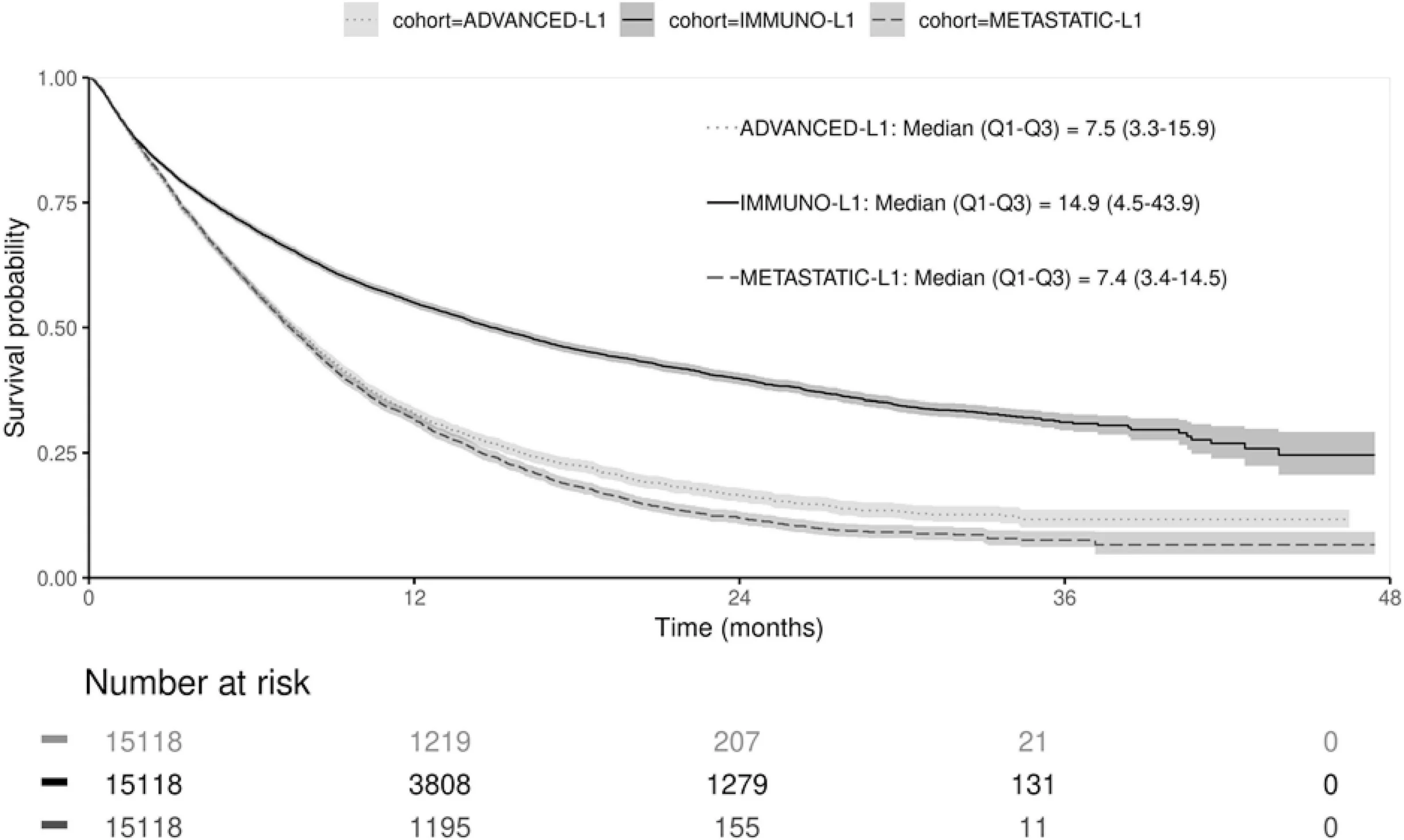
The introduction of first-line immunotherapy was associated with a substantial improvement in real-world overall survival.
Median OS:
- 14.9 months — IMMUNO-L1
- 7.5 months — ADVANCED-L1
- 7.4 months — METASTATIC-L1
Among patients receiving first-line pembrolizumab specifically, median OS was 15.7 months.
Thus, median survival in the first-line immunotherapy-era cohort was approximately twice that observed in the matched historical populations.
The magnitude of this difference is clinically important, but its interpretation requires caution. Because the analysis compared different treatment eras rather than contemporaneously randomized groups, the observed improvement cannot be attributed exclusively to immune checkpoint inhibition.
Survival Benefit Beyond the First-Line Setting
A similar pattern was observed when immunotherapy was introduced in the second or later treatment line.
Median OS from second-line treatment initiation:
- 8.1 months — IMMUNO-L2
- 4.3 months — ADVANCED-L2
- 3.7 months — METASTATIC-L2
The association between the immunotherapy era and improved survival was therefore observed across both first-line and later-line treatment settings.
The Economic Impact of Immunotherapy
The study simultaneously evaluated healthcare expenditure from the perspective of the French National Health Insurance system.
The analysis incorporated hospitalizations, high-cost anticancer drugs administered during hospitalization, outpatient anticancer treatment, radiotherapy, imaging, and other relevant healthcare utilization.
The survival improvement observed during the immunotherapy era was accompanied by a substantial increase in healthcare expenditure.
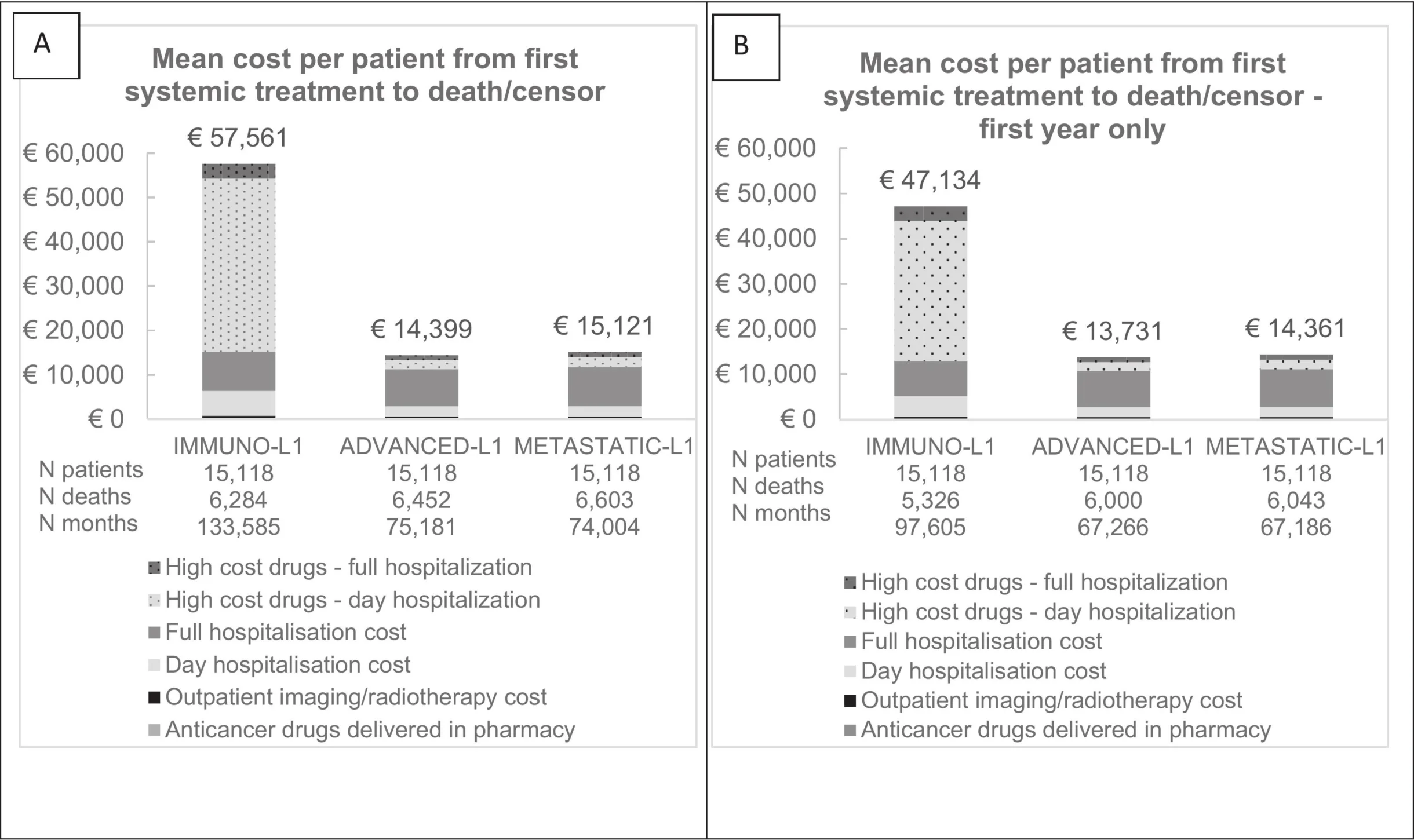
Mean monthly healthcare cost per patient:
- €8,801 — IMMUNO-L1
- €4,205 — ADVANCED-L1
- €4,314 — METASTATIC-L1
Thus, monthly healthcare expenditure was approximately twice as high among patients receiving first-line immunotherapy.
Cumulative Costs Increased Even More Substantially
The difference was greater when total expenditure over the observation period was considered.
Mean total healthcare cost per patient:
- €57,561 — IMMUNO-L1
- €14,399 — ADVANCED-L1
- €15,121 — METASTATIC-L1
During the first year following treatment initiation, mean healthcare expenditure reached:
- €47,134 with first-line immunotherapy
- €13,731 in ADVANCED-L1
- €14,361 in METASTATIC-L1
The higher cumulative expenditure reflects two simultaneous effects: patients treated during the immunotherapy era survived longer and therefore accumulated healthcare costs over a longer period, while their monthly cost of care was also substantially higher.
Higher Drug Expenditure, but Less Hospitalization
One of the most informative findings of the study was the distribution of healthcare resource utilization.
Despite higher overall expenditure, patients receiving immunotherapy spent less time in hospital.
Mean hospitalization duration per month was:
- 6.4 days — IMMUNO-L1
- 8.2 days — ADVANCED-L1
- 8.4 days — METASTATIC-L1
Mean monthly hospitalization frequency was also slightly lower with immunotherapy:
- 2.0 hospitalizations — IMMUNO-L1
- 2.3 hospitalizations — ADVANCED-L1
- 2.3 hospitalizations — METASTATIC-L1
The increased economic burden was therefore not driven primarily by greater inpatient healthcare utilization.
Instead, high-cost anticancer drugs accounted for 73.6% of monthly healthcare expenditure in IMMUNO-L1, compared with 21.6% and 22.1% in the ADVANCED-L1 and METASTATIC-L1 cohorts, respectively.
This distinction is important.
Immunotherapy altered not only the magnitude of healthcare expenditure but also its structure: less resource utilization through hospitalization, but substantially greater pharmaceutical expenditure.
Real-World Outcomes Remain Below Those Observed in Pivotal Trials
Although survival improved substantially compared with historical cohorts, the real-world outcomes remained less favorable than those reported in several landmark immunotherapy trials.
Median OS of approximately 15 months in the first-line immunotherapy cohort contrasts with the longer survival reported in selected trial populations, including approximately 22 months in KEYNOTE-189 and 26.3 months in KEYNOTE-024.
The authors emphasize that this trial-to-real-world gap has been observed in other studies.
One major explanation is differences in patient selection.
The French nationwide cohort included patients with substantial comorbidity and other adverse clinical characteristics that are frequently underrepresented in randomized trials. A cited German real-world analysis of first-line pembrolizumab found that nearly half of treated patients would not have met eligibility criteria for KEYNOTE-024 or KEYNOTE-042, predominantly because of performance status or multiple metastatic sites, and outcomes were poorer among trial-ineligible patients.
These findings reinforce the distinction between efficacy under controlled trial conditions and effectiveness across an unselected healthcare population.
An Important Methodological Caveat
The magnitude of the survival difference should not be interpreted as a direct causal estimate of immunotherapy efficacy.
The study compared patients treated during different historical periods.
Immunotherapy cohorts were treated between 2017 and 2020, whereas historical controls were treated between 2012 and 2016. During this interval, multiple aspects of lung cancer management may have evolved independently of immune checkpoint inhibition.
Furthermore, several clinically important variables were unavailable in the administrative database, including:
- ECOG performance status
- PD-L1 expression
- smoking history
- histological subtype
- precise disease stage
- molecular characteristics
Propensity score matching can balance measured variables but cannot eliminate confounding from characteristics that were not captured.
Accordingly, the study should be interpreted as an analysis of changes in survival and healthcare expenditure across treatment eras, rather than as a randomized comparison establishing that the entire survival difference was caused by immunotherapy.
Histological and Therapeutic Heterogeneity
The SNDS database also lacked histological information sufficient to reliably distinguish NSCLC from SCLC.
During the study period, reimbursed immunotherapies included nivolumab and atezolizumab in later-line NSCLC, pembrolizumab in first-line NSCLC, and atezolizumab in first-line SCLC.
Durvalumab consolidation following chemoradiotherapy was excluded because this represents a distinct clinical setting from advanced or metastatic disease.
The findings therefore describe the healthcare-system impact of the immunotherapy strategies available in France during the study period and should not automatically be extrapolated to all contemporary immunotherapy combinations or indications.
From Clinical Benefit to Healthcare Sustainability
The study raises a broader issue that is becoming increasingly relevant across immuno-oncology.
The introduction of ICIs was associated with a substantial improvement in population-level survival, but simultaneously shifted healthcare expenditure toward high-cost systemic therapy.
As checkpoint inhibitors continue to expand into earlier disease stages, perioperative treatment, combination regimens, and longer-duration strategies, the economic implications may become even greater.
The authors highlight optimization of administration schedules, treatment duration, and the introduction of biosimilars as potential approaches to improving the economic sustainability of immunotherapy.
The challenge is therefore no longer simply to develop more effective immunotherapies.
It is increasingly to determine how, for whom, and for how long these therapies should be administered to maximize clinical benefit while maintaining sustainable access.
You Can Read Full Article Here