
Sana Karam, Professor of Medicine, Chair, Department of Radiation Oncology Washington University School of Medicine, shared on X:
“Out now in Nature Communications.
We asked why radiation plus anti-PD-1 underperforms in head and neck cancer. The answer surprised us: PD-1 is a checkpoint on regulatory T cells too, and blocking it arms them.
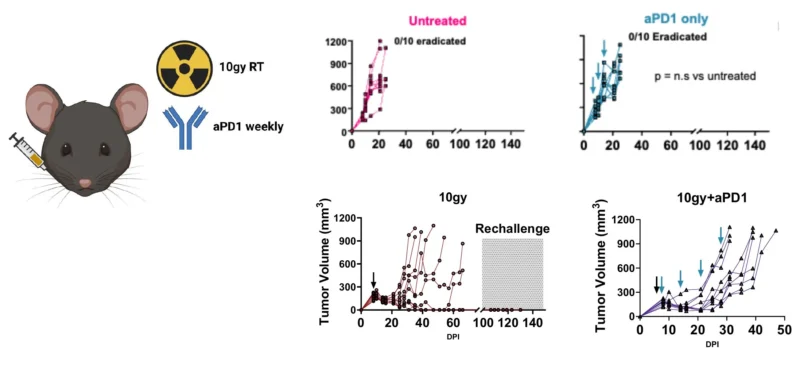
First, the problem. In anti-PD-1–refractory models, adding anti-PD-1 to radiation didn’t improve control.
– 1 RT plus aPD1 fails.
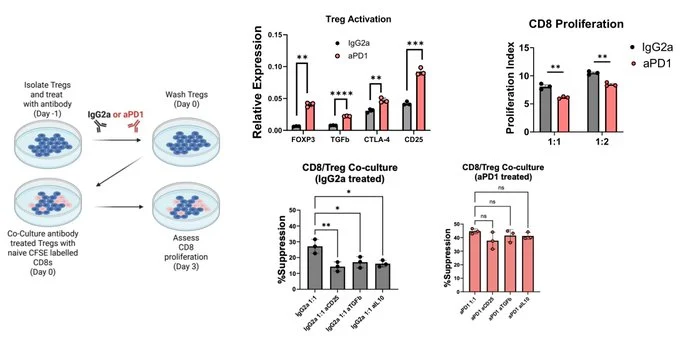
Anti-PD-1 conditioning of Tregs raised Foxp3, TGF-β, CTLA-4 and CD25, and increased their suppression of CD8 proliferation. This isn’t about Treg numbers. It’s about what the antibody does to them.
– 2 PD1 checkpoint on Tregs
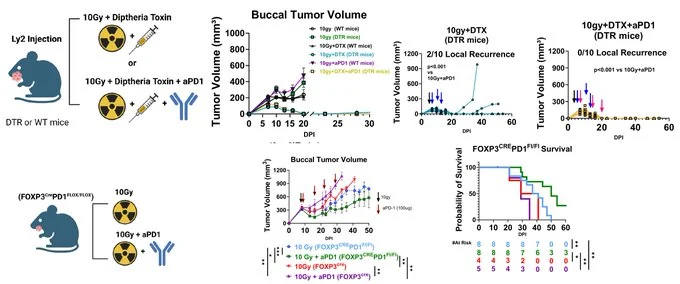
Not just an antibody effect. Deleting PD-1 specifically on Tregs restored response. Ablating Tregs outright did the same.
– 3 Tregs are the problem
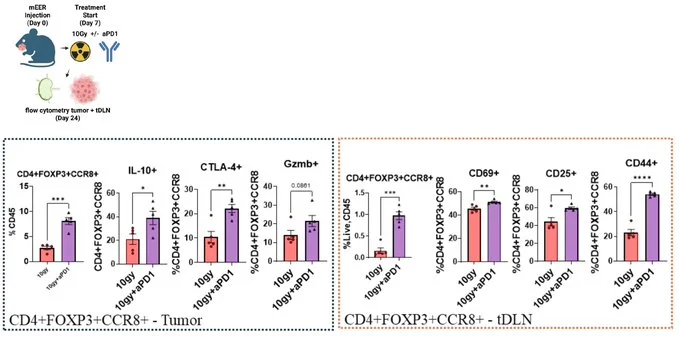
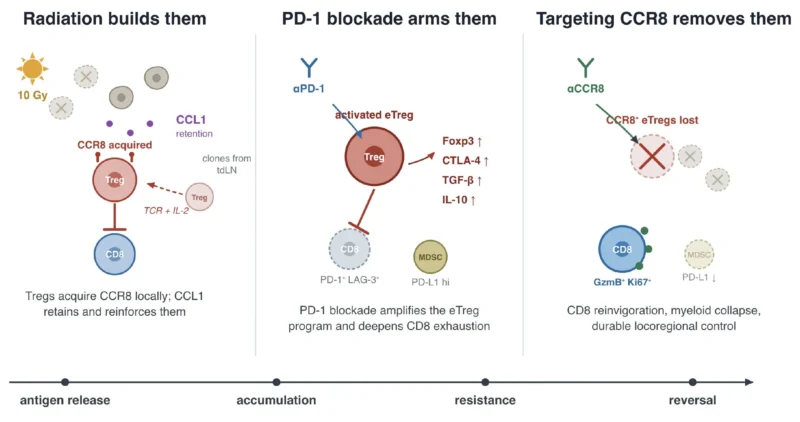
Where do these cells come from? Radiation induces CCL1 and CCR8+ Tregs accumulate — then anti-PD-1 activates them, in tumor and in node.
– 4 Each therapy supplies half the problem.
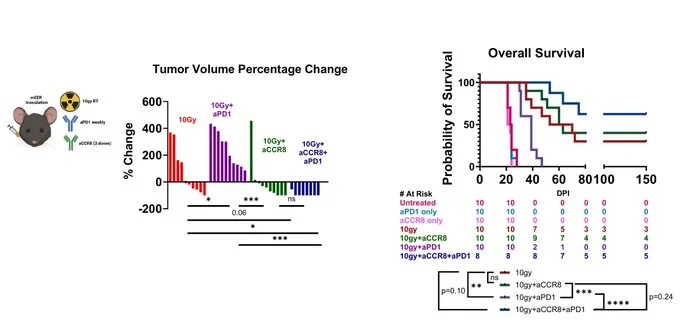
Three doses of anti-CCR8 with radiation restored anti-PD-1 efficacy. Durable survival across models, and cured mice rejected rechallenge.
– 5 aCCR8 restores efficacy
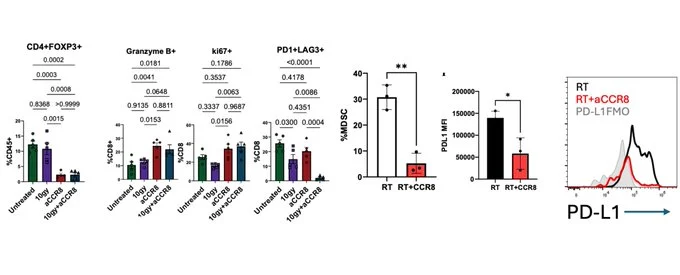
Removing one CD4 population did more than remove Tregs: CD8 exhaustion down, granzyme B up, MDSCs reduced, PD-L1 on MDSCs fell. The suppressive network was load-bearing.
– 6 suppressive architecture
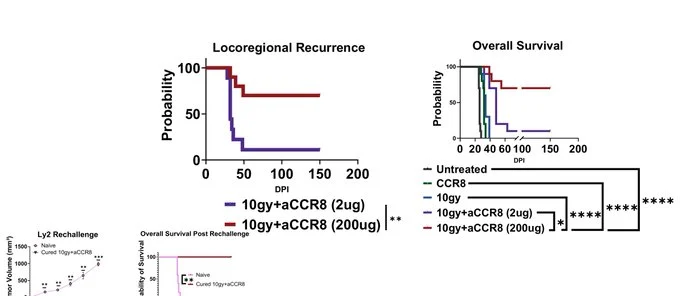
And it mattered regionally. Upfront, full-dose anti-CCR8 markedly reduced locoregional recurrence.
– 7 nodal recurrence
The whole story in one figure. Huge congratulations to Nicholas Olimpo, who drove this, and to the entire Karam Lab team and our collaborators.”
Main findings on CCR8-depleting antibodies
- In human and murine HNSCC, intratumoral CCR8-positive regulatory T cells showed immunosuppressive features and were associated with incomplete responses to radiotherapy and immunotherapy, identifying a potential therapeutic target for treatment.
- In preclinical HNSCC models, radiotherapy increased CCR8-positive T-cell infiltration into primary tumors, promoting tumor growth and recurrence; CCR8-depleting antibodies reversed these effects in treated mice.
- Anti-PD-1 activated CCR8-positive regulatory T cells, contributing to resistance to combined radiotherapy and anti-PD-1 treatment; adding CCR8-depleting antibodies reversed this resistance and restored antitumor response in preclinical models of HNSCC.
Title: CCR8-depleting antibodies restore response to radiotherapy plus anti-PD1 therapy in head and neck cancer by targeting intratumoral CCR8+ regulatory T cells
Authors: Nicholas A. Olimpo, Benjamin Van Court, Justin X. Yu, Brooke Neupert, Harshita Kumar, Michael Knitz, Jacob Gadwa, Chloe Hodgson, Alexander Nguyen, Jessica I. Beynor, Khalid N. M. Abdelazeem, Joline Sun, Tyler Weiskopf, Sidharth Puram, Andy Rankin, Nathan Pierce, Douglas G. Osbourne, Sana D. Karam
Read the full article:
You may also be interested in:
David Sher: Proton Therapy vs IMRT – What Really Matters in Head and Neck Reirradiation?
Ezra Cohen: A New Strategy for Anti-PD-1-Resistant Tumors
J. Robert Oppenheimer: Throat Cancer Diagnosis and Cause of Death