
J. Robert Oppenheimer, the American physicist who led the development of the first atomic bombs, spent the final years of his life fighting throat cancer. Diagnosed in 1966 after decades of heavy smoking, he underwent cancer treatment during a period when medical options were far more limited than they are today. Despite attempts to control the disease, he died on February 18, 1967, at the age of 62. Known as the Father of the Atomic Bomb, Oppenheimer helped transform the modern world through his leadership of the Manhattan Project.
His contributions to theoretical physics and nuclear science made him one of the most recognizable scientists of the twentieth century. Yet behind his public achievements was a serious illness that gradually changed the course of his final years. The U.S. National Park Service confirms that Oppenheimer was diagnosed with throat cancer in 1966 following a lifetime of heavy smoking. Although historical accounts frequently associate his illness with tobacco use, his complete medical records are not publicly available, making it impossible to establish every clinical detail or the precise cause of his cancer (National Park Service, 2025). His story remains medically relevant.
According to the National Cancer Institute’s Surveillance, Epidemiology, and End Results (SEER) program, an estimated 12,290 new cases of laryngeal cancer and 3,960 deaths are expected in the United States in 2026. The overall five-year relative survival rate is approximately 63%, although outcomes vary considerably depending on the stage at diagnosis (NCI SEER, 2026). Oppenheimer’s experience illustrates the consequences associated with long-term tobacco exposure, the challenges of treating cancers in anatomically complex regions, and the remarkable changes in oncology since the 1960s. His final illness also reveals a deeply human chapter in the life of a scientist whose work changed history.
Who Was J. Robert Oppenheimer?
Julius Robert Oppenheimer was born on April 22, 1904, in New York City. Raised in an intellectually active family, he developed interests in science, literature, philosophy, and languages from an early age. He studied at Harvard University before continuing his education at the University of Cambridge and the University of Göttingen in Germany, where he completed his doctorate in theoretical physics in 1927.
Oppenheimer subsequently became a professor at the University of California, Berkeley, and the California Institute of Technology. His research contributed to quantum mechanics, nuclear physics, and theoretical investigations of gravitational collapse. However, his most significant historical role emerged during World War II. In 1942, Oppenheimer joined the Manhattan Project, the secret American-led scientific initiative established to develop atomic weapons. He became the scientific director of the Los Alamos Laboratory in New Mexico, bringing together leading physicists, chemists, mathematicians, and engineers.

Photo: Depositphotos
Under his leadership, Los Alamos became the central research facility responsible for designing the first nuclear weapons. On July 16, 1945, the Manhattan Project conducted the Trinity test, the first successful detonation of a nuclear explosive device. Weeks later, atomic bombs were dropped on the Japanese cities of Hiroshima and Nagasaki. The bombings caused catastrophic loss of life and introduced a new era of nuclear warfare.
Oppenheimer’s role earned him international recognition, but it also placed him at the center of difficult questions about scientific responsibility and the consequences of technological discovery. After the war, he became director of the Institute for Advanced Study in Princeton, New Jersey, a position he held from 1947 until 1966. His career was later affected by Cold War political controversies, including the 1954 security clearance proceedings that damaged his relationship with the American government. In 1963, he received the Enrico Fermi Award in recognition of his scientific contributions. Three years later, he was diagnosed with cancer (Institute for Advanced Study, n.d.; National Park Service, 2025).
Was J. Robert Oppenheimer a Heavy Smoker?
Smoking was a recognizable feature of Oppenheimer’s personal and professional life. Numerous historical photographs show him holding a cigarette or pipe, and biographical descriptions frequently refer to him as a chain smoker. Tobacco use was common throughout much of his adult life, particularly during the first half of the twentieth century, when cigarettes were widely advertised and their long-term health consequences were not yet fully understood by the public. The first major epidemiological studies demonstrating a relationship between smoking and lung cancer emerged during the middle of the twentieth century.
By 1964, the U.S. Surgeon General’s landmark report had established cigarette smoking as a major cause of lung cancer and an important contributor to other diseases. Oppenheimer had already accumulated decades of tobacco exposure by that point. From an oncological perspective, prolonged smoking is particularly relevant because tobacco smoke contains multiple carcinogenic compounds capable of damaging cells throughout the upper respiratory and digestive tracts.
These include tobacco-specific nitrosamines, polycyclic aromatic hydrocarbons, and other chemicals that can contribute to DNA damage and cancer development. The National Cancer Institute identifies tobacco use as one of the principal risk factors for cancers of the larynx, oral cavity, oropharynx, and hypopharynx. The association is particularly strong for laryngeal cancer. Clinical research summarized in the medical literature has reported that smoking can be associated with approximately 15- to 30-fold higher rates of laryngeal cancer, although the magnitude of risk varies according to exposure history, study design, and other contributing factors (StatPearls, 2023).
Did Smoking Cause Oppenheimer’s Throat Cancer?
Historical accounts widely connect Oppenheimer’s cancer with his lifelong smoking. This interpretation is consistent with medical evidence showing that tobacco is a major cause of laryngeal and other head and neck cancers. However, it is important to distinguish an established population-level risk factor from an individually proven cause. Even when a person has a long history of tobacco exposure, it is generally impossible to determine the exact contribution of smoking to an individual malignancy without detailed clinical and biological evidence.
Oppenheimer’s original pathology findings, tumor stage, and complete medical history are not sufficiently documented in publicly accessible sources. Therefore, the most scientifically accurate conclusion is that his lifelong smoking was a major risk factor and is widely believed to have contributed to his throat cancer. This wording recognizes the medical evidence without presenting a retrospective interpretation as a confirmed individual diagnosis.
When Was J. Robert Oppenheimer Diagnosed With Throat Cancer?
Oppenheimer was diagnosed with throat cancer in the mid-1960s. Some biographical accounts place the diagnosis in late 1965, while the U.S. National Park Service identifies 1966 as the year in which the disease was diagnosed. The National Park Service’s official historical account states that Oppenheimer received the diagnosis in 1966 after a lifetime of heavy smoking. The Institute for Advanced Study also confirms that throat cancer caused his death on February 18, 1967. Historical reports often use the general term throat cancer, while some biographical accounts identify the malignancy as cancer of the larynx. The distinction is medically important.
Throat cancer is not a single anatomical diagnosis. It can describe cancers originating in several different regions, including the pharynx and larynx. Each region has different anatomical structures, lymphatic drainage patterns, symptoms, and treatment considerations. Although laryngeal cancer is frequently associated with Oppenheimer’s illness, the available historical documentation does not allow his precise tumor site, histological subtype, or stage to be independently established. Consequently, modern statistics for laryngeal cancer can provide relevant educational context, but they should not be treated as a direct prediction of Oppenheimer’s prognosis.
What Is Throat Cancer?
Throat cancer is a broad term referring to malignant tumors that develop in the throat and nearby structures. Most cancers in these regions arise from squamous cells, the thin epithelial cells lining the mucosal surfaces of the upper respiratory and digestive tracts. These cancers are generally classified as head and neck squamous cell carcinomas, although other, less common histological types can occur. Two important anatomical structures are the pharynx and the larynx.
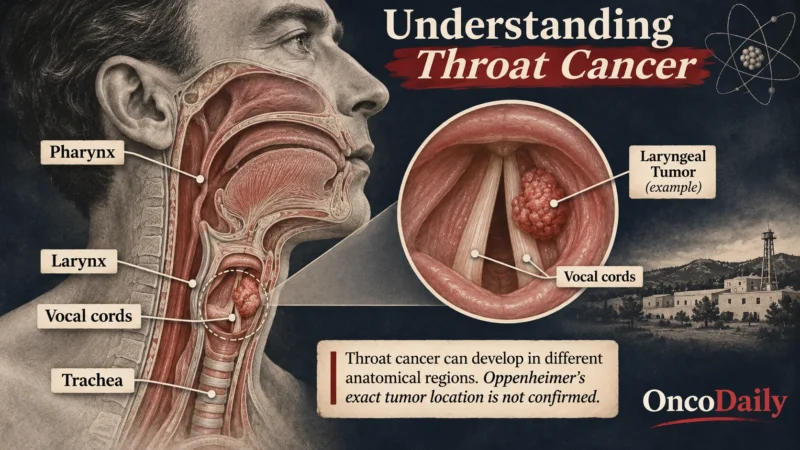
The pharynx is a muscular passage connecting the nasal cavity and mouth to the esophagus and larynx. It includes the nasopharynx, oropharynx, and hypopharynx. The larynx, commonly called the voice box, is located below the pharynx and above the trachea. It contains the vocal cords and plays a central role in speech, breathing, and airway protection during swallowing. Cancers originating in different parts of these structures may behave differently and require different treatment approaches (NCI, Laryngeal Cancer Treatment PDQ).
What Is Laryngeal Cancer?
Laryngeal cancer occurs when malignant cells develop in the tissues of the voice box. The majority of cases are squamous cell carcinomas. The larynx is divided into three anatomical regions. The supraglottis is the upper portion of the larynx, which includes the epiglottis and structures above the true vocal cords. Tumors in this region may cause swallowing difficulties, throat discomfort, or enlargement of neck lymph nodes. The glottis contains the true vocal cords. Even relatively small tumors in this region may cause persistent hoarseness because they interfere with normal vocal cord vibration.
The subglottis extends below the vocal cords toward the trachea. Primary tumors arising in this region are uncommon and may remain unnoticed until they interfere with breathing or extend into neighboring structures.
These anatomical differences influence cancer staging, symptoms, and treatment. Glottic cancers, for example, are sometimes detected earlier because changes in voice can develop before the tumor becomes large. Supraglottic cancers have more extensive lymphatic drainage and may be more likely to involve regional lymph nodes. According to the National Cancer Institute, the location and extent of laryngeal cancer are important determinants of prognosis and treatment selection (NCI, Laryngeal Cancer Treatment PDQ).
How Common Is Laryngeal Cancer Today?
Although laryngeal cancer is less common than malignancies such as lung, colorectal, breast, or prostate cancer, it remains an important public health concern. According to the National Cancer Institute’s SEER Cancer Stat Facts, 12,290 new cases of laryngeal cancer and 3,960 deaths are projected in the United States in 2026. These estimates represent approximately 0.6% of all newly diagnosed cancers in the country.
The age-adjusted incidence rate was approximately 2.5 new cases per 100,000 people annually during 2019–2023. Laryngeal cancer affects men more frequently than women. Over the same period, the incidence was approximately 4.3 cases per 100,000 men compared with 0.9 cases per 100,000 women. The median age at diagnosis was 67 years, and the greatest proportion of cases occurred among people aged 65–74 (NCI SEER, 2026). Oppenheimer was approximately 61–62 years old during the period when his cancer was diagnosed, placing him within an age range in which laryngeal cancer is more frequently observed. However, these modern epidemiological findings cannot establish the characteristics of his particular tumor.
Are Laryngeal Cancer Rates Increasing or Decreasing?
In the United States, laryngeal cancer incidence has generally declined over recent decades. According to SEER, age-adjusted incidence rates decreased by an average of approximately 2.5% per year between 2014 and 2023. Age-adjusted mortality rates also declined, by approximately 1.3% annually between 2015 and 2024. The decline in tobacco use is considered an important contributor to these trends, although changes in diagnosis, population exposures, and other factors may also influence cancer statistics.
The declining incidence is an encouraging public health development, but it does not mean that laryngeal cancer has become a minor concern. Thousands of individuals continue to receive the diagnosis each year, and patients with advanced disease may face serious treatment challenges (NCI SEER, 2026).
What Are the Warning Signs and Symptoms of Throat Cancer?
The symptoms of throat cancer depend on the location of the tumor and the extent to which surrounding tissues are affected. Some early laryngeal cancers produce noticeable symptoms, particularly when the vocal cords are involved. Others may remain relatively silent until the disease becomes more extensive. Persistent hoarseness is one of the most important warning signs of laryngeal cancer. When a tumor develops on or near the vocal cords, it can interfere with their normal movement and vibration, causing changes in voice quality.
Other possible symptoms include a persistent sore throat, difficulty swallowing, pain while swallowing, chronic cough, unexplained ear pain, a lump in the neck, breathing difficulties, and unintended weight loss. These symptoms are not specific to cancer. Respiratory infections, acid reflux, inflammation, and benign vocal cord disorders can produce similar complaints. However, persistent or progressively worsening symptoms should be evaluated by a healthcare professional. The National Cancer Institute notes that early vocal cord cancers are often detected because of hoarseness, whereas supraglottic tumors may initially cause throat discomfort, painful swallowing, ear pain, or enlarged cervical lymph nodes (NCI, Laryngeal Cancer Treatment PDQ).
What Symptoms Did Oppenheimer Experience?
Although Oppenheimer’s cancer diagnosis and death are well documented, the publicly accessible historical record does not provide a complete, reliable account of his earliest symptoms. It would therefore be inappropriate to claim that he initially experienced hoarseness, difficulty swallowing, neck swelling, or any other specific symptom without direct historical evidence. Later accounts of his illness describe progressive weakness and declining health, particularly during the final months of 1966. These descriptions provide insight into the seriousness of his condition but cannot substitute for a detailed medical history. The distinction matters because symptoms vary significantly among patients with head and neck cancer. Even individuals with tumors in similar locations may experience different clinical presentations.
How Was J. Robert Oppenheimer’s Throat Cancer Treated?
Following his diagnosis, Oppenheimer underwent cancer treatment during a period when modern head and neck oncology was still developing. Biographical accounts describe an initial surgical intervention followed by radiation therapy. Several accounts also report chemotherapy during the later stages of his illness. His treatment was ultimately unsuccessful, and he died in February 1967. The U.S. National Park Service and Institute for Advanced Study confirm his diagnosis and death, while more detailed descriptions of treatment come from historical biographies and secondary accounts. These sources do not establish a complete oncology record, including his exact pathological diagnosis, tumor stage, drug doses, or full radiation schedule.
Why Was Surgery Used?
Surgery has long been an established treatment for cancers of the throat and larynx. The main objective is to remove malignant tissue while preserving vital structures whenever possible. For a patient with a tumor limited to a small region, surgery may be able to remove the cancer completely. For larger or more extensive tumors, treatment may require removal of additional surrounding tissue. In some cases of advanced laryngeal cancer, a total laryngectomy may be necessary. This operation removes the entire larynx and permanently changes the pathway through which the patient breathes.
Historical descriptions characterize Oppenheimer’s surgery as inconclusive or unsuccessful, but they do not consistently identify the precise operation performed. Without an operative report or pathology findings, it is not possible to determine whether the procedure was primarily diagnostic, intended to remove the tumor, or performed for another reason.
What Radiation Therapy Did Oppenheimer Receive?
Historical accounts describe Oppenheimer receiving radiation treatment using technologies available during the 1960s, including cobalt gamma radiation and high-energy electrons. Radiation therapy uses ionizing radiation to damage cellular DNA, reducing the ability of malignant cells to survive and reproduce. During Oppenheimer’s lifetime, radiation oncology was undergoing an important technological transition. Earlier radiation equipment had limitations in the depth and precision of dose delivery. The introduction of cobalt-60 treatment machines and medical linear accelerators expanded the ability to treat tumors located deeper within the body.
However, modern computerized treatment planning, intensity-modulated radiation therapy, and image-guided radiation techniques had not yet been developed in their current forms.
Radiation to the head and neck is particularly challenging because several healthy structures are located close together. The tumor may be adjacent to the vocal cords, esophagus, salivary glands, muscles responsible for swallowing, and other important tissues. Treatment can therefore cause substantial side effects, including painful swallowing, inflammation of the throat, dry mouth, voice changes, altered taste, and difficulties maintaining adequate nutrition. Modern radiation techniques attempt to reduce unnecessary exposure to these structures while maintaining the dose required for cancer control. Oppenheimer did not have access to these contemporary approaches.
Did Oppenheimer Receive Chemotherapy?
Several historical summaries report that Oppenheimer received chemotherapy in late 1966 after other treatment attempts. However, publicly accessible documentation does not establish the exact medications or doses administered. Chemotherapy was still relatively limited as a treatment for many solid tumors during the 1960s. Modern platinum-based chemotherapy combinations, contemporary antiemetic supportive care, targeted therapies, and immune checkpoint inhibitors were not available in the form used today. Chemotherapy works primarily by interfering with processes required for cancer-cell growth and division, although its mechanisms differ according to the individual drug.
Because rapidly dividing healthy cells may also be affected, chemotherapy can produce adverse effects involving the bone marrow, gastrointestinal tract, hair follicles, and other tissues. The specific side effects Oppenheimer experienced have not been reliably established. It would also be inaccurate to assign him a contemporary regimen such as cisplatin-based chemoradiation without evidence. His treatment history demonstrates the limitations of the available medical options, but the absence of complete records prevents a detailed assessment of why each intervention failed.
Why Was Oppenheimer’s Cancer Difficult to Treat?
Cancers of the throat and larynx can be particularly challenging because they develop in regions essential for breathing, speaking, and swallowing. Treatment must achieve adequate cancer control while attempting to preserve these functions. A tumor involving the vocal cords may affect the voice. Extension into nearby tissues can interfere with swallowing or airway protection. More advanced tumors may involve surrounding structures or regional lymph nodes. The likelihood of successful treatment depends on several factors, including tumor size, anatomical location, lymph node involvement, histology, and the patient’s overall health.
The National Cancer Institute identifies increasing tumor stage and regional lymph node stage among the most important adverse prognostic factors for laryngeal cancer. It also reports that selected small laryngeal cancers without lymph node involvement may have cure rates of approximately 75–95%, depending on anatomical site, tumor size, and degree of infiltration. These figures show that laryngeal cancer is not uniformly fatal and that some patients with early-stage disease can achieve excellent outcomes (NCI, Laryngeal Cancer Treatment PDQ).
However, more extensive tumors generally require more complicated treatment and may be associated with reduced survival. Oppenheimer’s disease continued progressing despite treatment, indicating that his cancer was not successfully controlled. His exact stage at initial diagnosis is not sufficiently documented, so it cannot be stated confidently that he was diagnosed at stage III or IV.
What Are the Survival Rates for Laryngeal Cancer?
One of the most important developments in oncology is the ability to estimate cancer outcomes using large population-based registries. In the United States, the National Cancer Institute’s SEER program collects information on cancer diagnoses, disease characteristics, treatment-related population patterns, and survival. According to the latest SEER figures, the overall five-year relative survival rate for laryngeal cancer is approximately 62.5%, based on patients diagnosed during 2016–2022. However, this overall figure conceals substantial differences between patients whose disease is localized and those whose cancer has spread. For localized laryngeal cancer, meaning cancer confined to the primary site, five-year relative survival is approximately 79.8%.

For regional disease, meaning cancer that has spread to nearby structures or regional lymph nodes, the figure is approximately 49.4%. For distant metastatic disease, five-year relative survival is approximately 36.0%. In the same dataset, approximately 49% of cases were diagnosed with localized disease, 30% with regional disease, 15% with distant disease, and 6% with unknown stage (NCI SEER, 2026).
These statistics highlight how strongly the extent of disease at diagnosis is associated with survival. They also require careful interpretation. Five-year relative survival compares survival among people diagnosed with a particular cancer with survival expected among people of similar age and other demographic characteristics in the general population. It does not indicate the probability that an individual patient will be cured, and it does not mean that patients who survive five years will necessarily die shortly afterward. Furthermore, these figures represent modern populations treated decades after Oppenheimer’s death. They cannot be used to calculate what his survival probability would have been in 1966.
Would Oppenheimer Have Survived With Modern Cancer Treatment?
This is an understandable question, particularly given the remarkable progress in cancer treatment since the 1960s. Modern head and neck oncology offers better diagnostic imaging, improved surgical approaches, more precise radiation therapy, effective chemotherapy combinations, and additional systemic treatments. These advances have expanded the options available to patients with laryngeal and other head and neck cancers. However, it is impossible to determine whether Oppenheimer would have survived if he had received contemporary treatment.
His exact cancer stage, tumor location, pathological characteristics, and other relevant clinical factors are not sufficiently documented. Even today, some patients with advanced or recurrent head and neck cancer do not respond adequately to available treatments. Therefore, modern medical progress provides a reason for cautious optimism, but it does not justify assuming that a particular historical patient’s outcome would necessarily have been different.
How Has Throat Cancer Treatment Changed Since the 1960s?
When Oppenheimer received treatment, oncologists had considerably fewer options for diagnosing and managing head and neck malignancies. In the decades since his death, improvements in imaging, surgical techniques, radiation delivery, systemic treatment, and rehabilitation have changed the way these cancers are treated. The greatest shift has not simply been the development of more treatments. Modern oncology increasingly aims to control cancer while preserving essential functions and minimizing long-term complications.
Modern Imaging and Cancer Diagnosis
Today, patients with suspected laryngeal cancer undergo detailed examinations to establish the presence and extent of disease. Laryngoscopy allows physicians to visualize the larynx and surrounding structures directly. Suspicious lesions can be biopsied to determine whether malignant cells are present and identify the tumor’s histological characteristics. CT and MRI are used to assess the local extent of cancer, involvement of surrounding tissues, and possible regional lymph node metastases.
PET/CT may be useful in selected patients, particularly when evaluating more extensive disease, investigating suspected distant spread, or assessing treatment response. These examinations help clinicians establish the stage of cancer and develop an individualized treatment plan. In the 1960s, CT, MRI, and PET/CT were not available as they are today, making the assessment of tumor extent and treatment planning more limited.
Modern Surgery and Organ Preservation
Surgical management of laryngeal cancer has advanced considerably. For selected early-stage cancers, endoscopic procedures may allow removal of the tumor through the mouth without external incisions. Transoral laser microsurgery is one approach that can be used for certain appropriately selected tumors. For more extensive malignancies, partial or total laryngectomy may still be necessary. However, treatment decisions increasingly consider not only whether a tumor can be removed but also the likely effects on speech, swallowing, breathing, and quality of life. One of the most important advances has been the development of organ-preservation approaches.
For selected patients with locally advanced laryngeal cancer, concurrent chemoradiation can sometimes preserve the larynx while providing effective cancer treatment. Preserving the organ does not always mean preserving its normal function, and some patients continue to experience long-term swallowing or voice difficulties. The National Cancer Institute emphasizes that treatment selection should account for tumor characteristics, expected functional outcomes, and the patient’s individual circumstances (NCI, Laryngeal Cancer Treatment PDQ).
How Has Radiation Therapy Improved?
Radiation therapy has become substantially more precise since Oppenheimer’s illness. Modern techniques such as intensity-modulated radiation therapy (IMRT) allow clinicians to shape radiation doses around complex target volumes. Image-guided radiation therapy helps improve positioning accuracy during treatment. These developments are particularly important in head and neck cancer because malignant tissue may lie close to healthy structures responsible for swallowing, speech, and saliva production.
Improved planning can reduce radiation exposure to some healthy tissues, although significant treatment-related complications remain possible. Patients may still develop mucositis, painful swallowing, dry mouth, altered taste, fatigue, or longer-term swallowing difficulties. Radiation therapy is therefore commonly combined with nutritional support, dental assessment, symptom management, and rehabilitation when appropriate.
What Role Does Immunotherapy Play Today?
One of the major developments in modern head and neck oncology has been the introduction of immune checkpoint inhibitors. Immunotherapy works by modifying interactions between the immune system and cancer cells. Some tumors exploit immune checkpoint pathways to reduce the ability of immune cells to recognize and attack malignant tissue. Checkpoint inhibitors can interfere with these signals, potentially restoring aspects of antitumor immunity. Pembrolizumab and nivolumab are established treatment options in specific recurrent or metastatic head and neck squamous cell carcinoma settings.
The choice of therapy depends on factors such as previous treatment, PD-L1 expression when relevant, disease characteristics, and the approved clinical indication. However, immunotherapy is not effective in every patient and may cause serious immune-related adverse effects. It is also important to distinguish treatments for laryngeal cancer from those for other head and neck cancers because the clinical evidence and indications are not always identical. The American Society of Clinical Oncology has published recommendations addressing biomarker testing and immunotherapy for recurrent and metastatic head and neck cancers (ASCO, 2023). These treatment approaches would not have been available to Oppenheimer, whose illness occurred decades before modern cancer immunotherapy emerged.
Can Throat Cancer Be Prevented?
Not every case of throat cancer can be prevented, but several established risk factors are modifiable. Tobacco use is among the most important. Avoiding cigarettes and other tobacco products reduces exposure to carcinogens that can damage tissues lining the respiratory and digestive tracts. Reducing excessive alcohol consumption is also important because alcohol is an established risk factor for several head and neck cancers. The combination of smoking and heavy alcohol use can be especially harmful. Other prevention strategies depend on the type and location of cancer.
For example, HPV vaccination helps prevent infections responsible for many HPV-associated oropharyngeal cancers. However, HPV has a much stronger established causal association with oropharyngeal cancer than with laryngeal cancer. Prevention recommendations must therefore distinguish between different head and neck cancer sites.
Does Quitting Smoking Lower the Risk of Laryngeal Cancer?
Yes. Smoking cessation reduces the risk of developing laryngeal cancer and several other tobacco-associated malignancies. According to the National Cancer Institute, individuals who stop smoking experience a reduction in laryngeal cancer risk, although their risk may remain elevated compared with people who have never smoked. The benefit of quitting increases with the duration of abstinence, but the magnitude of risk reduction depends on previous tobacco exposure and other factors.
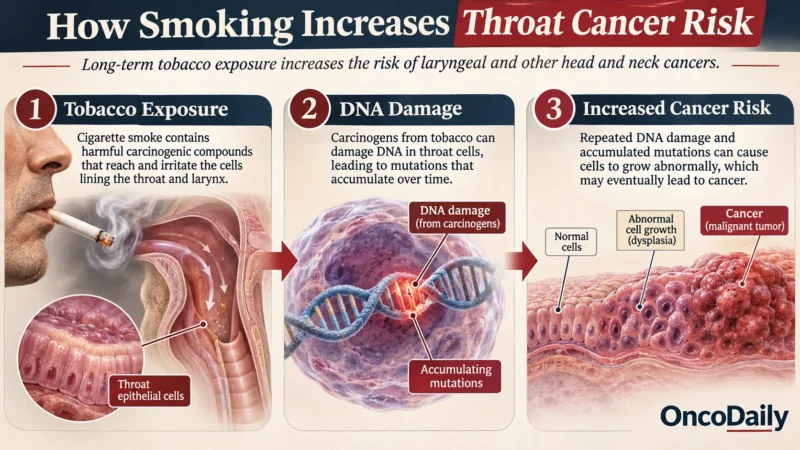
Importantly, stopping smoking remains beneficial even after many years of tobacco use. Smoking cessation is also important after a cancer diagnosis because continued smoking may interfere with treatment effectiveness and increase the risk of developing another primary cancer (NCI, Head and Neck Cancer Prevention PDQ; NCI, Laryngeal Cancer Treatment PDQ). Oppenheimer’s lifelong tobacco use is therefore an important aspect of his medical history, particularly when considered in the context of modern cancer prevention.
Why Is Early Detection Important in Throat Cancer?
Early diagnosis can improve treatment options for many patients with laryngeal cancer. Smaller tumors confined to their original location may sometimes be managed with less extensive treatment than cancers that have invaded surrounding structures or spread to lymph nodes. The SEER survival figures demonstrate the importance of disease extent. Five-year relative survival is approximately 79.8% for localized laryngeal cancer, compared with 49.4% for regional disease and 36.0% for distant metastatic disease (NCI SEER, 2026).
However, this does not mean that screening is routinely recommended for everyone. Unlike breast or colorectal cancer, laryngeal cancer does not have an established population-wide screening program for asymptomatic adults. In the United States, routine screening for laryngeal and hypopharyngeal cancer is not recommended for the general population because evidence has not demonstrated that such screening produces a favorable balance of benefits and harms. Instead, recognizing persistent symptoms and obtaining appropriate medical evaluation remain important (ACS, Early Detection and Diagnosis). People who experience persistent hoarseness, difficulty swallowing, unexplained neck swelling, or other concerning symptoms should consult a healthcare professional.
A detailed medical history, physical examination, and specialist evaluation may help determine whether further investigation is required. For Oppenheimer, the available historical documentation does not establish how long symptoms were present before his diagnosis. It would therefore be inappropriate to state that a delay in seeking medical attention caused his unfavorable outcome.
What Happened During Oppenheimer’s Final Months?
During 1966, Oppenheimer’s health became increasingly affected by his cancer. He stepped down as director of the Institute for Advanced Study after nearly two decades of leadership. Although his illness limited his activities, he continued to maintain connections with colleagues and the scientific community. Historical accounts describe the deterioration of his health as treatment continued. His final months were spent largely in Princeton, where he had lived and worked for many years. This period represented a profound change from the demanding intellectual and professional life that had defined his earlier decades.
During World War II, Oppenheimer had coordinated one of the most ambitious scientific projects in history. After the war, he had become an internationally recognized intellectual whose opinions carried considerable influence. By the end of 1966, his personal circumstances were increasingly shaped by medical treatment and progressive illness.
His condition illustrates an important aspect of serious cancer that is often less visible in historical biographies. Cancer can affect not only physical health but also a person’s ability to work, travel, maintain social relationships, and participate in activities that previously formed a central part of their life. For patients with head and neck cancer, difficulties with eating, swallowing, speaking, and maintaining adequate nutrition can further complicate treatment. However, Oppenheimer’s publicly available medical history does not provide sufficient detail to determine which of these complications he personally experienced.
When and How Did J. Robert Oppenheimer Die?
J. Robert Oppenheimer died on February 18, 1967, at the age of 62, from throat cancer. He died at his home on the grounds of the Institute for Advanced Study in Princeton, New Jersey. His death followed a prolonged illness and unsuccessful attempts to control the disease. The Institute for Advanced Study confirms the date and cause of death in its official historical account. The U.S. National Park Service similarly identifies throat cancer as the illness responsible for his death (Institute for Advanced Study, n.d.; National Park Service, 2025). Oppenheimer was survived by his wife, Katherine “Kitty” Oppenheimer, and their two children.
His death prompted tributes from scientists, colleagues, and public figures who recognized his influence on theoretical physics and twentieth-century history. A memorial service was held at Princeton University. His ashes were subsequently scattered at sea near St. John in the U.S. Virgin Islands, a place with which he and his family had maintained a personal connection. Although his death occurred decades after the development of the atomic bomb, his final illness was primarily documented as a tobacco-associated throat malignancy.
Did Radiation From the Manhattan Project Cause Oppenheimer’s Cancer?
Oppenheimer’s association with nuclear weapons raises an understandable question: could his cancer have been caused by radiation exposure during the Manhattan Project? Ionizing radiation is an established carcinogen. Exposure can increase the risk of certain cancers, depending on the radiation dose, affected tissues, exposure timing, and other biological factors.
However, Oppenheimer’s professional involvement in nuclear research does not itself establish that he received a radiation dose sufficient to cause his cancer. His historical accounts repeatedly document heavy tobacco use, an established risk factor for throat and laryngeal cancers. There is no sufficiently documented evidence demonstrating that occupational radiation exposure caused Oppenheimer’s malignancy. The Library of Congress also associates his fatal throat cancer with his longstanding smoking history (Library of Congress, 2023). It would therefore be inaccurate to claim that Oppenheimer developed cancer because he worked on the atomic bomb. His scientific career and his cancer diagnosis are connected through his biography, but that does not establish a medical causal relationship.
What Are the Most Famous Conspiracy Theories About J. Robert Oppenheimer?
J. Robert Oppenheimer’s involvement in the Manhattan Project, his political connections, and his mysterious downfall have inspired decades of controversy and conspiracy theories. While some suspicions emerged from genuine historical events, others remain unsupported by evidence. One of the most famous allegations was that Oppenheimer secretly worked as a Soviet spy. During the 1930s and 1940s, he maintained relationships with people associated with communist organizations. However, despite extensive investigations, no convincing evidence has established that he passed atomic secrets to the Soviet Union.
Another controversy concerns his 1954 security clearance hearing. Oppenheimer lost his clearance after accusations regarding his political associations and judgment. Some historians believe personal rivalries, particularly involving Lewis Strauss, contributed to his downfall. In December 2022, the U.S. Department of Energy formally vacated the decision, acknowledging serious flaws in the original proceedings.
The mysterious Chevalier incident also fueled suspicion. In 1943, Oppenheimer learned of a possible attempt to transmit scientific information to Soviet representatives. His delayed and inconsistent reporting later raised questions, although no evidence established that he transferred nuclear secrets. Another theory connects Oppenheimer’s throat cancer to radiation exposure during the Manhattan Project. However, no reliable evidence demonstrates that his nuclear research caused his illness. His lifelong heavy smoking was a major established risk factor for throat cancer.
Oppenheimer’s opposition to aspects of the hydrogen bomb program also contributed to speculation that powerful government figures deliberately targeted him. These controversies remain fascinating because his life combined secret scientific research, Cold War politics, and personal tragedy. Yet historical evidence must be distinguished from speculation. Perhaps the greatest mystery is not whether Oppenheimer betrayed his country, but how a scientist who helped develop America’s most powerful weapon became a target of his own government’s security apparatus.
The Human Side of Oppenheimer’s Cancer Battle
J. Robert Oppenheimer’s legacy is often discussed through the extraordinary scientific developments and moral dilemmas of the twentieth century. He helped lead the project that produced the first nuclear weapons, becoming a central figure in a technological transformation that permanently changed international politics and warfare. His work also raised questions about scientific responsibility that continue to be debated today. Yet his final illness reveals a different side of his life. Despite his intellectual achievements and access to medical care, Oppenheimer faced a disease that physicians could not successfully control.
His experience illustrates the difference between scientific progress and an individual’s ability to benefit from it. The 1960s were a period of remarkable technological development, but many aspects of cancer biology remained poorly understood.

Physicians had limited tools for visualizing tumors, assessing molecular characteristics, and delivering highly targeted treatment. Many therapies that are considered standard today had not yet been developed. Oppenheimer lived during an era in which nuclear physics had transformed the world, but oncology was still developing many of the principles and technologies that would shape modern cancer treatment. His personal experience also provides a reminder that disease is not determined by intelligence, achievement, or public recognition.
Cancer develops through complex biological processes involving cellular damage, genetic alterations, environmental exposures, and individual susceptibility. Even people with extraordinary scientific knowledge remain vulnerable to illness. For Oppenheimer, the final chapter of his life was not shaped by a new scientific discovery or a political controversy, but by a serious cancer diagnosis.
Why Does Oppenheimer’s Cancer Story Still Matter Today?
More than half a century after his death, Oppenheimer remains one of the most widely recognized figures in modern scientific history. His life continues to attract public attention through historical biographies, documentaries, academic research, and popular films, including Christopher Nolan’s 2023 film Oppenheimer. While most discussions focus on the Manhattan Project, nuclear weapons, and scientific responsibility, his cancer history provides an opportunity to explore an important medical and public health subject.
Laryngeal cancer continues to affect thousands of people each year. Although U.S. incidence rates have declined, the disease remains particularly challenging when diagnosed after regional or distant spread. The difference between the approximately 80% five-year relative survival associated with localized disease and 36% for distant disease illustrates the importance of disease extent. At the same time, progress in treatment has expanded the options available to patients.
Modern oncology includes advanced radiation planning, minimally invasive surgical procedures, combined-modality treatment, supportive care, and immunotherapy for selected disease settings. These developments reflect decades of scientific research and clinical investigation. However, one of the most important lessons from Oppenheimer’s story concerns prevention. Smoking remains a major established cause of several cancers, including laryngeal cancer. Reducing tobacco exposure can prevent disease before treatment becomes necessary. Oppenheimer’s story is therefore relevant not only because of who he was, but also because it connects a familiar historical figure with an ongoing public health challenge.
You Can Also Read The Day After a Nuclear Bomb: Generational Damage and the Silent Cancer Epidemic by OncoDaily

Written by Aharon Tsaturyan, MD, Editor at OncoDaily Intelligence Unit
FAQ
What was J. Robert Oppenheimer's cause of death?
J. Robert Oppenheimer died from throat cancer on February 18, 1967, in Princeton, New Jersey. His death followed unsuccessful cancer treatment. Institute for Advanced Study
How old was Oppenheimer when he died?
Oppenheimer was 62 years old when he died on February 18, 1967. He was born on April 22, 1904, in New York City.
What type of cancer did Oppenheimer have?
Oppenheimer was diagnosed with throat cancer in 1966. Some historical accounts identify it as laryngeal cancer, but publicly available medical records do not establish the exact anatomical site with certainty.
Did smoking cause Oppenheimer's cancer?
Oppenheimer was a lifelong heavy smoker, and tobacco is a major established cause of laryngeal cancer. Smoking is widely believed to have contributed to his disease, although its individual causal role cannot be proven retrospectively.
When was Oppenheimer diagnosed with throat cancer?
The U.S. National Park Service dates Oppenheimer's throat cancer diagnosis to 1966. Some other historical accounts suggest late 1965. He died in February 1967.
How was Oppenheimer's throat cancer treated?
Historical accounts describe surgery followed by radiation therapy and, reportedly, chemotherapy. These treatments did not control the disease. His exact chemotherapy regimen and radiation doses are not publicly established.
Did radiation from the atomic bomb cause Oppenheimer's cancer?
There is no established evidence that radiation exposure from his Manhattan Project work caused his cancer. His documented heavy smoking was a major known risk factor for throat cancer.
What were Oppenheimer's last words?
There is no reliably verified historical record establishing Oppenheimer's exact final words. Popular quotations attributed to him, including his famous reference to becoming death, should not be confused with statements made shortly before he died.
What is the survival rate for throat cancer?
Survival depends on the exact cancer site and stage. For U.S. laryngeal cancer patients diagnosed in 2016–2022, five-year relative survival was approximately 79.8% for localized disease, compared with 36.0% for distant disease.
Why is J. Robert Oppenheimer called the Father of the Atomic Bomb?
Oppenheimer earned the title because he served as scientific director of Los Alamos Laboratory during the Manhattan Project, coordinating the research and development of the first atomic bombs during World War II.