Pavlos Msaouel, Physician-Scientist, Oncologist at UT MD Anderson, shared on X:
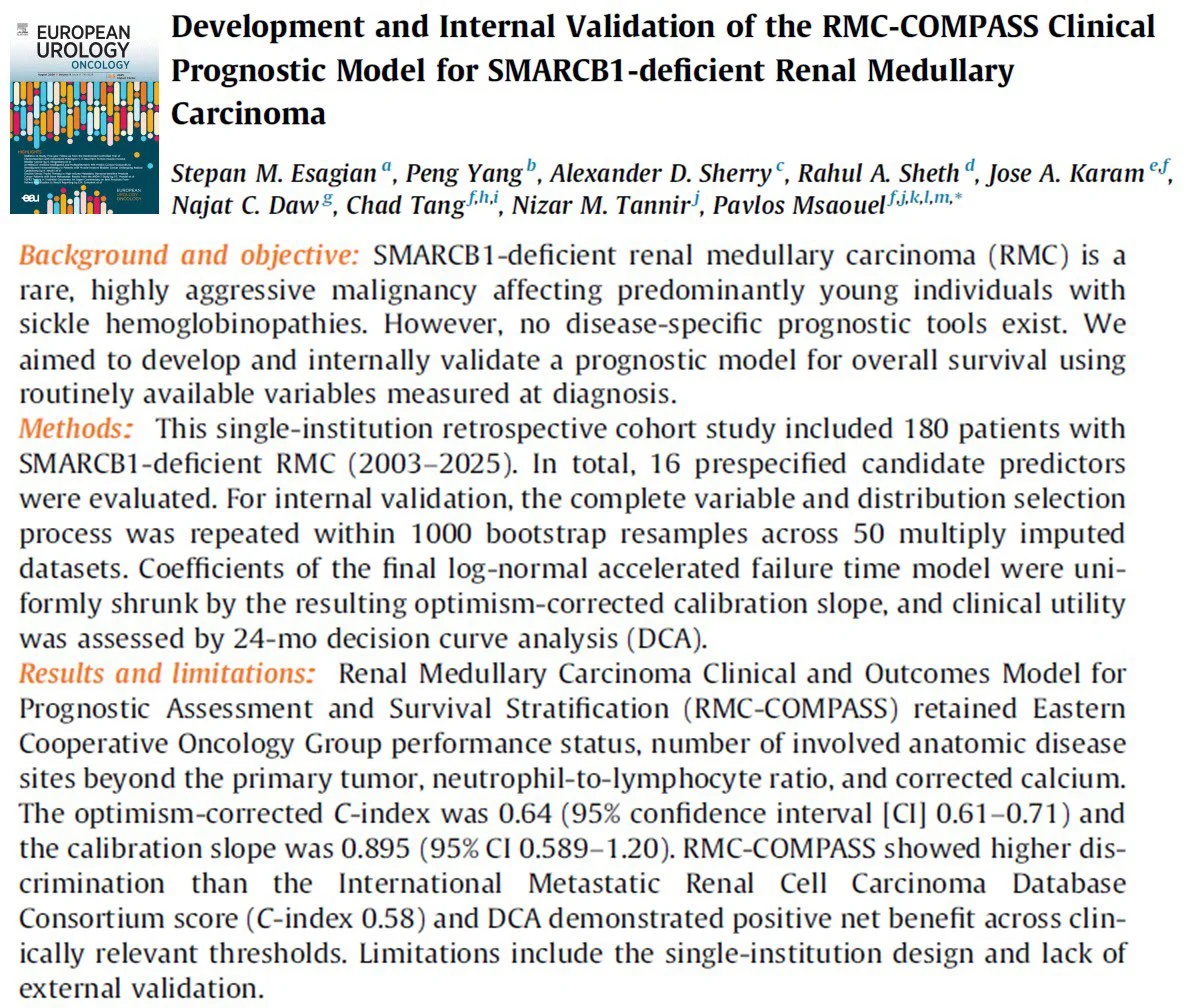
“Our latest Msaouel Lab article in European Urology Oncology introduces RMC-COMPASS.
The first prognostic model designed specifically for patients with SMARCB1-deficient Renal Medullary Carcinoma.
180 patients at MD Anderson, 2003–2025; median OS 15.2 mo.
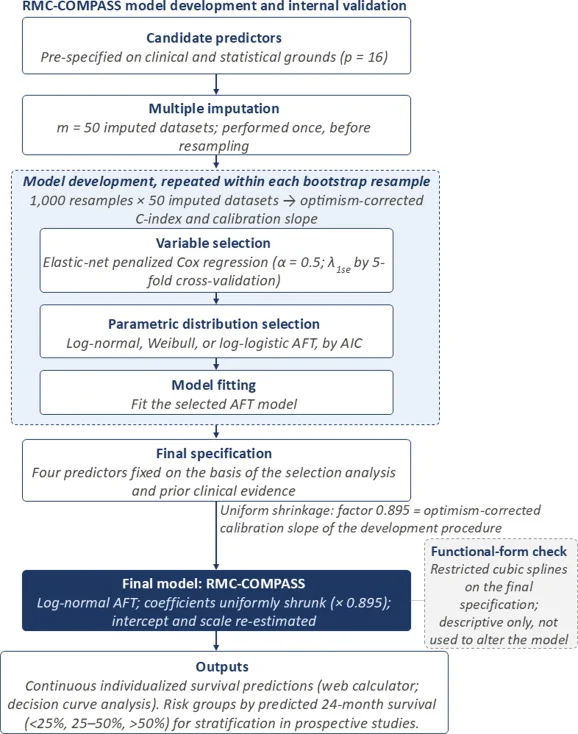
With 16 candidate predictors, we reran the full development procedure (elastic-net Cox screening, then AFT distribution selection by AIC) in 1000 bootstrap resamples × 50 imputations, so optimism reflects every step.
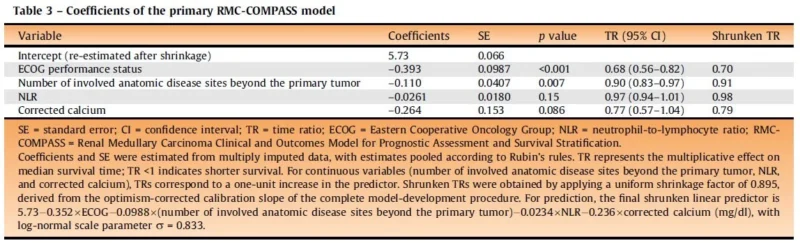
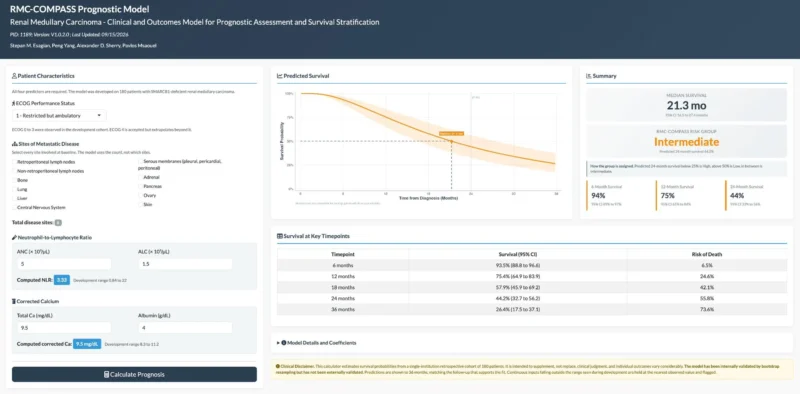
Four predictors, all available at diagnosis:
- ECOG PS
- number of involved anatomic disease sites beyond the primary tumor
- NLR
- corrected calcium.
Optimism-corrected C-index 0.64 (95% CI 0.61–0.71) vs 0.58 for IMDC. Calibration slope 0.895, used for uniform shrinkage.
Discrimination is modest, as expected when survival is uniformly short.
Apparent 24-mo net benefit across 40–80% thresholds. Refit on pre-2020 patients: C-index 0.64 in 2020+, but an imprecise calibration slope (0.839; 95% CI 0.351–1.30).
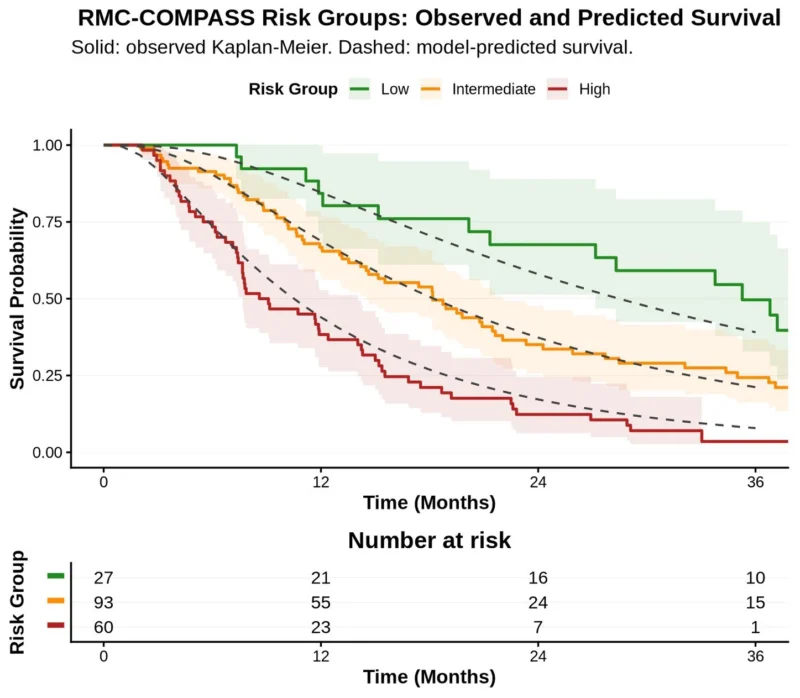
The full R code is freely available as a template for rigorous prognostic modeling across oncology. RMC-COMPASS Calculator for prognostic counseling and trial stratification of patients with Renal Medullary Carcinoma.”
Daniel Shapiro, urologic oncologist at UT MD Anderson, added:
“Another impressive step forward in RMC management Pavlos Msaouel.
The very fact that you can now model prognosis in patients with RMC other than all prognosis being poor is a testament to and your team’s relentless efforts!”
Title: Development and Internal Validation of the RMC-COMPASS Clinical Prognostic Model for SMARCB1-deficient Renal Medullary Carcinoma
Authors: Stepan M. Esagian, Peng Yang, Alexander D. Sherry, Rahul A. Sheth, Jose A. Karam, Najat C. Daw, Chad Tang, Nizar M. Tannir, Pavlos Msaouel
Read the full article:
Pavlos Msaouel – Major Accomplishments in Oncology
- Advancing treatment of rare kidney cancers: As an Associate Professor of Genitourinary Medical Oncology at The University of Texas MD Anderson Cancer Center, Dr. Msaouel has focused his clinical and translational research on genitourinary malignancies, particularly renal cell carcinoma (RCC) and rare subtypes such as renal medullary carcinoma (RMC).
- Developing biomarkers for renal medullary carcinoma: His laboratory identified a serum biomarker strategy used to monitor tumor burden in most patients with RMC, contributing to improved disease monitoring and clinical management.
- Leading clinical trials and novel therapeutic approaches: Serves as principal investigator of multiple completed and ongoing clinical trials involving rare and common kidney cancers, including studies investigating targeted therapies and immunotherapy combinations.
- Contributing to precision oncology and scientific research: Has authored numerous peer-reviewed publications on kidney cancer biology, molecular profiling, immunotherapy, and treatment strategies. His research has also contributed to the development of targeted therapies for RMC and improved understanding of its molecular characteristics.
You may also be interested in:
Phase 1/2 Trial of Alternating Pazopanib and Bevacizumab in Treatment-Naive Metastatic ccRCC