





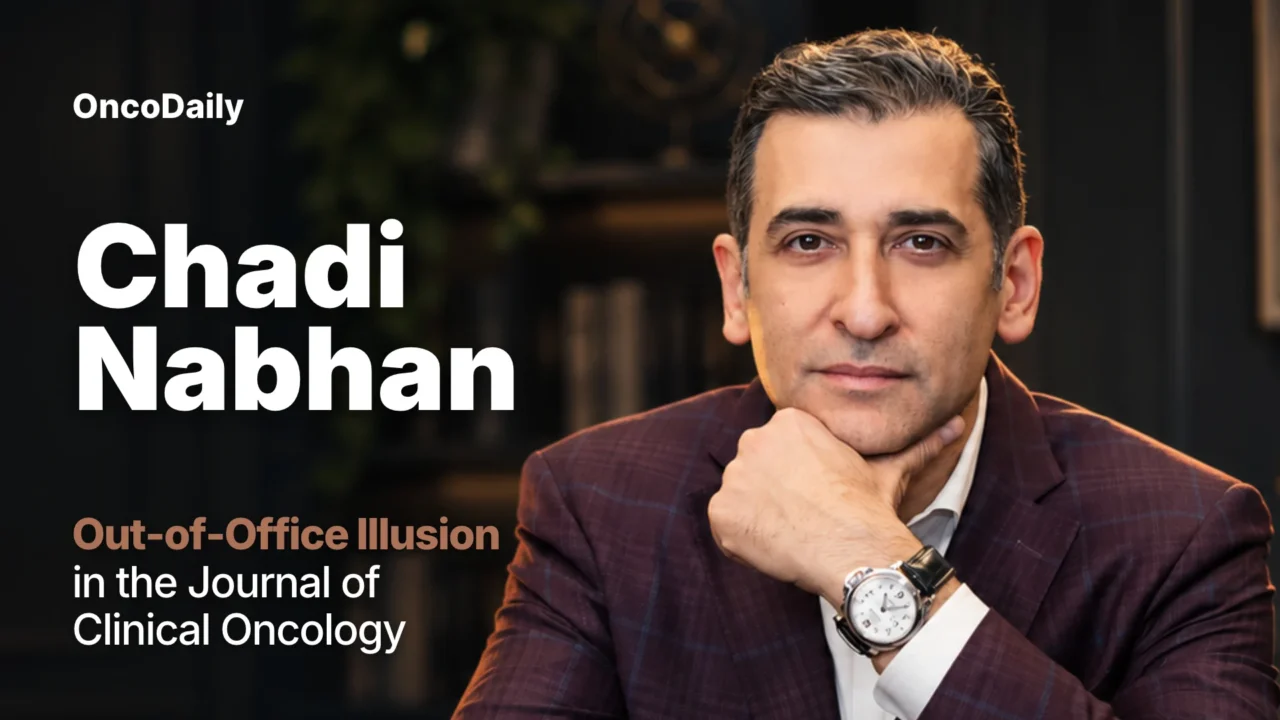
The ability to remain connected to work at any time has changed the way physicians experience their lives outside medicine. For oncologists, whose professional responsibilities often extend beyond working hours, the distinction between dedication and constant availability can become particularly difficult to define.
In his article, “Out-of-Office Illusion,” published in the Journal of Clinical Oncology, Chadi Nabhan, Chief Medical Officer at Foundation Medicine, examines why physicians struggle to disconnect, even when they have no immediate professional obligations, and how this behavior affects their personal relationships, emotional well-being, and professional sustainability.
The Personal Cost of Constant Availability
One of the central themes of Nabhan’s article is the impact of professional connectivity on life outside medicine. Using a family dinner as an example, he illustrates how seemingly insignificant interruptions, such as responding to an email or checking a notification, can gradually compromise the quality of time spent with loved ones.
His wife’s observation captures the consequences of this behavior:
“You’ve barely been with us all evening. This isn’t the first time. You’re here, but you’re really not.”
The experience raises questions about how physicians manage their attention outside the workplace and whether being physically present is enough when their thoughts remain occupied by professional responsibilities.
Reading the article during her own time off, Estela Rodriguez, Associate Director of Community Outreach in Thoracic Oncology at the University of Miami’s Sylvester Comprehensive Cancer Center, reflected on the consequences of this behavior for physicians’ families.
“A reminder that the people who matter most in our lives deserve more than whatever time and attention we have left after work.”
This was how Ashish M. Kamat, President of the International Bladder Cancer Group and Associate Editor at European Urology Oncology, summarized the personal significance of Nabhan’s article.
Has Constant Availability Become a Professional Expectation?
Nabhan identifies an important distinction between having professional responsibilities and feeling the need to remain continuously accessible.
In academic oncology, scientific meetings, research collaborations, clinical responsibilities, and career development can create an environment in which physicians feel compelled to make productive use of every available hour. Digital communication has further reinforced this behavior by making professional obligations accessible regardless of location.
“Technology has eliminated permission to be absent.”
This observation was also highlighted by Moshe Ornstein, a genitourinary oncologist at Cleveland Clinic.
However, one of Nabhan’s most important arguments is that external demands are not always responsible for this behavior. Reflecting on his inability to refrain from answering non-urgent emails during a family vacation, he recognizes how deeply the expectation of immediate responsiveness had become internalized.
His experience suggests that an out-of-office message has little practical value if physicians themselves feel uncomfortable being unavailable.
This particular realization caught the attention of Giannis Mountzios, Director of the 4th Oncology Department and Clinical Trials Unit at Henry Dunant Hospital Center, who highlighted Nabhan’s description of his out-of-office message as a personal promise that he had failed to keep.
The Complexity of Disconnecting in Oncology
Establishing professional boundaries in oncology involves considerations that extend beyond managing emails or limiting screen time. Physicians frequently care for patients whose clinical needs are unpredictable, making the decision to disconnect more complicated.
“It is absolutely a privilege to be an oncologist. But the identity does bleed into every facet of life. It is a struggle to balance that when I am also trying to be a husband and a father.”
Nicholas Hornstein, Gastrointestinal Medical Oncologist at Northwell Health Cancer Institute and Assistant Professor at the Donald and Barbara Zucker School of Medicine at Hofstra/Northwell, shared this reflection in response to Nabhan’s article.
Recalling a patient who had run out of pain medication shortly before Thanksgiving, Hornstein illustrated why remaining accessible can feel like a professional necessity rather than simply a personal habit.
The challenge, therefore, is not to reduce physicians’ commitment to their patients, but to establish systems that allow patient care to continue without depending on the uninterrupted availability of an individual physician.
Addressing Burnout Beyond Self-Care
A particularly important aspect of Nabhan’s article is his examination of psychological detachment from work as a component of recovery.
Although workload, administrative responsibilities, and emotional exhaustion are recognized contributors to physician burnout, Nabhan draws attention to the difficulty of recovering when professional obligations continue to occupy one’s thoughts outside working hours.
He questions whether conventional recommendations about self-care and personal boundaries can be effective without corresponding changes in institutional culture.
His proposed approaches include reliable clinical coverage, clear communication expectations, appropriate pathways for urgent patient concerns, and leadership that respects time away from work.
The importance of these measures is reflected in the experience of Thor Halfdanarson, Professor of Oncology at Mayo Clinic, who described how mutual trust and shared responsibilities within his team allow him to take time off while ensuring that urgent matters are addressed.
“If I do not take care of myself, how am I supposed to take care of my patients, family and friends…?”
Ultimately, Nabhan’s article challenges the assumption that professional dedication should be measured by accessibility. Rather than treating the inability to disconnect as an unavoidable consequence of a career in medicine, he calls for both physicians and healthcare organizations to reconsider the expectations that sustain this behavior.
Creating a healthier professional culture means recognizing that physicians can remain deeply committed to their patients, colleagues, and careers without being available at every moment.
Discover more articles like this on OncoDaily.
Written by Mane Hovhannisyan, Editor at OncoDaily.