Jacob Scott, Professor and Co-Director of the Center for Enabling Discovery in Disease Biology (AID2B) at Case Western Reserve University School of Medicine, shared on LinkedIn:
“This Personalized Medicine in Rad Onc analysis for rectal cancer, along with our recent Pediatric Oncology results:
Are exactly what I’ll be talking about at the WIN Symposium meeting just after ASTRO26 in Providence RI.
Let’s move Radiation therapy into the genomic era together!
In rectal cancer, knowing who needs more radiation – and who may safely need less-could materially change how we practice and understand outcomes.
Our new GARD analysis in locally advanced rectal cancer is now up on medRxiv, led by Drew T. Bergman, and a team from Memorial Sloan Kettering Cancer Center led by Paul Romesser and Cleveland Clinic Research and Moffitt Cancer Center ‘s Javier Torres-Roca
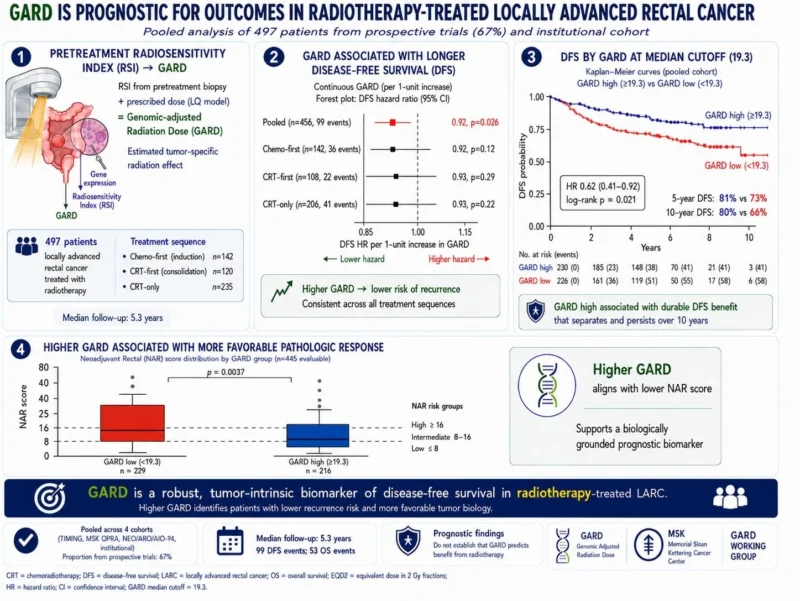
This was a particularly exciting dataset to work with: 497 patients across four modern cohorts, with 67% coming from prospective trials, spanning contemporary treatment sequences including induction chemotherapy, consolidation chemotherapy, and chemoradiotherapy alone.
And the signal was remarkably consistent.
- Higher continuous GARD was associated with longer disease-free survival
HR 0.92 per unit increase, p=0.026 – I say again, per unit! - At the median GARD cutoff, the difference in DFS was durable:
81% vs 73% at 5 years
78% vs 66% at 10 years - Higher GARD was also associated with a more favorable Neoadjuvant Rectal score, linking greater genomic radiation effect with better pathologic response.
What I find most interesting is the underlying clinical idea:
We give patients with rectal cancer remarkably similar physical radiation doses, yet their tumors can experience very different biological radiation effects.
If that biological effect is associated with both response and long-term outcome, then perhaps physical dose alone is not the quantity we should ultimately be prescribing.
That opens the door to the question we really care about: can we use tumor biology to identify who needs more radiation, who needs less, and what biological effect we should actually be aiming for?
Title: Genomic-adjusted radiation dose and outcomes in radiotherapy-treated locally advanced rectal cancer: a pooled multicohort analysis including the TIMING, OPRA, and CAO/ARO/AIO-94 prospective trials
Authors: Drew T. Bergman, Steven A. Eschrich, Javier F. Torres-Roca, Shivani Nellore, Nikhil Joshi, Ehsan Balagamwala, Jacob A. Miller, Chin-Tung Chen, Andrea Cercek, David Gomez-Sanchez, Martin R. Weiser, Francisco Sanchez-Vega, Steven Chen, Emmanouil Fokas, Claus Rödel, J. Joshua Smith, Julio Garcia-Aguilar, Jacob G. Scott, Paul B. Romesser
And for anyone working on RSI/GARD, radiation genomics, or sitting on datasets that could help independently test these ideas, we’re building the GARD Working Group:”