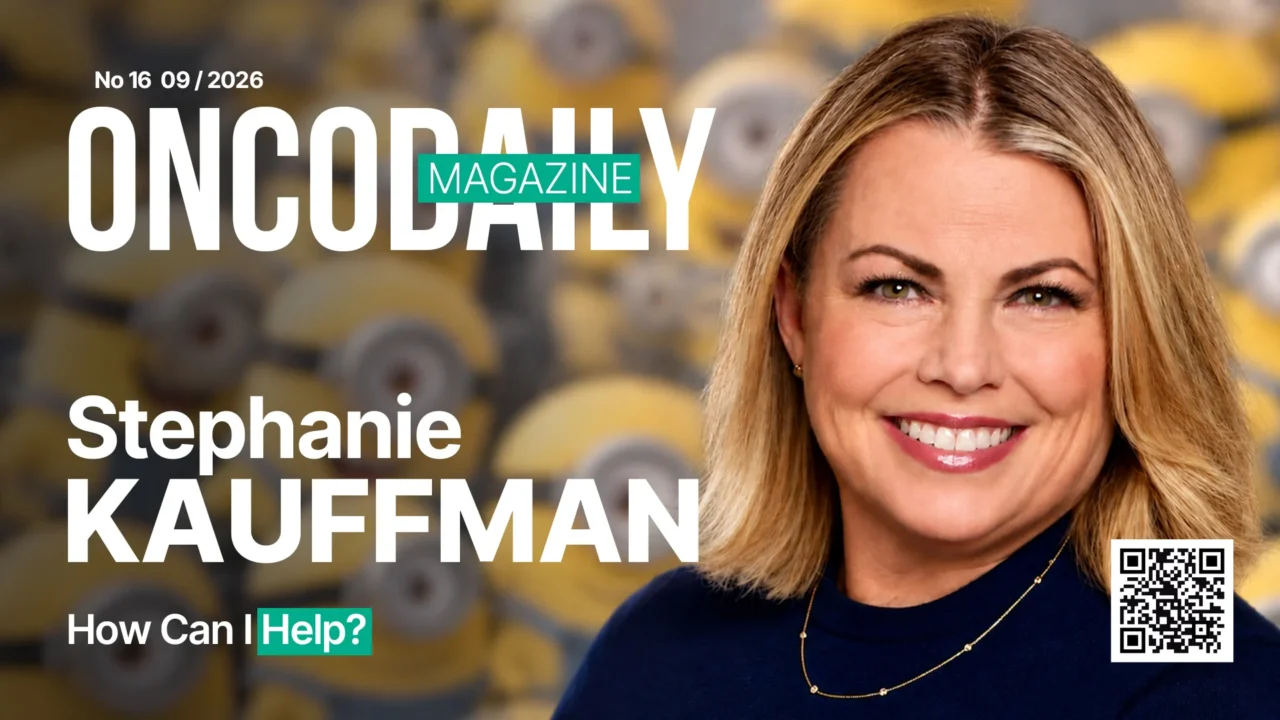
There is a woman who helped turn small yellow cartoon characters into a billion-dollar phenomenon.
She spent years at Universal Pictures. Long before the world knew what a Minion was, Stephanie Kauffman and her colleagues saw something.
“There’s something about these Minions that is really unique.”
They were right.
But the most important thing Hollywood taught Stephanie had little to do with movies.
It was storytelling.
How to make people care.
Then cancer entered her life.
And she took the same skills she had used to bring audiences, corporations and Hollywood together – and pointed them toward science.
Today, Stephanie Kauffman is the CEO of the Melanoma Research Alliance, one of the largest private funders of melanoma research in the world.
When I asked her to describe its mission in one sentence, she did not hesitate.
“To end suffering and deaths from melanoma.”
The Professional Translator
There was no plan to end up here.
“If you had told me 20 years ago that I would be the CEO of a cancer research organization, I would have thought that you were talking to someone else.”
Stephanie Kauffman grew up in Florida, studied marketing and imagined her future in tourism, hospitality and entertainment.
She joined Universal Orlando Resort and began working with major brands.
“How do you create refreshing moments with Coca-Cola and create that storytelling with millions of theme park visitors around the world?”
Eventually, she moved into Universal Pictures, working across movies, home entertainment and theme parks.
Through all of it, one skill became central.
“I think a hallmark of my career is, in some ways, I’ve become this professional translator.”
Take Fast and Furious.
“We have this film about street racing and the culture that not a lot of people know about, and you as a brand want to tap into this. And the reason why is it’s actually the next big cultural moment, and you don’t want to miss out as a brand.”
Often, she was convincing companies to invest in movies two or three years before those movies reached theaters.
“You have to believe in the product, believe in the hypotheses, and then be able to translate why it matters.”
She pauses.
“It’s a little bit of a leap of faith. Not unlike cancer research.”
The Minions
Unlike Disney, Universal did not really have its Mickey Mouse.
“We didn’t have that icon moment.”
Then Stephanie Kauffman’s team saw an early presentation of Despicable Me.
The Minions immediately stood out.
They began planning years ahead – retail, toys, partnerships, international markets.
“We knew that those Minion characters could translate very well across the globe.”

But they did not want to put them everywhere.
“We wanted to preserve the specialness of the Minions.”
The strategy worked.
The Minions became a global franchise and a billion-dollar retail phenomenon.
“It was definitely that spark of a moment to say, ‘There’s something here.’”
What did Hollywood ultimately teach her?
“The power of storytelling.”
“How do you tell the right story to the right audiences to inspire them to action?”
That lesson would soon become much more personal.
When Cancer Entered Her Life
Stephanie Sperber, the president of Stephanie’s group at Universal Pictures, once walked into her office.
“She said, ‘I need to go see the doctor. I’ve got some test results that came back because I found a lump in my breast. Will you come with me?’”
Kauffman went.
Sperber was diagnosed with triple-negative breast cancer.
Then Kauffman’s mother was diagnosed with stage IV lung cancer.
“She did not survive that diagnosis.”
A close friend and former Universal colleague developed metastatic melanoma.
“She passed away at age 42.”
Cancer was no longer abstract.
“I just personally became more interested in how can I personally support cancer research.”
At the same time, Universal was changing, and Stephanie Kauffman was considering the next chapter of her life.
“I thought, you know what? I’ve had a good 16-year run, and I’m really interested in what could look different for me.”
She connected with the Breast Cancer Research Foundation.
And Sperber encouraged her to make the move.
“She said to me, ‘I think you should go do this. I need for you, as a breast cancer patient, to maybe think about doing this.’”
Stephanie Kauffman did.
Taking Hollywood Into Cancer Research
The transition required some adjustment.
“In the movie business, you can kind of get away with, ‘We had the best opening of a comedic film on a Wednesday with a full moon during a leap year.’”
She laughs.
“You can’t do that in science.”
She had no MD and no PhD, but she knew how to translate.
“How do we think about humanizing the science? How do we create different storytelling about why science matters?”
And how could companies be made to see cancer research not simply as philanthropy?
“It’s more than just checking a box for your corporate social responsibility.”
At BCRF, Stephanie wanted to change the conversation.
“We’re not just a nonprofit coming to help you fund our research.”
They had science. Patients. A powerful global symbol.
“The pink ribbon stands for something that matters.”
And that mattered to companies because cancer affected their customers, employees, families and communities.
“We’re coming to you with a very powerful platform of research and science and patients.”
But success created another problem.
People would ask: with so much money already invested in breast cancer, shouldn’t it be solved?
Stephanie Kauffman had a simple answer.
“If we’re being very successful with 70% of patients who are being diagnosed, and if it becomes your mother, daughter, wife, sister, do you want them to still be in the 30%?”
For her, one of the hardest parts of working in cancer remains meeting people for whom progress did not arrive quickly enough.
“The most difficult thing that you face in this role is the patient set for which science was not fast enough.”
“How Can I Help?”
Then COVID happened.
Retail stores closed. Airlines stopped flying. Corporate support collapsed.
“40% of BCRF’s funding support kind of went away almost overnight because of COVID.”
Organizational changes followed, and Stephanie’s role was among those affected.
Her response was simple.
“How can I help?”
A former corporate partner called her about Americares.
“We have so many opportunities to get medicine and supplies and COVID PPE. Can you come on board and help us?”
She did.
Stephanie moved into global humanitarian aid – helping mobilize medicines and supplies during COVID and in response to hurricanes, earthquakes and other disasters.
Again, the field had changed.
The skill had not.
Relationships.
Partnerships.
Translation.
“How can I help?”
Back to Cancer
Eventually, Dr. Marc Hurlbert called.
They had worked together at BCRF and experimented with unconventional models of fundraising.
One collaboration with Blizzard Entertainment’s Overwatch raised $12 million in two weeks.
“We were both very much in this space of how do we find unique ways to accelerate research funding, create different conversations.”
After Hurlbert became CEO of the Melanoma Research Alliance, he asked Kauffman to join him.
“I’d love for you to come and be my partner here.”
For her, the decision was personal.
Two people in her life had died from melanoma.
“I felt that calling to get back into cancer research.”
“It’s Just Melanoma”
Melanoma has a perception problem.
People hear “skin cancer” and often imagine something you simply cut out.
“Melanoma may represent 1% of all skin cancer diagnoses, but 80% of skin-cancer-related deaths are as a result of melanoma.”
“It is a very fast-moving cancer. It is an insidious cancer if it is not caught early.”
And it is not only a disease of sun-exposed skin.
Melanoma can arise in the eye, beneath nails, on the palms and soles, and in mucosal surfaces.
Twenty years ago, advanced melanoma could leave patients with almost no options.
“You maybe had six months to get your affairs in order.”
Modern treatments have radically changed that.
But the public perception has not necessarily changed with them.
Stephanie hears patients describe the difference.
With breast or lung cancer, people immediately rally around them.
With melanoma?
“People were like, ‘You’re just going to get it cut out, and you will be fine.’”
That misunderstanding can be dangerous.
The UV-Index Generation
At the same time, melanoma is increasingly colliding with a new phenomenon: health misinformation.
“We are, science and healthcare at large, facing just a tsunami of misinformation and disinformation that gets exaggerated and amplified at warp speed.”
Kauffman points to a disturbing trend.
“The number one cancer being diagnosed right now in young women 25 to 29 is melanoma.”
Tanning beds still exist.
Social media has created a new generation of self-described wellness experts.
“We’re also up against people who pass themselves off as wellness experts who have no credentials whatsoever, but they have an affiliate link to sell that product.”
One claim has become particularly widespread: sunscreen causes cancer.
“There has been no verifiable study around sunscreen causing melanoma or skin cancer at large.”
Others blame seed oils.
But the reality is much more complex: population growth, different exposure patterns, better detection, environmental factors and potentially other exposures.
“There are a lot of different things that are creating this uptick within melanoma that have nothing to do with sunscreen and have nothing to do with this notion of seed oils.”
Twenty-Five Years Behind
For decades, there was another strange contradiction.
The United States – one of the world’s great centers of biomedical innovation – went roughly 25 years without approving a new sunscreen filter, while Europe and Asia moved forward.
Stephanie Kauffman herself was surprised.
“How can we be one of the most innovative countries – we pride ourselves on so many different innovations and technologies – and be 25 years behind?”
Part of the explanation is regulation.
“Sunscreen in the US is treated as an over-the-counter medication. In other countries it’s treated as a cosmetic product.”
She emphasizes that current US sunscreens remain safe.
But innovation matters.
Texture matters.
Products that do not leave a white cast matter.
If people dislike sunscreen, they are less likely to use it.
“Any way that we can find new innovative filters to help create better adoption habits, that would be great.”
Losing a Generation of Scientists
Then comes the problem that keeps Stephanie awake.
Research funding.
“Nobody’s going to be a bigger funder of cancer research than the US federal government.”
Private philanthropy can help, but it cannot replace that system.
And the greatest risk may be to young scientists.
“How do we continue to support the early-career scientist?”
Labs are facing uncertainty. Researchers are reconsidering academic careers. Some are receiving offers from abroad.
“We are very concerned that we’re going to lose a generation of scientists.”
Other countries see an opportunity.
Researchers who once moved to the United States for science may now be offered new laboratories, resources and technology elsewhere.
“If you’re a researcher and you have flexibility, you’re thinking long and hard about that.”
Yet she remains optimistic about the ability of philanthropy to close some of those gaps.
“One of the things I think that makes the United States really phenomenal is the way that private philanthropy can come in and help.”
MRA itself has increased its investment dramatically.
“This year, we committed $18.8 million in research support, the most amount of funding that we were ever able to create.”
When she joined, that figure was around $9–10 million.
But the urgency remains.
“We have patients who are desperately waiting for new treatment options.”
When Private Equity Fights Melanoma
One of MRA’s most interesting models began with two finance leaders who developed advanced melanoma.
Jeff Rowbottom and Brendan Dillon had benefited directly from advances in melanoma treatment.
“They truly said that the work has saved their lives.”
Their first idea?
“Why don’t we host a cocktail party and we’ll get all of our relationships together?”
That cocktail party became Leverage Finance Fights Melanoma which has raised nearly $40 million for melanoma research.
Today, around 1,500 people attend, supported by roughly 150 sponsors.
“It is probably one of the only spaces anywhere within the private equity community where the private equity community all comes together.”
And this is why the model works.
MRA is not simply asking them for money.
It creates something valuable for them too.
Networking. Relationships. Conversations about markets and deal flow.
“This has now become the place to be if you are in leverage finance at a senior level.”
The platform expanded from New York to London, and there is interest in taking it further.
“Possibly into the Middle East and Asia.”
It reflects Stephanie Kauffman’s broader philosophy: understand what matters to the people sitting across the table and find a way for everyone to create value.
“I Like to Be Told It Can’t Be Done”
When I asked Kauffman about the key to her success, she returned to one word.
Relationships.
“The key to success is the relationships that you build.”
But there is something else.
“I like to be told it can’t be done, and then I’m going to figure out a way to get it done.”
People wondered whether gamers would care about breast cancer.
They raised $12 million.
People questioned whether the private-equity model would work internationally.
It did.
“My ability to be a data-driven storyteller who builds partnerships has been something that I’m really proud of.”
Her advice to younger people is equally simple.
“Be curious. Ask questions. Don’t be afraid to ask those questions.”
And don’t assume your first profession has to be your last.
“You don’t have to stay in one career lane.”
The Mentors
Kauffman credits several people with shaping her thinking.
Ron Meyer, the legendary entertainment studio president who led Universal Studios for more than two decades, taught her that good negotiations are not about destroying the other side.
“Everybody’s going to walk away not getting exactly everything that they want, but that’s a good negotiation.”
The late Leonard Lauder, the executive chairman of The Estée Lauder Companies and one of the United States’ most influential philanthropists, gave her what she calls “a masterclass in philanthropy and branding and marketing.”
But also in leadership.
“How do you invest in the teams that you have? How do you make them feel valued?”
And then there are the patients.
“The biggest mentors to me have also been the patient community.”
But one lesson came at the very beginning of her career.
Her first mentor, Wrenda Goodwyn, told her:
“You’re not here to win Miss America. You’re not here to win Miss Congeniality. You’re here to win on behalf of the people that you serve.”
“That has always stayed with me.”
If Someone Gave Her $1 Billion
At the end of our conversation, I gave Stephanie an imaginary billion dollars.
For melanoma.
Where would she put it?
First: new treatments.
mRNA vaccines.
Cell therapies.
Treatment-resistant melanoma.
Brain metastases.
Leptomeningeal disease.
Second: early detection.
“How do we continue to create better early-detection diagnostics?”
Especially using AI and technology to solve another huge problem.
“Forty percent of the US does not have immediate access to a dermatologist.”
In some places, getting an appointment can take five or six months.
“That can make a huge difference between that mole being very much highly treatable to it advancing.”
Third: the rare melanomas.
Acral.
Mucosal.
Uveal.
Pediatric melanoma.
And finally, the patients for whom today’s extraordinary advances are still not enough.
“Anything that we can do to enable the 50% of the patients who don’t respond today – those are the key areas that I would look to invest in.”
***
Stephanie Kauffman began her career figuring out how to make people care about movies, brands and small yellow cartoon characters.
Today, she is trying to make them care about a scientist whose laboratory may disappear.
A young woman deliberately chasing the highest UV index.
A patient waiting months for a dermatologist.
A person with metastatic melanoma waiting for the next treatment.
Perhaps Hollywood and cancer research are not as different as they seem.
Both begin with an idea.
Both require people willing to believe before they know whether it will work.
Both require resources.
And both need somebody who can explain why the story matters.
Stephanie Kauffman has spent her career doing exactly that.
Being the translator.
Only now, the success is not measured at the box office. It is measured in lives!
By Gevorg Tamamyan, Editor-in-Chief of OncoDaily and World Health Voices Magazine
Read in the September issue of OncoDaily Magazine, “I Am Fatima’s Child “