Financial Toxicity in Cancer — A Lived Experience Advocacy Hub Series
by Carmen Monge, Lived Experience Advocacy Hub
Chapter 1: The Right to Be Forgotten — Financial Discrimination After Cancer
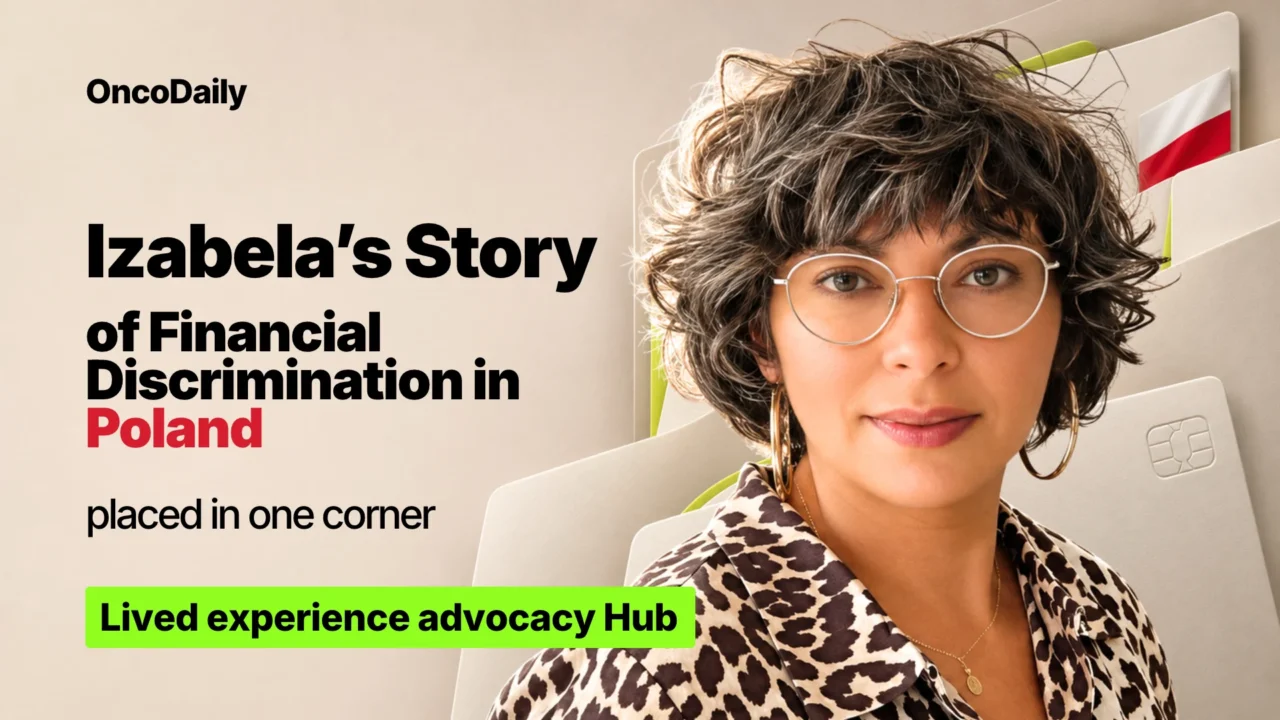
For Izabela Chelkowska-Klasa, a lawyer and cancer patient advocate living in Gdańsk, Poland, cancer has affected her family’s life twice.
In 2011, her husband was diagnosed with cancer while they were raising their young son. Although he achieved remission, his diagnosis affected his ability to work and later created difficulties when the family sought life insurance and a housing loan.
More than a decade later, in December 2024, Izabela received her own cancer diagnosis. She recalls being dismissed from her job shortly afterwards.
“My boss told me ‘Sorry, I need a healthy person at work’. I felt as if I had been buried alive.”
Her experience illustrates how the consequences of cancer can extend beyond medical treatment, affecting employment, financial stability, and plans for the future.
Today, Izabela advocates for cancer patients, collaborates with foundations in Poland, and raises awareness about clinical trials and the financial discrimination survivors may face.
As part of OncoDaily’s Financial Toxicity in Cancer series, she shares her family’s experiences, reflects on the Right to Be Forgotten, and explains why survivors must be included in decisions about the policies that affect them.
“Nothing about us without us.”
- Could you briefly introduce yourself and tell us a little about your cancer experience? Please share only what you feel comfortable with?
My name is Izabela Chelkowska – Klasa. I am a lawyer, living in Poland, In Gdansk. I`m an advocate for caner patients. I collaborate with nationalwide foundations and I promote awerness about clinical trials. So, my history is that, cancer has appeared in my life twice.
It first struck in 2011, when my husband was diagnosed with cancer. At that time, we were a young married couple with a small son. My husband achieved remission, but he was unable to work during his treatment (he was selfemployed).
Following my cancer diagnosis in december 2024, I was immediately dismissed from my job. My boss told me „Sorry, I need a healthy person at work”. I felt as if I had been buried alive.
2. Have you faced any difficulties getting insurance, a mortgage, a loan, or another financial service because of your cancer history? If so, could you tell us what happened?
Yes, we had difficulties. After my husband treatment ended, in 2013, he wanted to take out life insurance. Unfortunately, the insurer deemed him a high-risk individual due to his history of cancer.
In 2018, we also tried to apply for a housing loan, but were told it was impossible – again, because of the cancer. We relied on family support.
It wasn`t until 2020 that we applied to the bank, for a small loan – and we were granded it. Only then, my husband was able to take out life insurance, because the bank required it.
3. How did this experience affect your personal life, your plans, or your future?
When the first cancer diagnosis occurred (2011), our family was a huge help; they supported us in every way possible. Plans to buy a house and other expenses – such as going on vacatio –had to be set aside. Eventually, five years ago, we managed to buy a Home – a result of our own hard work.
However, when I fell ill (2024) more than a decade after my husband and subsequently lost my job, we once again had to keep a very close eye on our household budget.
4. Were you aware of the Right to Be Forgotten or any legal protections for cancer survivors in your country?
When cancer first entered my life – affecting my family in 2011 – I was not yet aware of the “right to be forgotten.” At that time, information on this subject was not available in my country – neither in the mass media nor on forums for cancer patients.
When I was diagnosed myself in 2024, I was already well-informed about this issue, so I began speaking out – including on social media (Instagram @trojujemna) – to raise awareness among other cancer survivors that we often face discrimination from financial and insurance institutions.
5. What do you think needs to change to better protect cancer survivors from financial discrimination?
First, the widespread implementation and standardization of the “right to be forgotten”. Many organizations – including the Association of European Cancer Leagues advocate for the statutory establishment of a fixed timeframe (e.g., 5 or 10 years after the completion of active treatment) beyond which financial institutions would no longer be permitted to request information about a past cancer diagnosis or take it into account when assessing risk.
Second, the updating of medical guidelines within the financial sector: Insurance risk algorithms and tables are often based on outdated statistical data. Institutions should be required to regularly update their medical knowledge to account for modern, highly effective oncological therapies, which have fundamentally altered patient prognoses.
Third, increased transparency regarding decisions to decline applications: Consumers should have a statutory right to receive a detailed, understandable justification for why their application for insurance or credit was rejected, or why they were offered a higher premium. This would prevent discrimination from being masked by vague “risk assessment” formulas.
Fourth, the introduction of appeal mechanisms and oversight: This could include the establishment of independent expert Dobies – or instance, within the office of a Financial Ombudsman or an insurance regulatory authority –to which patients could appeal if they believe a financial institution has assessed their risk in a manner disproportionate to their actual state of health. Fifth, the creation of public-private guarantee schemes. For individuals who, due to medical reasons, remain in a higher-risk category, government support programs or guarantee funds – which share risk with insurers – could serve as a solution, enabling those who have recovered from an illness to access standard financial products.
6. Why do you think it is important to include cancer survivors in discussions and decisions about these policies?
I believe that strength lies in a unified voice. Only a group that speaks with one voice, acts in solidarity, and supports one another on every level can have a real impact on the course of events. That is precisely why we must bring this issue to light and respond firmly to any instances of pathological behavior on the part of institutions.
Nothing about us without us.
7. Was there a message or discussion from the Brussels conference that was particularly important to you?
Yes, I paid particular attention to what Dr. Luigino Dal Maso said and presented. Based on his many years of research, he demonstrated that the medical data is solid: an increasing number of cancer survivors are being cured. These are concrete arguments that must be taken into account by financial institutions, insurance companies, and banks.
8. What message would you like to share with policymakers, financial institutions, or other cancer survivors?
My specific demands and appeals, directed at various groups, are as follows:
-
To policymakers (government officials and legislators)
Introduction of the “right to be forgotten”: It is time for the full implementation of regulations that prevent discrimination against individuals who have won their battle with cancer. After a certain period following the completion of treatment, one’s medical history should no longer impact their daily life.
Coordination of post-cancer care: The public healthcare system should provide a clear pathway for psychological, nutritional, and rehabilitative support after hospital-based treatment concludes, rather than leaving patients to fend for themselves.
Simplification of bureaucracy: Procedures for determining disability status or fitness for work should be flexible and respectful, taking into account factors such as chronic post-cancerfatigue syndrome.
2. To financial institutions (banks and insurers)
An end to financial stigmatization: A past cancer diagnosis must not serve as a permanent verdict that bars individuals from accessing mortgages or life insurance.
Individualized risk assessment: Institutions should base their decisions on up-to-date medical knowledge and realistic cure-rate statistics, rather than on outdated risk models.
Transparency in procedures: The criteria for granting financial products to cancer survivors should be clear, straightforward, and free from hidden, prohibitive costs (such as drastically inflated premiums).
3. For those who have experienced cancer
Your voice holds immense power: Educating the public and breaking down the taboos surrounding life “after cancer” helps reshape the legal and social landscape – your experience contributes to building a better world for others.
You have the right to return to normalcy: Returning to work, pursuing your passions, or making financial plans – these are all your fundamental rights, which are worth asserting and claiming.
Take care of yourselves, guilt-free: The recovery process – both physical and emotional –often takes much longer than the medical treatment itself; give yourselves the time and space needed to heal and regenerate.
Beyond One Family’s Experience
Izabela’s testimony highlights several interconnected challenges: financial barriers after a cancer diagnosis, the loss of employment and income, and the importance of legal protections that reflect current medical evidence.
Her experience also raises a question that extends beyond Poland: how can societies ensure that people who have experienced cancer have a fair opportunity to rebuild their lives?
Through this series, the OncoDaily Lived Experience Advocacy Hub will continue sharing survivor perspectives from different countries, including places where Right to Be Forgotten protections exist and places where they remain absent.
Surviving cancer should not mean spending the rest of your life paying for it.
You can also read: