
OncoDaily Lived Experience Advocacy Hub | Financial Toxicity in Cancer Series – Right to be Forgotten
By Carmen Monge
Imagine surviving cancer, completing treatment, and finally being ready to move forward with your life. You want to buy a house, start a business, or simply access life insurance.
But years after your diagnosis, you discover that your cancer history is still being used against you.
From a medical perspective, you may be healthy enough to move forward. But from a financial perspective, society may still consider you too sick to do so.
This is the reality faced by many cancer survivors around the world. Financial toxicity is not a new challenge for people with lived experience of cancer. According to the World Health Organization’s Global Status Report on Cancer 2026, at least 45% of people participating in its global survey reported financial hardship
These difficulties can include medical expenses, loss of income during treatment, and long-term economic consequences. However, for some survivors, financial challenges continue even years after completing treatment. According to the Ending Discrimination Against Cancer Survivors (EDACS) initiative, more than 55% of people diagnosed with cancer are estimated to be cured, while the cancer survivor population continues to grow by approximately 3% annually. As more people survive cancer, ensuring their quality of life and access to equal opportunities becomes increasingly important.
While medical advances have improved cancer survival, access to financial services has not always followed the same progress.
Cancer survivors may face difficulties obtaining mortgages, loans, and insurance, or may be offered significantly higher premiums because of their medical history.
But why should a past cancer diagnosis continue to determine someone’s future?
Cancer survivorship should not be the responsibility of healthcare providers alone. Supporting life after cancer requires the involvement of the entire system, including governments, financial institutions, employers, and society.
As Professor Françoise Meunier has emphasised in discussions about this issue, protecting cancer survivors from discrimination is a matter of human rights, not simply a favour or an act of compassion.
One important initiative addressing this challenge is the Right to Be Forgotten (RTBF).
What Is the Right to Be Forgotten?
The Right to Be Forgotten in cancer survivorship refers to legal protections that prevent a previous cancer diagnosis from being used against survivors when accessing certain financial services, after specific conditions have been met.
Depending on the country, these protections may apply to life insurance, mortgage-related insurance, loans, job opportunities or other financial products.
In some countries, survivors are no longer required to disclose their cancer history after a defined period following treatment. In others, insurers may receive the information but are restricted from using it to impose discriminatory conditions, such as premium tariffs.
The required waiting periods and eligibility criteria vary between countries. In several European frameworks, these periods range from five to ten years after the end of treatment, with specific provisions sometimes applying to people diagnosed during childhood.
The Right to Be Forgotten does not mean deleting medical records. Medical information remains available for healthcare purposes. Instead, these laws limit how a past cancer diagnosis can be used in specific financial decisions.
Which Countries Are Taking Action?
In 2022, the European Parliament adopted a resolution calling for stronger protection of cancer survivors against financial discrimination. It urged EU Member States to guarantee the Right to Be Forgotten by 2025, proposing a maximum waiting period of ten years after treatment, reduced to five years for people diagnosed before the age of 18.
This was an important step in recognising that financial discrimination after cancer requires attention beyond the healthcare system.
In Europe, according to EDACS, as of July 2026, eleven European Union Member States had adopted specific legal measures addressing financial discrimination against cancer survivors: France, Belgium, the Netherlands, Portugal, Romania, Spain, Cyprus, Italy, Slovenia, Malta, and Ireland.
However, these protections are not identical. Waiting periods, eligible financial products, and implementation mechanisms differ between countries.
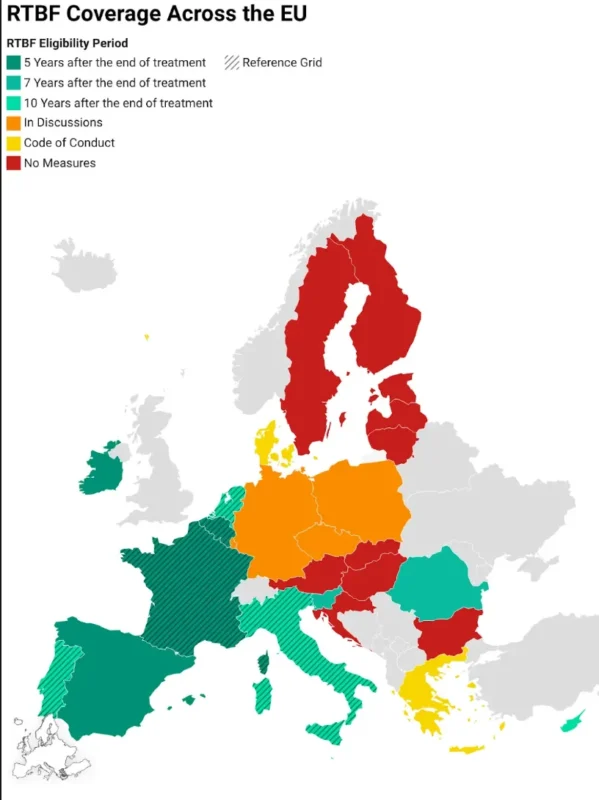
Figure 1. National overview of legal measures and codes of conduct addressing financial discrimination against cancer survivors across European Union Member States. Source: Ending Discrimination Against Cancer Survivors (EDACS), national-level overview, July 2026.
In Latin America, progress is also taking place.
Chile introduced its Right to Be Forgotten legislation in 2024, becoming an important reference for the region. Peru, Colombia and Panama adopted the legislation in the last two years. Other countries, such as Costa Rica, a Right to Be Forgotten bill was introduced approximately two years ago. However, changes to the original proposal have delayed the process, reminding us that introducing legislation is only the first step but ensuring the voice of people with a lived cancer experience is just as important.
These experiences offer opportunities for international collaboration, allowing countries to learn from existing legislation while adapting solutions to their own healthcare, financial, and legal systems.
However, the Right to Be Forgotten should not be seen as only a European or Latin American issue. As cancer survival improves globally, countries across different regions will need to consider how their financial systems protect people who have experienced cancer.
The challenge is global, even if the solutions may differ between countries.
Why Is This Especially Important for Young Cancer Survivors?
For people diagnosed during childhood, adolescence, or young adulthood, the consequences of financial discrimination can extend across many years. A diagnosis that happened early in life should not automatically become a barrier to future opportunities.
Protecting young cancer survivors is particularly important because many major financial decisions happen years after treatment.
Cancer may have interrupted their lives once. Financial discrimination should not continue doing so.
Why Lived Experience Must Be Part of the Conversation
Legislation is an important step, but understanding how discrimination affects people requires listening to those who have experienced it. Testimonies could identify barriers that may not be visible in legal documents or financial policies.
They understand what it means to receive an insurance rejection, face unexpected financial conditions, or feel that a past diagnosis continues to define their opportunities.
This is why lived experience must be at the centre of the conversation.
People with lived experience should not only be invited to share their stories. They should be involved in shaping the solutions.
Passing a law is only part of the process
People with lived experience and their caregivers must know their rights. Healthcare professionals should be aware of the protections available. Financial institutions must understand their responsibilities.
Without awareness and effective implementation, legal protections may fail to reach the people who need them.
A right that people do not know exists is a right they may never be able to exercise.
Moving the Conversation Forward: A Global Series by OncoDaily
At OncoDaily, we believe that progress in cancer care must include progress in the quality of life of people affected by cancer.
Through the OncoDaily Lived Experience Advocacy Hub, we are launching a global series exploring the Right to Be Forgotten through scientific evidence, expert perspectives, and testimonies from cancer survivors around the world.
We want to understand how financial discrimination affects people’s lives, learn from different countries, and amplify the voices of those directly affected.
Because lived experience should not only be part of the conversation. It should help shape the solutions.
Surviving cancer should not mean spending the rest of your life paying for it.
This is the first article in OncoDaily’s global series on the Right to Be Forgotten. In the coming articles, we will share expert perspectives and personal testimonies from cancer survivors around the world.
You can also read: Cancer Literacy: Understanding Cancer Should Not Be a Privilege