






Matthew Gubin, Associate Professor at MD Anderson Cancer Center, shared on LinkedIn:
“New study from a collaboration between the Gubin lab and Stephanie Watowich lab, led by Josué Pineda, PhD, and Tomoyuki Minowa. Long read, I know.
Both MHC-I and MHC-II Are Required for DC1 Vaccine Efficacy
Type 1 conventional dendritic cells (DC1s) play a central role in coordinating antitumor immunity, yet their scarcity and dysfunction within tumors have limited their therapeutic exploitation. Interestingly, prior work from the Murphy lab at Wash U, led by Steve Ferris (when he was in the Murphy lab), established that endogenous DC1s prime not only CD8 T cells but also CD4 T cells in tumor-bearing hosts and that DC1s are licensed by CD4 T cells in this setting.
In recent work, the Stephanie Watowich lab developed a cellular cancer vaccine immunotherapy using ex vivo-differentiated, tumor antigen-loaded DC1s and demonstrated that intratumoral delivery of these cells elicits antitumor immunity across multiple models (e.g., PMID: 32273347, PMID: 38935717).
Following up on this work, Josué and Tomo define the antigen presentation requirements that underlie effective DC1-based cancer therapy using mouse models. We show that ex vivo-differentiated DC1s derived from bone marrow closely resemble intratumoral DC1s in both mice and humans, while adjuvant stimulation shifts them toward a CCR7+/mregDC-like maturation state.
Using ex vivo-differentiated DC1s selectively deficient in MHC class I (MHC-I) or MHC-II as vaccines, we demonstrate that both pathways contribute to tumor control and that coexpression of both MHC-I and MHC-II on the same vaccine-delivered DC1 is required for robust therapeutic efficacy, with additional support from host DC1s.
We also found that host DC1s support the efficacy of vaccination with exogenous DC1s, as demonstrated by impaired tumor control in Irf8+32−/− mice, which lack endogenous DC1s. Our findings at first appear to differ somewhat from an important prior study from the Murphy lab (Ferris et al. PMID: 35648641) using a spontaneously regressing tumor model, which showed that DC1 vaccines could mediate tumor rejection independently of host DC1s.
The spontaneously regressing tumors used by Ferris et al. are inherently highly immunogenic and may therefore be less dependent on endogenous DC1s than the less immunogenic tumor models used in our studies. Nevertheless, our work is consistent with Ferris et al. in demonstrating that exogenously administered DC1s retain antitumor activity in the absence of endogenous DC1s, although this activity was less effective than in mice with an intact endogenous DC1 compartment.
DC1 Vaccines May Offer Superior Tumor Antigen Presentation
Our work is also consistent with the idea that exogenously administered DC1s can directly present tumor antigens to prime tumor-specific T cells in the absence of endogenous DC1s. This contrasts with monocyte-derived DCs (MoDCs), which rely on the transfer of tumor antigens to endogenous DCs.
This may be a factor contributing to the enhanced efficacy of DC1-based cellular vaccines compared with MoDC approaches. These differences may help explain in part why prior DC vaccine trials have generally shown limited clinical efficacy, as such studies historically relied predominantly on MoDCs rather than DC1s.
MHC-II KO Strain May Alter Btnl2 Expression
Finally, an unexpected finding from our study relates to the MHC-II KO mouse we used (JAX #003584). Btnl2 transcript expression was upregulated in BM-derived DC1s from this strain. Btnl2 protein (which we did not measure) has been implicated in modulating T cell costimulation.
The increased Btnl2 transcript expression we observed may be linked to the genomic architecture surrounding the MHC-II locus, as Btnl2 is positioned adjacent to the targeted H2-Ab1 region in the mouse genome and the targeted deletion may have altered regulatory elements that normally restrain Btnl2 transcription. Our published and unpublished findings suggest this did not contribute to the reduced efficacy of MHC-IIKODC1 vaccines in vivo. Nevertheless, our finding highlights a potentially important consideration when using this mouse strain.”
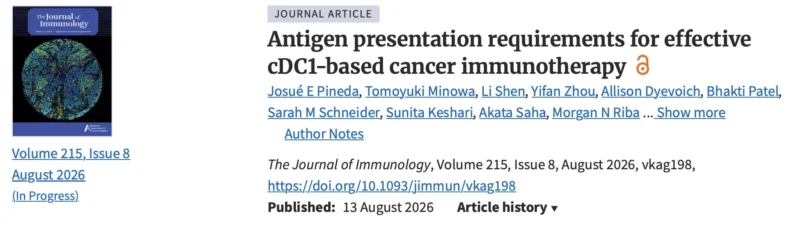
Title: Antigen presentation requirements for effective cDC1-based cancer immunotherapy
Authors: Josué E. Pineda, Tomoyuki Minowa, Li Shen, Yifan Zhou, Allison Dyevoich, Bhakti Patel, Sarah M. Schneider, Sunita Keshari, Akata Saha, Morgan N. Riba, Jing Wang, Stephanie S. Watowich, Matthew M. Gubin
Read the Full Article
Other articles about cancer vaccines on OncoDaily.