Bayer is accelerating its expansion in precision oncology with two major announcements in just two days, combining the development of a next-generation cancer treatment with investment in pharmaceutical manufacturing infrastructure.
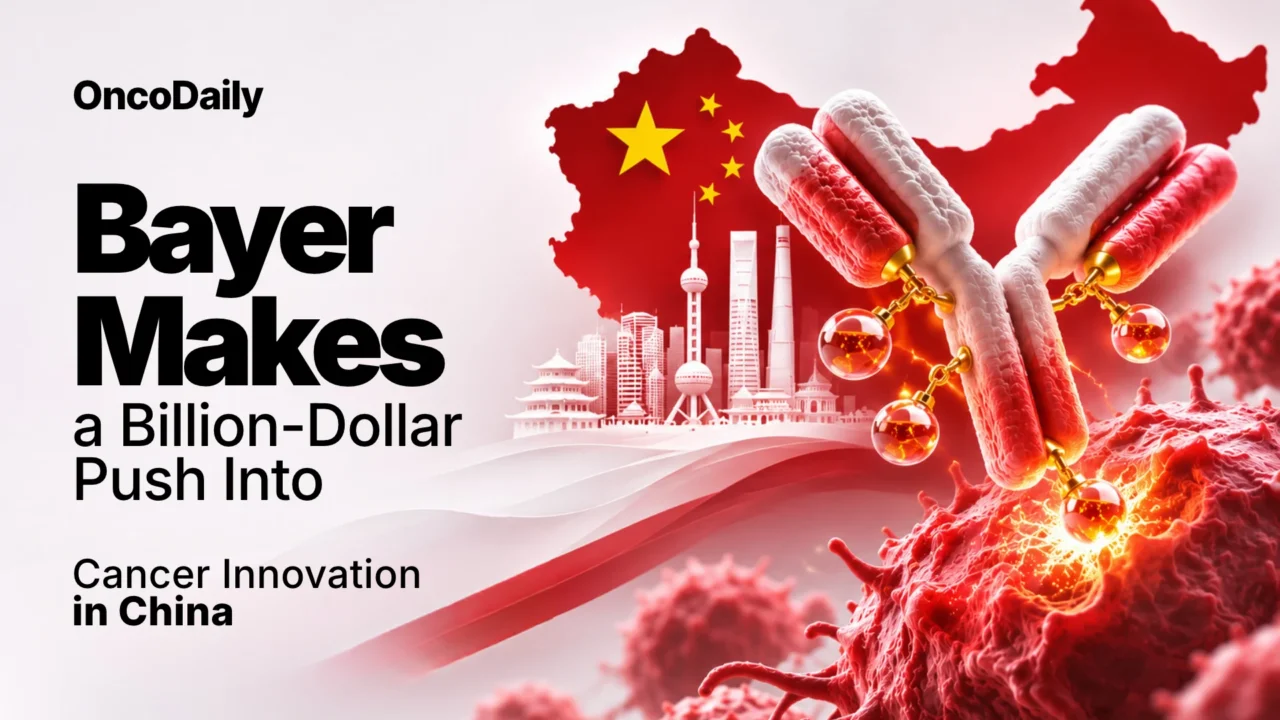
On November 25, 2026, Bayer announced a global licensing agreement with Hansoh Pharma worth potentially $3.25 billion for HS-20122, an investigational bispecific antibody-drug conjugate (ADC) being developed for lung cancer and other advanced solid tumors.
One day later, the company announced plans to invest up to €500 million in expanding its pharmaceutical manufacturing facility in Beijing, China, with plans to accommodate future oncology products.
Together, the announcements highlight Bayer’s growing commitment to cancer drug development and the increasingly important role of China in global pharmaceutical innovation.
Bayer and Hansoh Pharma Join Forces to Develop Next-Generation Cancer Treatment
Under the licensing agreement, Bayer will obtain exclusive rights to develop, manufacture, and commercialize HS-20122 worldwide, excluding mainland China, Hong Kong, Macau, and Taiwan.
Hansoh Pharma will receive an upfront payment of $150 million and could receive an additional $3.1 billion tied to development, regulatory, and commercial milestones. The agreement also includes tiered royalties on potential future sales.
The collaboration brings another promising ADC into Bayer’s precision oncology portfolio at a time when these therapies are reshaping treatment strategies across multiple cancer types.
Juergen Eckhardt, Head of Business Development and Licensing at Bayer’s Pharmaceuticals Division, highlighted the importance of the collaboration:
“We are excited to further advance HS-20122, a next-generation, bispecific ADC, together with Hansoh Pharma.”
He emphasized that despite advances in lung cancer treatment, there remains a considerable need for therapies offering improved efficacy and tolerability.
What Is HS-20122 and How Does It Work?
HS-20122 is an investigational bispecific antibody-drug conjugate designed to simultaneously target two proteins involved in cancer growth and treatment resistance: epidermal growth factor receptor (EGFR) and mesenchymal-epithelial transition factor (c-MET).
Unlike conventional ADCs that recognize a single molecular target, HS-20122 is designed to recognize both EGFR and c-MET while delivering a cytotoxic payload to cancer cells.
This approach is particularly relevant in non-small cell lung cancer (NSCLC), where alterations in EGFR and activation of MET signaling can contribute to tumor progression and resistance to targeted therapies.
By combining dual-target recognition with targeted delivery of a cancer-killing agent, HS-20122 could potentially provide an additional treatment option for patients whose disease has progressed following existing therapies. However, its clinical benefit remains to be established in larger studies.
Promising Lung Cancer Results Presented at ESMO 2026
The licensing agreement follows encouraging early clinical findings presented at the European Society for Medical Oncology (ESMO) Congress 2026 in Madrid, Spain.
Hansoh Pharma presented results from an ongoing first-in-human Phase I clinical trial (NCT06927570) evaluating HS-20122 in patients with advanced solid tumors. As of the July 6, 2026, data cutoff, the study had enrolled 215 participants.
Across tumor types, the reported objective response rate (ORR) was 44.1%, with a disease control rate (DCR) of 91.0%.
Particularly encouraging findings were observed among patients with EGFR-mutated NSCLC whose disease had progressed following treatment with EGFR tyrosine kinase inhibitors (TKIs). In this population, the reported objective response rate reached 61.3%, with a six-month progression-free survival rate of 75.3%.
Clinical activity was also reported in other cancer types, including:
- Squamous NSCLC: Objective response rate of 32.1%.
- Head and neck cancer: Objective response rate of 50.0%.
No dose-limiting toxicities were reported. Most treatment-related adverse events were Grade 1 or 2, while the most frequent Grade 3 or higher treatment-related adverse events included neutropenia (25.6%) and decreased white blood cell count (15.8%).
Although these preliminary results support continued clinical development, HS-20122 remains investigational. Larger studies will be necessary to establish its long-term safety, durability of response, and comparative effectiveness.
Bayer Invests €500 Million in Pharmaceutical Manufacturing in China
Alongside its oncology licensing agreement, Bayer revealed plans for its largest single pharmaceutical investment in China to date, committing up to €500 million to expand its existing pharmaceutical production center in Beijing.
The planned facility will span approximately 18,000 square meters and feature three independently operated manufacturing modules. Production could begin as early as 2032, with the expansion expected to accommodate up to 300 employees.
Although initial manufacturing activities will focus on cardiovascular treatments, the facility is intended to incorporate capabilities for producing high-potency medicines, including future cancer therapies, primarily for the Chinese market.
Stefan Oelrich, Member of the Board of Management of Bayer AG and President of its Pharmaceuticals Division, commented:
“This planned investment reflects the strength of our business in China and our confidence in its long-term development.”
The expansion accompanies Bayer’s plans to spend approximately €1 billion through 2030 on strengthening its pharmaceutical operations in China, including medical capabilities, digital technologies, manufacturing, and supply chains.
Bayer has not identified which oncology medicines will be manufactured at the expanded facility, nor has it announced plans to produce HS-20122 at the site.
Inside Bayer’s Growing Oncology Pipeline
The agreement with Hansoh Pharma represents another step in Bayer’s efforts to diversify its oncology portfolio beyond established cancer treatments, with increasing emphasis on precision oncology, molecularly targeted therapies, and targeted radiopharmaceuticals.
The addition of an EGFR/c-MET-directed ADC complements the company’s broader interest in developing treatments that address molecular drivers of cancer and mechanisms of therapeutic resistance.
Lung cancer is becoming a particularly important area of interest for Bayer. The company’s development of HER2-directed therapies, alongside its latest investment in EGFR/c-MET-targeted drug development, reflects the growing importance of identifying molecularly defined patient populations and developing treatments tailored to their tumors.
Prostate cancer also remains a central component of Bayer’s oncology strategy, alongside emerging investigational programs targeting difficult-to-treat solid tumors.
The Hansoh Pharma collaboration introduces another approach to this portfolio, potentially extending Bayer’s reach into cancer populations with limited treatment options following progression on existing targeted therapies.
China’s Growing Role in Global Oncology Innovation
The two announcements also reflect a broader transformation in the international pharmaceutical industry. Chinese biotechnology companies are increasingly emerging as developers of novel cancer treatments, attracting substantial licensing investments from global pharmaceutical companies.
Antibody-drug conjugates have become a particularly competitive area of oncology research, with companies pursuing new molecular targets, bispecific antibodies, and improved drug delivery technologies to address limitations associated with existing treatments.
Bayer’s agreement with Hansoh Pharma illustrates how early-stage clinical innovation originating in China can become part of a global oncology development strategy. Meanwhile, its Beijing manufacturing expansion underscores the country’s importance as both a pharmaceutical market and a production hub.
While the two initiatives remain independent, they point toward a common strategic direction: expanding access to pharmaceutical innovation through international partnerships and investment in long-term manufacturing capabilities.
For patients with advanced lung cancer and other solid tumors, the most important question now is whether the encouraging early findings with HS-20122 will translate into meaningful and durable clinical benefits in future trials.
Read further on OncoDaily: Bayer Plans $2.2 Billion Ohio Manufacturing Campus to Support Oncology and Cardiorenal Portfolio