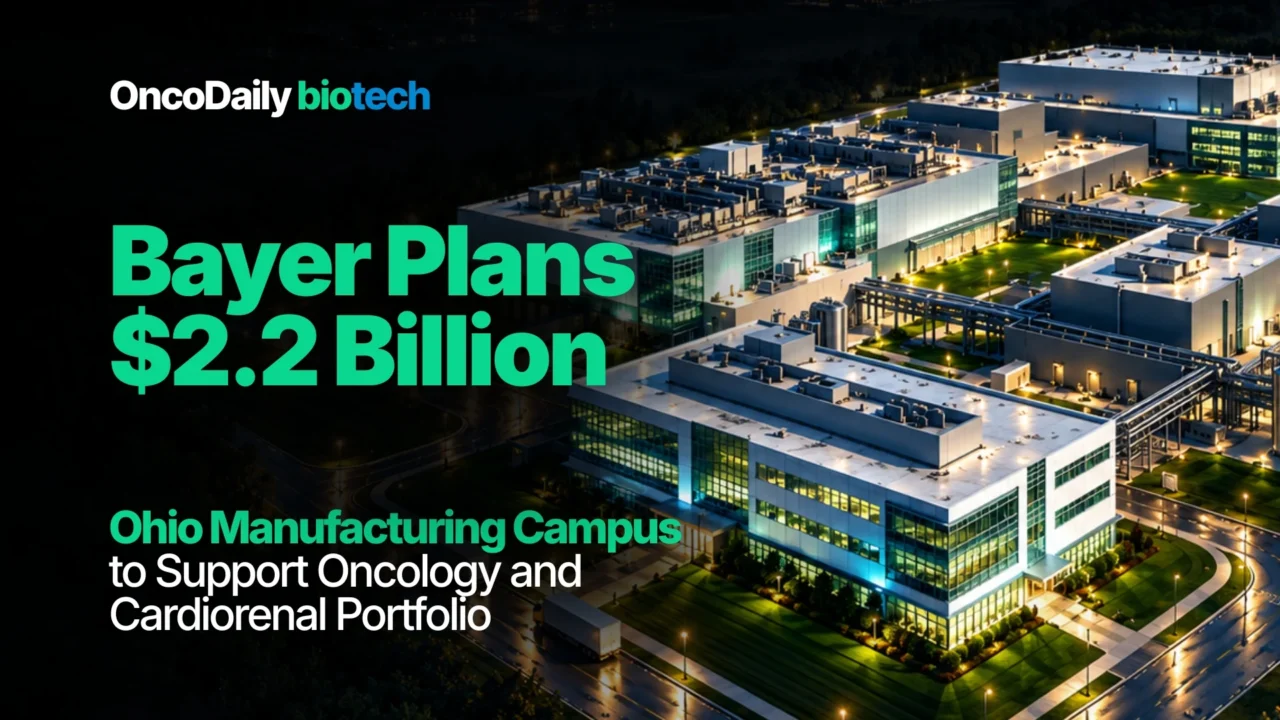
Bayer plans to invest $2.2 billion in a new pharmaceutical manufacturing campus in New Albany, Ohio, expanding its capacity to produce medicines for the U.S. and international markets.
Announced on October 2, 2026, the multiyear project will be developed within the New Albany International Business Park and is expected to create around 600 permanent, highly skilled jobs. Bayer also anticipates approximately 1,500 construction jobs during the facility’s development.
According to the company, the investment builds on more than $7 billion it has spent on pharmaceutical research, development, and manufacturing in the United States over the past five years. Bayer describes the U.S. as its largest and fastest-growing pharmaceutical market, making the new facility an important part of its longer-term growth and product-supply strategy.
What will the facility manufacture?
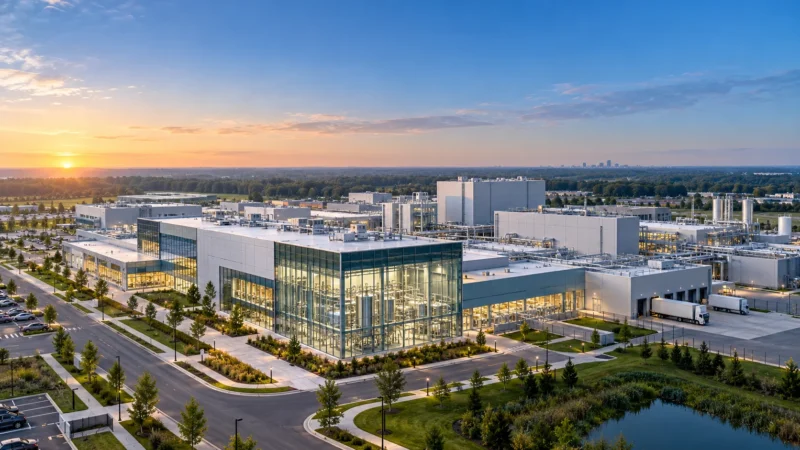
The New Albany campus will be designed to bring two major stages of pharmaceutical production together at one location.
Its first module will manufacture drug substances – the active pharmaceutical ingredients or other core therapeutic components used to make medicines. Bayer expects this portion of the site to become operational in 2031.
A second module, scheduled to follow in 2034, will focus on drug-product manufacturing. This stage converts the active substance into a finished medicine with the required formulation, dosage form, packaging, and quality controls needed for distribution to patients.
Bayer said the flexible, modular campus will use advanced digital systems and automation and will initially support its growing portfolio in oncology, cardiovascular medicine, and renal care. The company has not yet disclosed the individual products, pipeline candidates, formulations, or therapeutic modalities that will be manufactured in Ohio.
This distinction is important: the announcement establishes broad production capabilities but does not confirm that any specific Bayer medicine will be assigned to the site.
Connecting manufacturing with Bayer’s pipeline
The investment arrives as Bayer works to accelerate growth from a pharmaceutical portfolio increasingly centered on precision oncology and cardiorenal medicine.
In oncology, the company’s portfolio includes Nubeqa (darolutamide) for prostate cancer and Hyrnuo (sevabertinib), an oral targeted therapy for advanced HER2-mutated non-small cell lung cancer. Bayer is also studying darolutamide in additional prostate cancer settings and sevabertinib across other HER2-mutated solid tumors. Its broader oncology pipeline includes small molecules and targeted radionuclide therapies, with research focused on genitourinary, gastrointestinal, and lung cancers.
The cardiovascular and renal pipeline includes finerenone (Kerendia), which is being developed in non-diabetic chronic kidney disease after its September U.S. approval in kidney disease associated with type 1 diabetes, alongside investigational programs for heart failure, stroke, pulmonary embolism, Alport syndrome, and other cardiovascular and renal conditions. Bayer’s July 2026 pipeline overview listed approximately 30 clinical-stage projects spanning small molecules, protein therapies, cell and gene therapies, imaging agents, and radionuclide treatments.
The Ohio site therefore gives Bayer the option to prepare manufacturing capacity for both its established portfolio and future medicines progressing through development. However, because the company has not detailed the site’s technical specifications by modality, it remains unclear whether New Albany will support only conventional pharmaceutical production or eventually accommodate more specialized products.
Why the investment matters
Manufacturing capacity has become a strategic issue across the pharmaceutical industry. Discovering and clinically validating a medicine is only part of bringing it to patients; companies must also be able to produce it consistently, at commercial scale, and under tightly controlled quality standards.
Adding U.S.-based capacity can reduce dependence on geographically concentrated suppliers, shorten certain supply routes, and provide additional flexibility when responding to demand or disruption. Locating drug-substance and finished-product manufacturing on the same campus may also simplify technology transfer and coordination as products move from development toward commercial production.
For Bayer, the investment adds another major manufacturing location to a U.S. network that already includes operations in California, Massachusetts, New Jersey, North Carolina, and Pennsylvania. The company also aims to connect the Ohio campus with academic and scientific partners, creating an ecosystem that links research innovation with advanced manufacturing expertise.
The announcement is part of a wider expansion of U.S. pharmaceutical production. Eli Lilly has committed more than $50 billion to domestic manufacturing since 2020, including a planned $5 billion Virginia facility for active ingredients, monoclonal antibodies, and antibody-drug conjugates used primarily in oncology.
Johnson & Johnson separately announced in March 2025 more than $55 billion in planned U.S. manufacturing, research, development, and technology investments over four years. This includes a 10-year, $2 billion commitment supporting biopharmaceutical production at a new facility on Fujifilm’s site in Holly Springs, North Carolina.
Together, these projects point to a broader industry shift toward expanding advanced manufacturing closer to major commercial markets. The expansion also comes as new U.S. tariffs on imported patented medicines take effect, with lower rates for companies that commit to domestic manufacturing; Bayer has not publicly linked the Ohio project to tariffs. For patients, the ultimate importance will depend on whether these facilities translate scientific progress into a stable and timely supply of new medicines.
Bayer expects the first Ohio manufacturing module to begin operating in 2031, followed by the second in 2034.
Read the latest on OncoDaily: From $24 Million to $400 Million: Why Merck Paid Up for the Same Founder’s Next KRAS G12D Drug