
For patients with persistent, recurrent, or metastatic cervical cancer, long-term disease control has historically been difficult to achieve. The introduction of immune checkpoint inhibitors has changed the first-line treatment landscape, but an important question remains: how durable is the benefit of immunotherapy?
The five-year results of the phase III KEYNOTE-826 trial, published in JAMA Oncology by Kosei Hasegawa, Nicoletta Colombo, Krishnansu S. Tewari, and colleagues, demonstrate that the survival benefits of pembrolizumab combined with chemotherapy, with or without bevacizumab, are maintained after a median follow-up of 59.1 months.
Among patients with a PD-L1 combined positive score (CPS) ≥1, approximately one in three patients receiving pembrolizumab was alive at five years, while more than one in four remained alive without disease progression.
These findings highlight the potential of first-line immunotherapy to change the long-term disease trajectory for a subset of patients with advanced cervical cancer.
KEYNOTE-826: Study Design
KEYNOTE-826 (NCT03635567) is a randomized, double-blind phase III trial evaluating the addition of pembrolizumab to platinum-based chemotherapy, with or without bevacizumab, in patients with persistent, recurrent, or metastatic cervical cancer who had not previously received systemic chemotherapy for advanced disease.
The study enrolled 617 patients across 151 centers in 19 countries. Eligible patients had squamous cell carcinoma, adenocarcinoma, or adenosquamous carcinoma of the cervix, measurable disease according to RECIST v1.1, and an ECOG performance status of 0 or 1.
Patients were randomly assigned to receive:
- Pembrolizumab (n = 308): 200 mg intravenously every three weeks for up to 35 cycles (approximately two years).
- Placebo (n = 309): administered according to the same schedule.
Both groups received paclitaxel (175 mg/m²) combined with either cisplatin (50 mg/m²) or carboplatin (AUC 5) every three weeks for six cycles, with additional cycles permitted in selected patients.
Bevacizumab (15 mg/kg every three weeks) was administered at the investigator’s discretion and was used in approximately 63% of participants.
The dual primary endpoints were overall survival (OS) and investigator-assessed progression-free survival (PFS).
The current exploratory analysis was conducted approximately 20 months after the previous final analysis, with a median follow-up of 59.1 months and a data cutoff of June 4, 2024. The objective was to assess the durability of previously established survival benefits and characterize long-term safety rather than formally retest treatment efficacy.
Five-Year Overall Survival: A Benefit That Persists Over Time
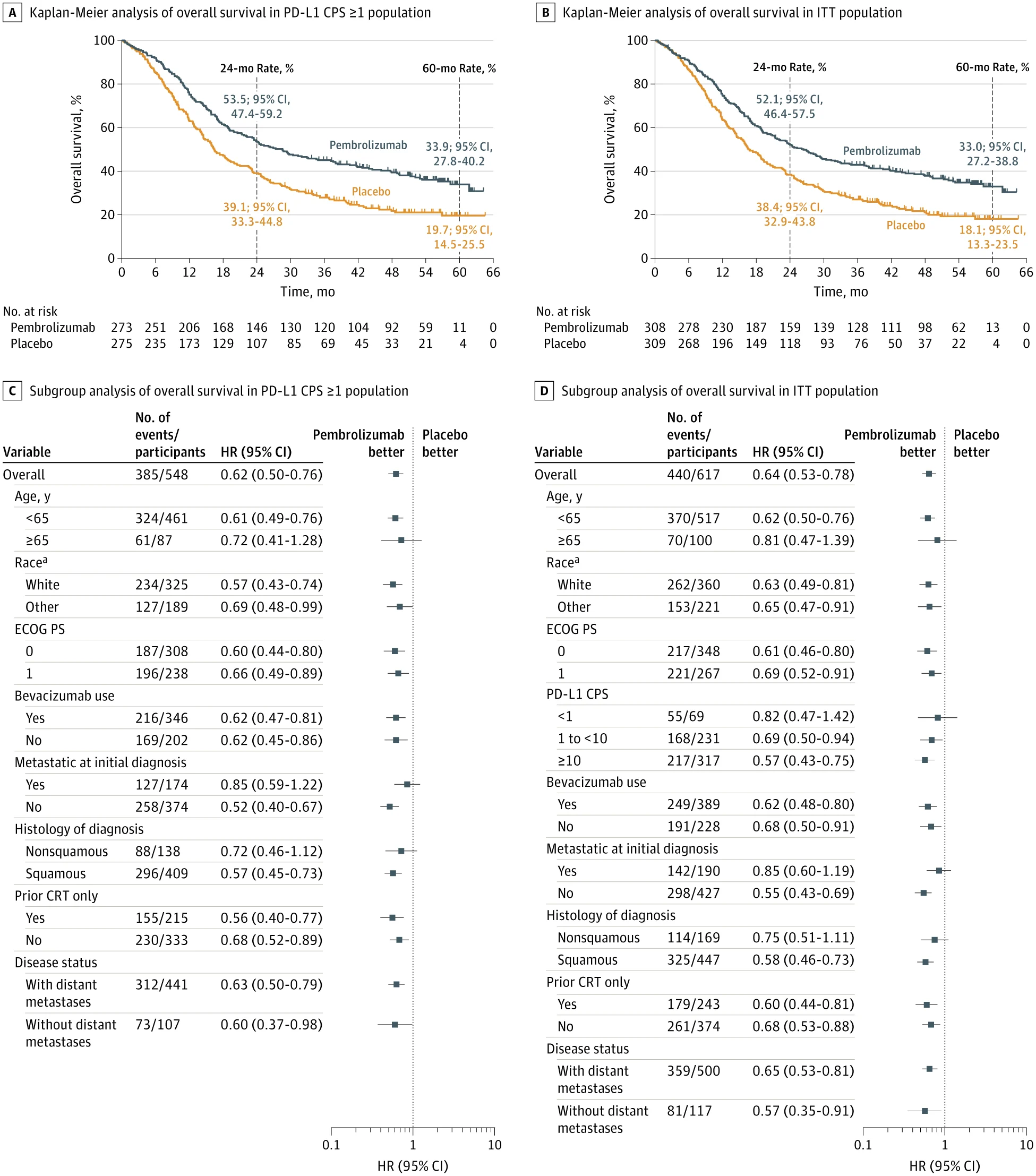
The overall survival advantage associated with pembrolizumab remained evident throughout extended follow-up, both in patients with PD-L1 CPS ≥1 and in the intention-to-treat (ITT) population.
Patients With PD-L1 CPS ≥1
The addition of pembrolizumab was associated with a 38% lower hazard of death compared with placebo.
- Median OS: 28.6 vs. 16.5 months.
- Five-year OS rate: 33.9% vs. 19.7%.
- Hazard ratio (HR): 0.62 (95% CI, 0.50–0.76).
The median overall survival difference was 12.1 months, with an absolute improvement of 14.2 percentage points in estimated five-year survival.
Intention-to-Treat Population
The overall survival benefit was similarly maintained across the randomized population.
- Median OS: 26.4 vs. 16.8 months.
- Five-year OS rate: 33.0% vs. 18.1%.
- HR: 0.64 (95% CI, 0.53–0.78).
The magnitude of benefit remained consistent with the previous final analysis, conducted after a median follow-up of 39.1 months.
Importantly, approximately 89% of the study population had a PD-L1 CPS ≥1. Therefore, the favorable results in the ITT population should not be interpreted as establishing a survival benefit specifically in patients with PD-L1-negative tumors.
Progression-Free Survival: Looking Beyond the Median
Perhaps the most interesting finding from the five-year analysis is the difference between the improvement in median PFS and the magnitude of long-term disease control.
Patients With PD-L1 CPS ≥1
Pembrolizumab was associated with a 42% lower hazard of disease progression or death.
- Median PFS: 10.5 vs. 8.2 months.
- Five-year PFS rate: 27.3% vs. 9.9%.
- HR: 0.58 (95% CI, 0.48–0.71).
Intention-to-Treat Population
A similar pattern was observed across the overall randomized population.
- Median PFS: 10.4 vs. 8.2 months.
- Five-year PFS rate: 26.2% vs. 9.0%.
- HR: 0.61 (95% CI, 0.51–0.74).
Among patients with PD-L1 CPS ≥1, the improvement in median PFS was only 2.3 months. However, at five years, the estimated proportion of patients remaining alive without disease progression was nearly three times higher with pembrolizumab.
This difference illustrates an important characteristic of immunotherapy outcomes. Median PFS describes the time at which half of the population has experienced disease progression or death, but it does not fully capture the magnitude of benefit among patients who achieve prolonged disease control.
The five-year PFS results therefore provide a complementary perspective on the clinical value of adding pembrolizumab to first-line treatment.
Survival Outcomes Across Clinical Subgroups
The extended analysis demonstrated favorable OS and PFS hazard ratios across protocol-specified clinical and demographic subgroups in both the PD-L1 CPS ≥1 and ITT populations.
A separate post hoc analysis evaluated overall survival specifically in patients with persistent or recurrent cervical cancer.
The results continued to favor pembrolizumab:
- PD-L1 CPS ≥1 population: HR, 0.57 (95% CI, 0.45–0.72).
- ITT population: HR, 0.59 (95% CI, 0.48–0.74).
These findings suggest that the survival benefit extends beyond patients presenting with metastatic disease at initial diagnosis.
However, the subgroup analyses were exploratory, were not adjusted for multiple comparisons, and included some relatively small patient populations. They should therefore be interpreted as supportive findings rather than independent confirmation of efficacy in each subgroup.
Five-Year Safety: No New Safety Signals Identified
As more patients achieve prolonged survival following immune checkpoint inhibition, understanding the long-term safety profile becomes increasingly important.
At the five-year analysis, the safety profile of pembrolizumab combined with chemotherapy, with or without bevacizumab, remained consistent with previous reports.
Treatment-related adverse events in the pembrolizumab versus placebo groups included:
- Any-grade treatment-related adverse events: 96.7% vs. 97.1%.
- Grade ≥3 treatment-related adverse events: 69.4% vs. 65.4%.
- Any-grade immune-mediated adverse events and infusion reactions: 43.6% vs. 29.8%.
- Grade ≥3 immune-mediated adverse events and infusion reactions: 14.7% vs. 5.2%.
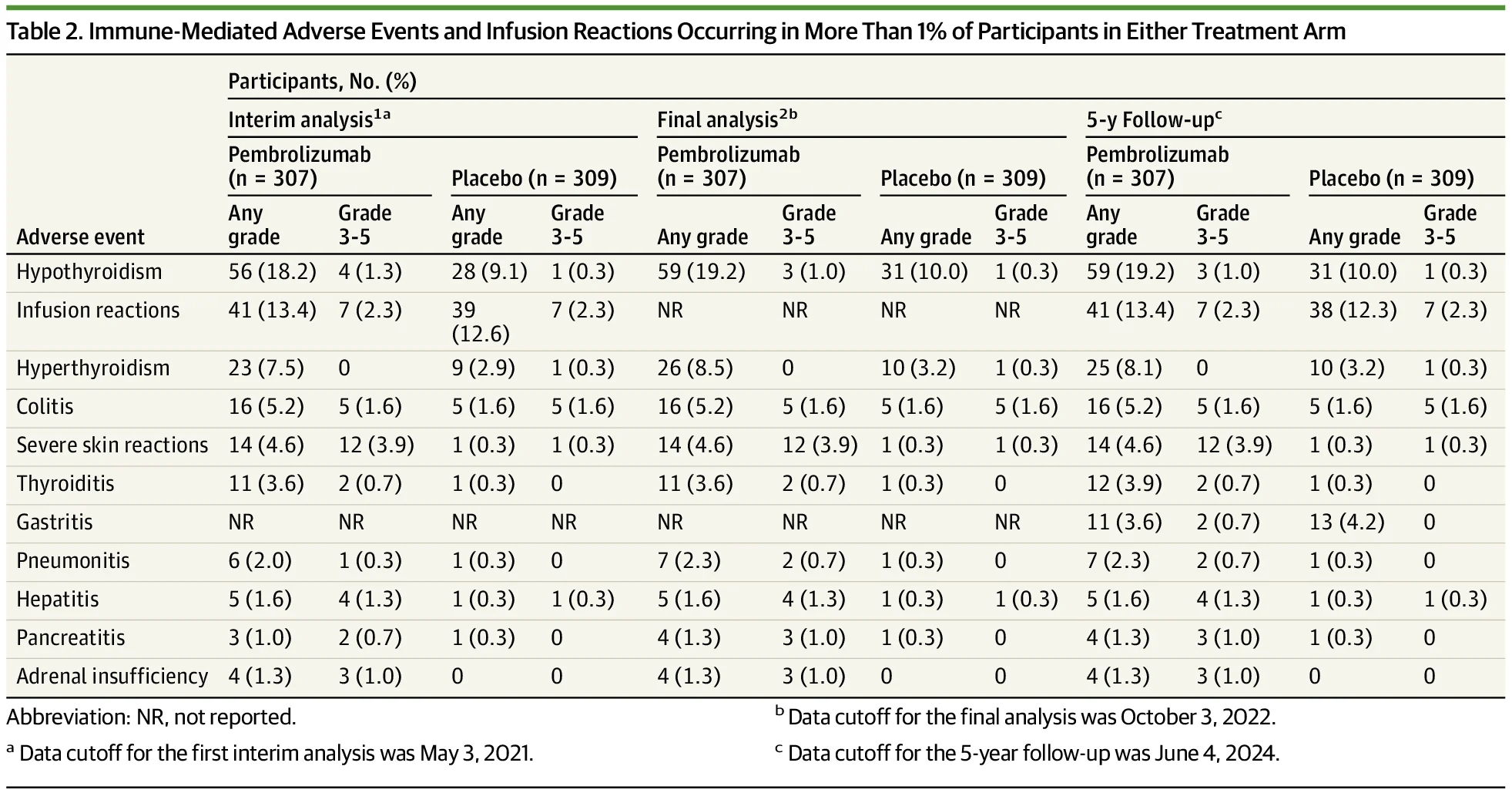
Thyroid dysfunction remained among the most frequently reported immune-mediated toxicities. The most common immune-mediated adverse events included:
- Hypothyroidism: 19.2% vs. 10.0%.
- Hyperthyroidism: 8.1% vs. 3.2%.
- Colitis: 5.2% vs. 1.6%.
The most frequently reported grade ≥3 immune-mediated adverse events included severe skin reactions, colitis, and hepatitis.
Since the previous final analysis, only one additional low-grade immune-mediated event of thyroiditis was reported in the pembrolizumab group. No additional deaths attributable to treatment-related adverse events or immune-mediated adverse events and infusion reactions were reported.
Although no new safety signals emerged, routine adverse-event collection was limited to protocol-defined periods following treatment discontinuation. Consequently, these findings should not be interpreted as excluding persistent or delayed immune-related toxicities.
Beyond Two Years of Immunotherapy: Understanding the Survival Plateau
The separation of the overall survival and progression-free survival curves became apparent approximately three months after randomization and was maintained throughout the five-year follow-up period.
The investigators also observed a plateau in the PFS curves beginning at approximately 12 months, suggesting the presence of a subgroup of patients experiencing prolonged disease control.
This observation is particularly relevant because pembrolizumab administration was limited to a maximum of 35 cycles, corresponding to approximately two years. The survival advantage at five years therefore extended well beyond the maximum planned duration of immunotherapy.
For a disease historically associated with limited prospects for long-term survival, this represents an important clinical development.
However, a survival plateau does not establish cure, nor does it demonstrate that all long-term responders remained free of subsequent anticancer treatment. Rather, it supports the possibility that integrating immune checkpoint inhibition into first-line therapy can produce durable disease control in a subset of patients.
The Next Challenge: Identifying Long-Term Responders
KEYNOTE-826 has established the clinical value of pembrolizumab-based first-line therapy, but substantial heterogeneity in treatment outcomes remains.
While some patients experience prolonged disease control, others develop progression within months despite receiving the same therapeutic regimen.
PD-L1 CPS remains an established biomarker for treatment selection in this setting, but it does not fully explain these differences in individual outcomes.
From an immuno-oncology perspective, several important questions remain:
- Can characteristics of the tumor immune microenvironment identify patients most likely to achieve durable responses?
- Could HPV-specific immune responses provide additional predictive information in HPV-associated cervical cancer?
- Could circulating tumor DNA (ctDNA) or circulating HPV DNA help characterize treatment response and identify emerging resistance?
- Can additional immunotherapeutic strategies improve outcomes in patients with primary or acquired resistance to PD-1 blockade?
These questions were not addressed in the current KEYNOTE-826 analysis but represent potential directions for future research aimed at extending the benefits of immunotherapy to more patients.
Conclusion
The five-year results of KEYNOTE-826 reinforce pembrolizumab combined with platinum-based chemotherapy, with or without bevacizumab, as a first-line standard of care for eligible patients with PD-L1 CPS ≥1 persistent, recurrent, or metastatic cervical cancer.
The sustained improvements in overall survival and progression-free survival, together with the absence of new reported safety signals, provide further evidence of the durability of pembrolizumab-based treatment.
Perhaps the most meaningful finding is not simply the extension of median survival, but the emergence of a larger population of patients achieving long-term disease control.
KEYNOTE-826 has changed the first-line treatment landscape of advanced cervical cancer. The next challenge is understanding why some patients experience years of disease control and how this benefit can be extended to those who remain resistant to immunotherapy.
Read Full Article Here