Fever, painful chondritis, skin lesions, markedly elevated inflammatory markers, on its own, this cluster might point toward a rheumatologic disease. But add macrocytic anemia, thrombocytopenia, or unexplained bone marrow abnormalities, and the diagnosis starts to blur. In VEXAS syndrome, these findings are not coincidental.
Since its identification in 2020, VEXAS (vacuoles, E1 enzyme, X-linked, autoinflammatory, somatic) has upended the traditional divide between hematologic and inflammatory disease. The driver mutations arise in hematopoietic stem and progenitor cells, yet most of the clinical picture manifests outside the bone marrow.
What Is VEXAS Syndrome?
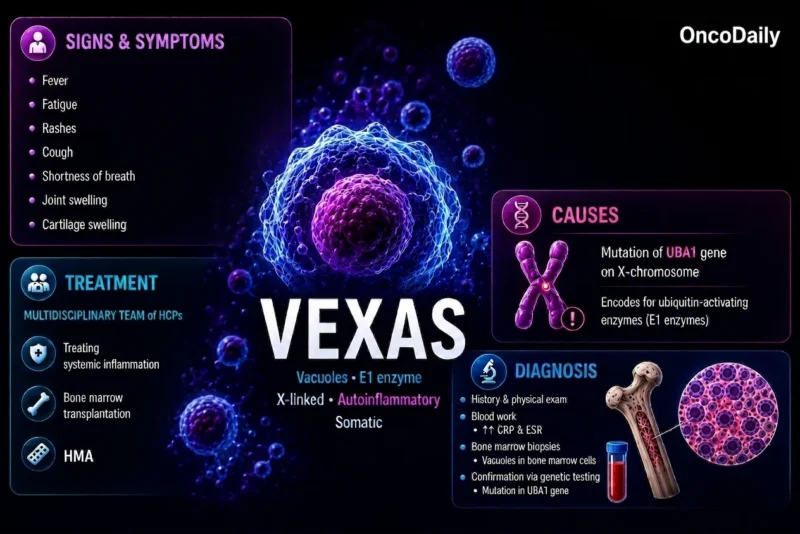
VEXAS is an acquired, adult-onset hemato-inflammatory syndrome caused by somatic UBA1 mutations in hematopoietic cells. Most patients are men over 50, reflecting the gene’s location on the X chromosome. UBA1 encodes an E1 enzyme involved in ubiquitination. Most VEXAS mutations affect methionine 41, which disrupts cytoplasmic UBA1 activity and triggers cellular stress and inflammatory signaling.
VEXAS is a clonal hematopoietic disease, but not synonymous with a myeloid neoplasm, a distinction that matters most when weighing its overlap with myelodysplastic neoplasms (MDS).
How Does a UBA1-Mutated Clone Become Dominant?
In a 2025 Nature Medicine study, Molteni et al. found that UBA1-mutant hematopoietic stem and progenitor cells were more resilient to the inflammatory environment, while wild-type cells grew progressively exhausted and were eventually outcompeted by VEXAS clones.
Using single-cell transcriptomics and humanized mouse models, the researchers showed that hematopoiesis skewed toward the myeloid lineage, and that mutant cells acquired senescence-like programs.
The result is a potentially self-reinforcing cycle: mutant hematopoiesis fuels inflammation, inflammation damages normal hematopoiesis, and the mutant clone’s relative fitness climbs further.
The Hematologic Side
Macrocytic anemia is one of the most characteristic hematologic findings. Other cytopenias are also common, and progressive marrow dysfunction can eventually lead to transfusion dependence. In a patient with persistent systemic inflammation, these abnormalities can be an important clue to the diagnosis.
Bone marrow examination often shows cytoplasmic vacuoles in erythroid and myeloid precursors. Although characteristic of VEXAS, vacuoles are not specific and can occur in other acquired and inherited conditions. The diagnosis therefore relies on identifying somatic UBA1 mutation in the appropriate clinical setting.
Is VEXAS a Myelodysplastic Neoplasm?
VEXAS patients often show cytopenias, dysplastic marrow findings, and clonal hematopoiesis, features that raise concern for MDS. A 2026 Blood Advances review found MDS diagnosed in roughly 30-50% of VEXAS patients. Seen from the reverse view, only about 1% of unselected MDS patients carry UBA1 mutations.
Some marrow abnormalities may be intrinsic to the UBA1-driven syndrome itself, not a separate malignancy. Some patients do have a true concomitant myeloid neoplasm, others have severe clonal dysfunction without meeting formal criteria. So, VEXAS should not be considered another name for MDS.
Additional mutations add complexity. Age-related clonal hematopoiesis (DNMT3A, TET2) can coexist with UBA1-mutated hematopoiesis, yet the UBA1 clone may become strikingly dominant. Competing clones can expand or suppress one another.
Why Do Symptoms Extend Far Beyond the Bone Marrow?
UBA1-mutant myeloid cells circulate throughout the body. Patients can present with recurrent fever, relapsing polychondritis, neutrophilic dermatoses, inflammatory arthritis, ocular disease, pulmonary infiltrates, and vasculitis, and these often dominate the picture.
Thrombosis deserves special attention: it’s unusually common in VEXAS and can be part of the diagnostic pattern, particularly venous thromboembolism, sometimes recurring despite treatment. The mechanism is multifactorial – intense systemic inflammation, endothelial activation, and abnormal hematopoiesis all playing a role.
This multisystem phenotype is why VEXAS management requires hematology and rheumatology working together, often alongside dermatology and pulmonology. But don’t let the multidisciplinary presentation obscure the core mechanism: this is a systemic disease driven by acquired abnormal hematopoiesis.
Current Treatment Approaches
Glucocorticoids control inflammatory symptoms fast, but many patients end up steroid dependent, a real problem in an older population already prone to infection and treatment complications. That’s pushed clinicians toward steroid-sparing options like cytokine-directed therapies and JAK inhibitors. Responses vary, and the evidence is still mostly observational.
That gap is the rationale for clone-directed therapy. Hypomethylating agents, azacitidine in particular, have drawn interest. A 2026 systematic review pulled together 30 reports covering 166 genetically confirmed VEXAS patients treated with hypomethylating agents. Across the literature, treatment improved inflammatory manifestations, reversed cytopenias, cut steroid requirements, and in some patients produced molecular responses. The data is heterogeneous and doesn’t make azacitidine standard therapy.
If two therapies control fever and chondritis equally well, but only one meaningfully reduces the UBA1-mutant clone, are they delivering the same depth of disease control? Whether molecular response actually matters clinically is still unsettled.
Can Allogeneic Transplantation Cure VEXAS?
At present, transplantation remains the only treatment considered potentially curative. A 2026 review identified 45 reported patients who had undergone allogeneic transplantation for VEXAS. Importantly, transplantation has also been performed in patients without an overt myeloid malignancy, showing that the indication can arise from severe VEXAS itself. The difficulty is deciding who should undergo such an intensive procedure and when.
Better predictors of progressive marrow failure, MDS development, treatment response, and transplant benefit are needed, plus standardized measures that capture inflammatory, hematologic, and molecular response together.
Allo-HSCT vs HMA
A 2026 multicenter retrospective study offered the first direct comparison of HMA therapy and allogeneic transplantation in VEXAS. Among 66 patients, alloHSCT was associated with better overall survival, with an adjusted HR for death of about 0.20.
Molecular remission was achieved in all evaluable transplant recipients compared with 22% of patients treated with HMA, while glucocorticoids were discontinued in 58% and 6%, respectively. The findings strengthen the case for alloHSCT, while the retrospective design means the survival advantage still needs prospective confirmation.
VEXAS Is Changing How We Think About Clonal Hematopoiesis
VEXAS matters beyond the raw number of patients carrying UBA1 mutations. It’s not a hematologic cancer in the conventional sense, yet a clone can be clinically destructive without being malignant. Its discovery linked manifestations once scattered across multiple specialties, and, importantly, changed how the disease can be approached therapeutically.

TP53-Mutated MDS: Can New Therapies Change the Prognosis?
FAQ
Is VEXAS syndrome a type of cancer?
No. VEXAS is a clonal hematopoietic disorder, but the presence of an abnormal hematopoietic clone does not by itself make it a hematologic malignancy. Some patients develop a concomitant myeloid neoplasm, particularly myelodysplastic neoplasms (MDS), while others do not.
Can women develop VEXAS syndrome?
Yes, although VEXAS occurs predominantly in men because UBA1 is located on the X chromosome. VEXAS has been reported in women, particularly in settings that favor expression of the mutant X chromosome, such as acquired X-chromosome monosomy or skewed X-inactivation. It should therefore not be considered exclusively a male disease.
Why are blood clots so common in VEXAS?
VEXAS carries a substantial thrombotic burden, particularly venous thromboembolism. The mechanism is not completely defined, but persistent inflammation, endothelial activation, and abnormalities related to clonal hematopoiesis may all contribute.
Who should be considered for allogeneic transplantation in VEXAS?
There is no single established profile. Transplantation may be considered in selected patients with severe or treatment-refractory disease, progressive hematologic involvement, or associated myeloid neoplasms, but age, comorbidities, organ damage, infection risk, and transplant fitness are major considerations.