
Molecular classification has changed how myelodysplastic neoplasms (MDS) are diagnosed and risk-stratified, but few genetic abnormalities carry the weight of a TP53 mutation.
The mutation is reliably linked to complex cytogenetics, resistance to conventional therapy, rapid progression, and a high rate of relapse even after allogeneic hematopoietic cell transplantation (allo-HCT).
This is where TP53-mutated MDS exposes a broader problem in hematology: achieving a response is not the same as controlling the disease. Hypomethylating agents, venetoclax-based regimens, and newer investigational therapies can reduce blast counts and induce remission, sometimes convincingly so, but durability is another matter.
Understanding why begins with recognizing that TP53-mutated MDS is not a uniform diagnosis.
What Is TP53-Mutated MDS?
TP53 encodes p53, a tumor-suppressor protein activated by cellular stresses including DNA damage. Its functions include cell-cycle arrest, DNA repair, senescence, and apoptosis. Loss of this protective response allows damaged hematopoietic cells to survive and expand despite accumulating genomic abnormalities. In MDS, this is clinically reflected by the strong association between TP53 alterations and complex or monosomal karyotypes.
TP53 mutations are found in only a minority of de novo MDS and AML cases, but they are substantially enriched in secondary and therapy-related myeloid neoplasms. Cytotoxic chemotherapy and radiation create selective pressure within hematopoiesis, TP53-mutant clones can have a survival advantage under such stress. For clinical purposes, however, identifying a mutation is only the first step.
“TP53-Mutated” Isn’t a Single Diagnosis
TP53 can be disrupted by a single mutation with the wild-type allele still intact (monoallelic), or by a second hit, an additional TP53 mutation, a 17p deletion, or copy-neutral loss of heterozygosity (cnLOH) that eliminates normal p53 function entirely (multihit).
The clinical significance of this distinction was demonstrated by Bernard et al. in a 2020 Nature Medicine analysis of 3,324 patients with MDS, 378 of whom carried TP53 mutations. The split was telling: 33% had monoallelic disease, 67% multihit. And the phenotype long attributed to TP53 mutation in general, complex karyotype, high-risk presentation, leukemic transformation, dismal survival, turned out to belong almost entirely to the multihit group. Multihit TP53 independently predicted both death and progression to AML.
Variant allele frequency adds useful context but is no substitute for this determination. A rising VAF can hint at a dominant TP53-mutant clone or loss of the remaining wild-type allele, but confirming allelic state usually requires copy-number and LOH analysis alongside sequencing. This is why contemporary MDS classification has moved toward treating biallelic/multihit TP53 as a distinct high-risk entity.
Why Does TP53-Mutated MDS Behave So Aggressively?
Many anticancer treatments depend, directly or indirectly, on converting cellular damage into cell death. A TP53-deficient clone may survive treatment sufficiently to repopulate the marrow after an apparent remission. Patients can achieve conventional response criteria while remaining at exceptionally high risk of early relapse.
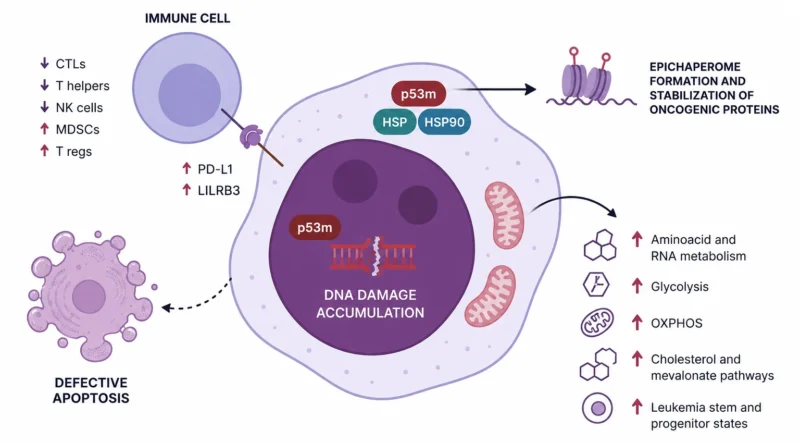
Emerging work suggests that TP53-mutated myeloid disease is accompanied by immune and stromal changes capable of supporting malignant clone persistence and immune escape. The issue becomes particularly important when considering why several biologically attractive targeted and immune therapies have underperformed in randomized trials.
mdpi.com
The Limits of Current Treatment
Azacitidine and decitabine remain central to the management of higher-risk MDS, including TP53-mutated disease. TP53-mutated clones are not universally incapable of responding to HMAs; meaningful hematologic and marrow responses occur, but they are often short-lived. The same has emerged from adding venetoclax. AZA-VEN produced a complete remission rate of 41.7%, yet the median duration of response was only 4.4 months.
In TP53-mutated MDS, overall response rate and complete remission remain useful endpoints, but they cannot carry the entire argument for a treatment. Duration of response, molecular clearance, transition to transplantation, relapse after transplantation, and ultimately survival become especially important.
Can Mutant p53 Be Targeted Directly?
Eprenetapopt (APR-246) was developed around an appealing strategy: restoring function to mutant p53. Its active metabolite, methylene quinuclidinone, binds mutant p53 and promotes a more wild-type-like conformation, potentially restoring p53-mediated apoptosis.
Phase II data supported the concept: eprenetapopt combined with azacitidine produced high response rates in TP53-mutated MDS and AML, including molecular responses in some patients. But the phase III randomized trial in TP53-mutated MDS did not meet its primary endpoint, complete remission was numerically higher with the combination than with azacitidine alone, but not significantly so. Development in this setting stalled.
Magrolimab and the Limits of Early Clinical Promise
A second major strategy approached TP53-mutated disease through the immune system. CD47 acts as an antiphagocytic signal that allows malignant cells to evade macrophages. Magrolimab blocks CD47. Combined with azacitidine, which can increase pro-phagocytic signals, the strategy had a strong rationale.
That optimism did not survive randomized testing. The phase III ENHANCE trial of magrolimab plus azacitidine in previously untreated higher-risk MDS was discontinued for futility, and subsequent development in myeloid malignancies encountered further setbacks.
These trials have changed how investigational therapy in higher-risk MDS should be interpreted. A 2026 analysis of failed phase III trials argued that biological classification deserves greater weight in trial design and specifically proposed that TP53-inactivated MDS should be studied in dedicated trials, or at minimum incorporated as a stratification factor. The same analysis questioned reliance on traditional response criteria.
Where Is TP53-Directed Therapy Going Next?
Failure to restore p53 successfully with one drug does not make TP53 therapeutically irrelevant. It has broadened the strategy.
One approach remains direct manipulation of mutant p53. Another is to target cellular dependencies created by TP53 loss. TP53-deficient cells must continue replicating despite genomic stress, making pathways involved in DNA-damage response, cell-cycle checkpoints, and survival potential targets. This creates opportunities for synthetic lethality.
The Role of Allogeneic Transplantation
A 2024 systematic review and meta-analysis of eight studies involving 540 patients with TP53-mutated MDS reported a pooled 3-year overall survival of only 21%. Relapse occurred in 58.9% of patients. These outcomes are poor by any conventional transplant benchmark, but they do not mean transplantation is futile. The same analysis concluded that allo-HCT still provides a survival advantage compared with non-transplant approaches.
Evidence from the BMT CTN 1102 study supports that distinction. In analyses of patients with TP53-mutated higher-risk MDS, 3-year overall survival was approximately 23% with transplantation compared with 11% with non-transplant therapy. The absolute probability of long-term survival therefore remains low, but without transplantation it appears lower still.
But which TP53-mutated patients have a realistic chance of benefiting from it? Several factors appear relevant:
- TP53 allelic state
- VAF
- cytogenetic complexity
- disease burden
- performance status
- response before transplantation
For an eligible patient who has achieved reasonable disease control, transplantation often remains the best available opportunity for durable survival even when molecular eradication cannot be demonstrated.
Eprenetapopt plus azacitidine has been explored as post-transplant maintenance, and other targeted or immune approaches may eventually occupy this space. At present, however, no maintenance strategy has definitively solved the high relapse rate.
Is TP53-Mutated MDS Curable in 2026?
Allo-HCT remains the only established treatment with curative potential. HMAs can induce responses. Venetoclax can deepen them. Eprenetapopt and magrolimab produced enough activity in early studies to advance into randomized development. Continued attempts now focus on targeting mutant p53 directly or exploiting the cellular dependencies created by TP53 loss.
Transplant strategies are increasingly moving away from treating TP53 mutation as a binary variable. And the period after transplant, when minimal residual disease can still expand into overt relapse, is emerging as its own therapeutic window, one that post-transplant strategies are only beginning to address.
The same logic extends to drug development: folding these patients into broader higher-risk MDS trials risks obscuring whether a therapy actually works for them.
TP53-mutated MDS is curable in some patients in 2026, but not through any reliably curative drug strategy. The gap between achieving remission and eliminating the disease remains the field’s central unsolved problem.

Myelodysplastic Neoplasms (MDS): From Ineffective Hematopoiesis to Sideroblastic Phenotype