In the late 1950s, thalidomide was marketed as a safe, gentle sedative, prescribed for pregnancy-related nausea. It turned out to be anything but. More than 10,000 children were born with severe congenital abnormalities before the drug was withdrawn from most markets in 1961. The regulatory consequences extended far beyond, strengthening requirements for evidence of safety and efficacy across the industry.
Yet the drug did not disappear from medicine entirely. Decades later, it became the first of a new therapeutic class in multiple myeloma (MM). Research into its mechanism revealed a principle now central to targeted protein degradation: a small molecule can redirect the cell’s protein-disposal machinery toward proteins it would not normally destroy. That idea developed backwards, the clinical effects came first, the explanation later.
The Thalidomide Disaster
Thalidomide entered the market in 1957 as a non-barbiturate sedative promoted as relatively safe. Its antiemetic effects led to widespread use for nausea and vomiting during pregnancy. Its reproductive toxicity was devastating. Exposure during a critical window of embryonic development could produce severe limb reduction defects along with abnormalities of the ears, eyes, and internal organs.
More than 10,000 children worldwide are estimated to have been born with thalidomide-associated abnormalities, not counting miscarriages and stillbirths, which add to the true toll. This exposed a basic weakness in drug development at the time: a medication could appear well tolerated in adults while exposing the embryo to profound toxicity.
Antiangiogenic effects, oxidative stress, and disruption of developmental signaling were among the mechanisms proposed, but a direct molecular target would not emerge until half a century after the drug’s withdrawal.
How Thalidomide Returned to Medicine
Thalidomide’s return did not begin with cancer. In the 1960s, Israeli physician Jacob Sheskin observed rapid improvement of erythema nodosum leprosum, a painful inflammatory complication of leprosy, after giving thalidomide to a patient. Subsequent work confirmed its anti-inflammatory and immunomodulatory activity, leading to its use for this indication under strict controls.
Its path toward MM came later, as investigators grew interested in the role of angiogenesis in cancer. Myeloma marrow was known to have increased microvascular density, and thalidomide had shown antiangiogenic activity in experimental models.
In 1999, Singhal and colleagues reported single-agent thalidomide activity in heavily pretreated patients with refractory MM, with responses in roughly one-third of the study population, the first new drug in decades to show substantial single-agent activity in the disease. The observations offered no unifying molecular explanation for why thalidomide and its derivatives worked so well in a plasma-cell malignancy.
The Rise of the Immunomodulatory Drug Class
Thalidomide itself had major limitations. Peripheral neuropathy, sedation, constipation, venous thromboembolism complicated treatment, and its teratogenicity required strict pregnancy-prevention measures.
Medicinal chemistry produced related compounds with improved antimyeloma activity and different toxicity profiles. Lenalidomide and later pomalidomide became major components of MM therapy. Collectively, thalidomide and its derivatives became known as immunomodulatory drugs, or IMiDs, a name that described what clinicians observed better than what the drugs were actually doing.
Cereblon Solved Part of a Decades-Old Mystery
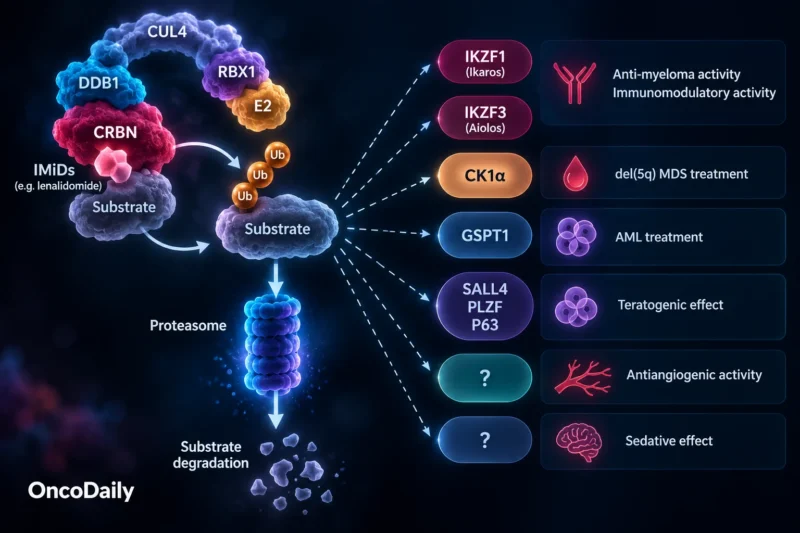
In 2010, Ito and colleagues identified cereblon (CRBN) as a direct molecular target of thalidomide. CRBN functions as the substrate receptor of the CRL4^CRBN E3 ubiquitin ligase complex, part of the cellular machinery that determines which proteins are tagged with ubiquitin and directed toward proteasomal degradation.
This gave thalidomide’s developmental toxicity a molecular anchor, and subsequent work has shown the relationship is more complex than CRBN alone: the consequences of exposure depend on which proteins are recruited to the drug-modified CRBN complex.
If CRBN was thalidomide’s direct target, could it explain why thalidomide-related drugs killed myeloma cells? Zhu and colleagues addressed this in 2011. Reducing CRBN expression made MM cells highly resistant to lenalidomide and pomalidomide while preserving sensitivity to unrelated agents – bortezomib, dexamethasone, and melphalan. CRBN was not an incidental binding partner, the antimyeloma activity of the drug class depended on it.
Ikaros and Aiolos Reveal the Mechanism
Landmark studies showed that lenalidomide promotes CRBN-dependent ubiquitination and degradation of the lymphoid transcription factors IKZF1 (Ikaros) and IKZF3 (Aiolos), proteins central to plasma-cell biology and MM-cell survival. Their loss suppresses the IRF4-MYC transcriptional program that supports myeloma-cell survival and explains the immunological effects associated with IMiDs.
Lenalidomide does not occupy an active site and block a protein from working: by binding CRBN, it changes which proteins the E3 ligase recognizes as substrates for destruction. IKZF1 and IKZF3 are central to the hematologic effects of IMiDs, developmental toxicity has been linked to other substrates, including SALL4.
Thalidomide Was a Molecular Glue Before We Knew the Term
This mechanism is now understood through the concept of a molecular glue, a small molecule that creates or stabilizes an interaction between proteins that would otherwise interact weakly or not at all. Thalidomide derivatives bind CRBN and alter its recognition surface, allowing new substrates, or neosubstrates, to be recruited, ubiquitinated, and destroyed by the proteasome.
Many conventional drugs depend on finding a functional pocket on a disease-driving protein and blocking it, a strategy that works well for many enzymes and kinases, but not for transcription factors and scaffolding proteins that lack suitable binding sites. A relevant protein does not always need to be inhibited if the cell can instead be induced to eliminate it.
From IMiDs to CELMoDs
Cereblon E3 ligase modulators (CELMoDs), including iberdomide and mezigdomide, retain the basic principle established by IMiDs but were designed for more potent and efficient degradation of Ikaros and Aiolos. It’s very relevant as lenalidomide and pomalidomide are used earlier, for longer, with resistance becoming more common.
In August 2026, iberdomide brought this approach into approved MM therapy when the FDA granted accelerated approval to Zenbexus in combination with daratumumab, hyaluronidase-fihj, and dexamethasone for adults with MM after at least one prior line of therapy.
In the primary efficacy population, minimal residual disease-negative CR at any time was achieved in 41% of patients on iberdomide versus 21% on the comparator. The connection back to 1957 is hard to miss: iberdomide carries a boxed warning for embryo-fetal toxicity and serious venous and arterial thromboembolism.
Mezigdomide, another oral cereblon modulator, has shown phase III activity in relapsed or refractory MM. In SUCCESSOR-2, mezigdomide with carfilzomib and dexamethasone produced a median progression-free survival of 18.0 months versus 8.3 months with carfilzomib and dexamethasone alone.Mezigdomide is still investigational, but its New Drug Application is now under FDA review.
The Expansion into Programmable Protein Degradation
PROTACs use a different design: one end binds the target protein, the other recruits an E3 ligase, and a linker connects them. This brings the target into the ubiquitin-proteasome system for degradation.
CRBN became one of the most widely used E3 ligases for this approach. In 2015, dBET1 used a thalidomide-derived CRBN recruiter to degrade BET proteins such as BRD4, an epigenetic regulator implicated in hematologic malignancies and several solid tumors.
A decade later, this strategy reached clinical practice. In May 2026, vepdegestrant became the first FDA-approved PROTAC, for ESR1-mutated, ER-positive/HER2-negative advanced or metastatic breast cancer.
Targeted degradation has become attractive for proteins historically labeled “undruggable,” but it depends on suitable molecular recognition, productive geometry between target and ligase, cellular exposure, E3 ligase availability, and adequate selectivity.
PROTACs add their own complications, since two binding components plus a linker make them bulkier, which can complicate membrane permeability, oral exposure, and pharmacokinetics.
Can Molecular Glues Be Designed Deliberately?
Designing a molecular glue against a predetermined target from scratch is much harder than it sounds. Small chemical changes can shift which neosubstrates fit the drug-modified ligase surface, altering both therapeutic activity and toxicity.
Structural studies of CRBN molecular glues have turned up recurring recognition features, including glycine-containing motifs, suggesting a much broader neosubstrate space than is currently exploited therapeutically. Computational algorithms have flagged thousands of human proteins with potentially compatible motifs, though structural compatibility alone guarantees nothing about selective degradation or clinical activity.
Structural biology can show how these drug-induced interfaces form, proteomics can identify which proteins disappear after exposure to a candidate compound, and computational screening is increasingly used to search for molecules that produce useful ligase-target pairings.
The Unexpected Legacy of Thalidomide
Thalidomide’s later therapeutic value does not diminish the consequences of its teratogenicity. Its scientific legacy is complicated. When thalidomide entered medicine, its molecular target was unknown. In MM, decades of research turned it from an empirically used drug into the starting point for an entire therapeutic lineage.
CRBN-binding chemistry then became a building block for PROTACs directed at unrelated targets, and CELMoDs extended this lineage, most recently with the 2026 approval of iberdomide. What began with thalidomide largely by accident, drug development is now trying to get to on purpose.
From Poison to Pill: The History and Future of Arsenic Therapy in Leukemia
FAQ
Is thalidomide still used to treat multiple myeloma today?
Yes, although its role has declined substantially as newer immunomodulatory drugs such as lenalidomide and pomalidomide became available. Thalidomide remains historically important because it established a therapeutic class that became central to MM treatment.
Why was thalidomide dangerous in pregnancy but useful against cancer?
These effects share CRBN as important molecular machinery but involve different downstream proteins. In MM, degradation of Ikaros and Aiolos contributes to antimyeloma activity, whereas developmental toxicity has been linked to other CRBN-dependent substrates, including SALL4.
Are lenalidomide and pomalidomide chemically related to thalidomide?
Yes. They are thalidomide derivatives developed through medicinal chemistry to improve antimyeloma activity and alter the toxicity profile. Together, these drugs became known as immunomodulatory drugs, or IMiDs.
Why does resistance to lenalidomide develop?
Resistance can arise through changes affecting the CRBN-dependent degradation pathway and other mechanisms that allow MM cells to survive despite treatment. This is increasingly relevant because lenalidomide and pomalidomide are now used earlier and for longer periods during the course of MM.
Can CELMoDs work after previous IMiD treatment?
Potentially. CELMoDs were developed for more potent and efficient CRBN-dependent degradation of key substrates such as Ikaros and Aiolos. Iberdomide has now entered approved MM therapy, and mezigdomide is being investigated in relapsed or refractory disease.
What is the difference between a molecular glue and a PROTAC?
Both redirect cellular protein-degradation machinery, but their designs differ. Molecular glues are small molecules that create or stabilize an interaction between proteins, whereas PROTACs contain separate target-binding and E3-ligase-binding components connected by a linker.
Could molecular glues eventually target thousands of different proteins?
Possibly, but the number of proteins with structurally compatible motifs should not be confused with the number of viable drug targets. Computational analyses suggest a potentially large neosubstrate space, but successful degradation also requires the right molecular geometry, cellular context, selectivity, exposure, and biological relevance.