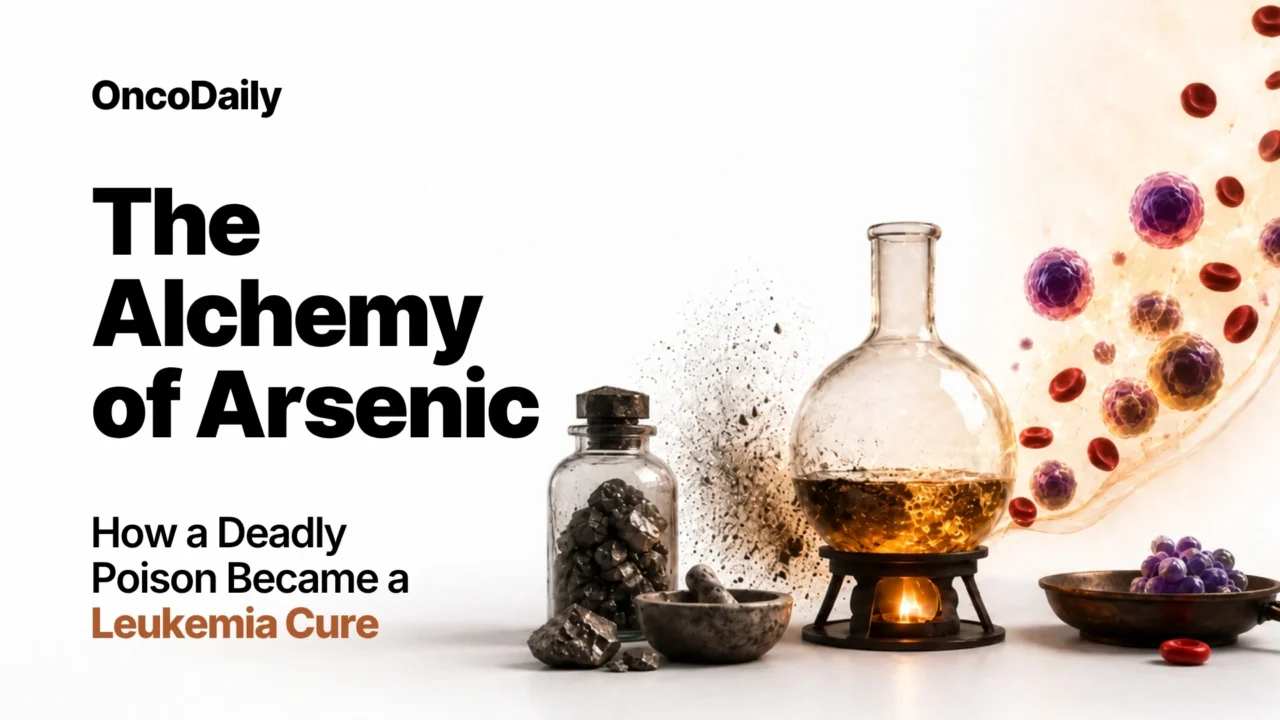
For centuries, arsenic was associated more with poisoners than with pharmacies, the substance of choice for anyone who needed a death to look natural. That it is now central to one of hem-oncology’s most effective treatments. Intravenous arsenic trioxide helped turn acute promyelocytic leukemia from a disease that could kill within weeks into one of the most curable leukemias there is, often without a single dose of conventional chemotherapy.
The next step may be arsenic in pill form, and this isn’t hypothetical. Oral arsenic already has years of real-world use in China and Hong Kong and is now entering formal international development.
Long ago, Arsenic Was the “Inheritance Powder”
White arsenic, arsenic trioxide, earned its reputation. It was cheap, sold openly, nearly tasteless, and disappeared without a trace into food or wine. To a physician working before modern toxicology, arsenic poisoning looked like a brutal stomach illness: vomiting, cramping, diarrhea, and then, often, death.
Seventeenth-century France even gave it a nickname, poudre de succession, “inheritance powder,” for how conveniently it moved estates from one generation to the next. Crime writers would later run with the image, but the real history needed no embellishment: arsenic turned up in medicines, pesticides, wallpaper dye, and household goods causing accidental poisonings as often as deliberate ones.
Arsenic left no obvious trace until 1836, when British chemist James Marsh worked out how to convert arsenic from a biological sample into arsine gas and precipitate it as a visible metallic mirror. The Marsh test turned arsenic poisoning into one of forensic toxicology’s first real victories.
That history is exactly why calling arsenic a cancer cure still sounds like a contradiction. The chemical hasn’t changed. What changed is the dose, the monitoring, and, decisive above all, a leukemia so molecularly specific that arsenic can take it apart with precision instead of blunt toxicity.
How Arsenic Entered Medicine
Medicinal use of arsenic goes back more than 2,000 years, appearing in traditional Chinese medicine and later in Western practice for everything from skin disease to infections.
In 1786, British physician Thomas Fowler introduced Fowler’s solution, a potassium arsenite preparation that became one of the most widely used medicines of the nineteenth century.
Its use in leukemia dates to 1865, when David Lissauer treated patients with what would now be recognized as chronic myeloid leukemia, reporting drops in white cell counts and spleen size along with improved anemia.
The responses didn’t last, and the treatment was never well standardized. Arsenic was gradually pushed aside by radiation and then by modern cytotoxic chemotherapy. Its narrow therapeutic margin and growing reputation as an environmental carcinogen sealed the retreat. By the mid-twentieth century, it looked like a relic of oncology’s past.
The Rediscovery of Arsenic Trioxide in China
In the 1970s, investigators at Harbin Medical University in northeastern China studied a preparation called Ailing-1, built from a traditional formula containing arsenic and mercury compounds. They worked out which component was doing the antileukemic work and identified arsenic trioxide as the active agent.
The responses were especially striking in acute promyelocytic leukemia. Over years of clinical refinement, the group stripped out the unnecessary components and showed that arsenic trioxide alone could produce remissions.
Chinese investigators went on to report high remission rates in both newly diagnosed and relapsed APL. Results published internationally in the 1990s confirmed the responses and supplied the pharmacokinetic data behind intravenous arsenic trioxide. Trials outside China reproduced the activity, and the FDA approved it for relapsed or refractory APL in September 2000. Arsenic was back in leukemia treatment, this time with a molecular explanation attached.
You can also read about
From Salvage Treatment to Frontline Cure
Intravenous arsenic trioxide started out as a salvage option for APL. That changed as trials moved it into first-line therapy alongside ATRA. The pivotal APL0406 trial compared ATRA plus arsenic trioxide against ATRA plus anthracycline-based chemotherapy in newly diagnosed, non-high-risk APL.
The arsenic regimen delivered excellent survival with less hematologic toxicity and fewer infections, though hepatic toxicity was more common. It established that many patients could be cured without conventional chemotherapy at all.
Arsenic-based strategies have since spread beyond that original low-risk group. High-risk APL still generally needs additional control of leukocytosis, anthracyclines or gemtuzumab ozogamicin, depending on the protocol, but arsenic and ATRA remain the biological backbone of treatment everywhere.
Why Arsenic Works So Well in APL
Arsenic trioxide’s success in APL isn’t a sign that it works broadly against cancer. Its activity hinges on APL’s molecular features.
Most cases involve the translocation t(15;17), which generates the PML::RARA fusion protein. This abnormal protein disrupts retinoic-acid signaling, stalls myeloid cells at the promyelocyte stage, and disorganizes normal PML nuclear bodies, producing both a pileup of abnormal promyelocytes and the severe coagulopathy that defines APL.
ATRA and arsenic trioxide go after different parts of that same fusion protein. ATRA binds the RARA piece and releases the transcriptional block, letting the leukemic cells differentiate. Arsenic binds the PML piece, pushing it through oxidation, multimerization, SUMOylation, ubiquitination, and eventual degradation.
At lower doses, arsenic promotes cell differentiation, at higher doses, it triggers apoptosis. What matters most is that sustained degradation of PML::RARA clears out the leukemia-initiating cells, which is why ATRA and arsenic together outperform either one alone.
Why It Has Not Become a Solid-Tumor Drug
Arsenic trioxide can trigger oxidative stress, mitochondrial damage, apoptosis, ferroptosis, and shifts in angiogenic signaling, enough to fuel a large body of preclinical work in breast, liver, lung, pancreatic, and brain cancers.
None of it has reproduced APL’s results in the clinic. Early solid-tumor trials generally found weak activity when arsenic trioxide was used alone: a phase II study in metastatic melanoma, for instance, found no objective tumor regressions at all.
Most solid tumors simply don’t carry PML::RARA, so they lack the precise vulnerability, and pushing arsenic’s broader cellular effects hard enough to matter tends to run into cardiac, hepatic, or neurologic toxicity first. Delivery systems and rational combinations are still being explored, but arsenic trioxide remains an APL drug.
The Problem With IV Formulation and What Oral Therapy Could Change
Intravenous arsenic trioxide requires frequent administration throughout induction and consolidation – dozens of infusions, repeated clinic visits, venous access, pharmacy preparation. For patients living far from a specialist center, this burden can limit access to the optimal regimen while disrupting work, education, and family life.
APL remains a medical emergency at diagnosis, with risk of early death from bleeding, thrombosis, differentiation syndrome, and treatment-related leukocytosis. The clearest practical benefit of oral arsenic may come during consolidation, once the patient is stable.
A standardized oral formulation could make this phase closer to home with specialist and regional teams sharing responsibility for molecular assessment, toxicity surveillance, and adherence – missed pills are easier to miss than missed infusions.
Oral Arsenic Is Already More Than a Theory
Several oral approaches have developed along largely independent tracks. The best-established is the Chinese Realgar-Indigo naturalis formula, or RIF. Its arsenic component is realgar (tetra-arsenic tetrasulfide), not arsenic trioxide, and the formulation also includes Indigo naturalis, Salvia miltiorrhiza, and Pseudostellaria heterophylla, components that lab work suggests may act in complementary ways.
Randomized studies in adults with non-high-risk APL found oral RIF-based therapy noninferior to intravenous arsenic. A more recent trial by Huang et al., reported identical five-year event-free survival, 97.6%, with oral RIF and IV arsenic trioxide, with children on RIF spending fewer days in hospital and getting fewer infections during consolidation, and no sign of long-term arsenic retention on follow-up.
Hong Kong investigators took a different route: a liquid oral formulation of arsenic trioxide itself, studied in relapsed disease, maintenance, and frontline regimens. Long-term experience there suggests it can control disease durably while keeping most treatment outpatient. It’s registered in Hong Kong but hasn’t reached comparable availability elsewhere.
QTX-2101 Enters Phase III
QTX-2101, formerly SY-2101, is an oral capsule formulation of arsenic trioxide in development for APL. A pharmacokinetic crossover study compared it directly against intravenous arsenic trioxide in APL patients already in complete remission.
The capsule produced drug exposure consistent with clinical equivalence, was generally well tolerated, and could be taken with or without food, with most side effects mild. That pharmacokinetic match matters: a product meant to replace IV arsenic has to deliver predictable systemic exposure.
The pivotal QUATRO-APL phase III trial is now testing QTX-2101 plus ATRA against IV arsenic trioxide plus ATRA in adults with newly diagnosed low-risk APL, evaluating efficacy, safety, and pharmacokinetics, and it began enrolling internationally in 2026. QTX-2101 has also picked up FDA Fast Track designation.
The Future of Arsenic Therapy
The open questions now are about equivalence, not basic biology: Can oral arsenic match IV therapy on molecular remission, relapse prevention, and long-term survival? Can it be used safely in induction? Does it hold up in high-risk disease with proper cytoreduction? And can manufacturing keep exposure consistent across different populations and health systems?
If the phase III data holds up, moving from IV to a capsule may not be as transformative as arsenic’s original rediscovery decades ago. For patients, though, it could matter just as much, the same cure, without the months spent in an infusion chair.
You can also read about

FAQ
Is arsenic trioxide the same arsenic that can cause poisoning?
Yes. Arsenic trioxide is a highly toxic inorganic arsenic compound, but toxicity depends strongly on dose, exposure, and context. In APL, it is given at carefully controlled therapeutic doses with monitoring of electrolytes, liver function, cardiac rhythm, and treatment-related complications. The drug’s effectiveness comes from a specific vulnerability in APL cells, not from indiscriminately poisoning cancer cells.
Why is acute promyelocytic leukemia so unusually sensitive to arsenic?
APL has a molecular target that arsenic can directly exploit. In most patients, the disease is driven by the PML::RARA fusion protein created by the t(15;17) translocation. Arsenic trioxide interacts with PML and ultimately promotes degradation of the fusion protein. Few cancers have such a direct relationship between a defining oncogenic protein and the activity of arsenic.
Could resistance to arsenic trioxide develop in APL?
Yes, although it is uncommon in the modern frontline setting. One particularly interesting mechanism involves mutations affecting the arsenic-binding region of PML, which can interfere with arsenic-induced degradation of PML::RARA. Studying these rare resistant cases may help explain why some patients relapse despite a treatment that is remarkably effective for most APL.
Does arsenic trioxide permanently remain in the body after APL treatment?
No. Arsenic is metabolized and progressively eliminated, predominantly through urine, although its metabolites can temporarily accumulate in tissues. Long-term safety is particularly important as APL patients now have excellent survival and may live for decades after treatment. Follow-up studies of modern arsenic-based regimens have therefore increasingly examined late toxicity as well as leukemia control.
Could oral arsenic allow patients with APL to receive treatment at home?
Potentially, especially during consolidation when patients are clinically stable. Oral treatment could substantially reduce infusion-center visits, but it would not make APL a completely home-managed disease. Patients would still require specialist supervision, molecular monitoring, laboratory testing, electrocardiographic assessment when indicated, and careful evaluation for toxicity and adherence.