At ASCO 2026, Roberto Mina, MD, presented results from MajesTEC-9 (NCT05572515), the first phase 3 study evaluating earlier use of teclistamab monotherapy in patients with RRMM after 1-3 prior lines of therapy.
Background and Rationale
Despite significant improvements in survival with triplet and quadruplet regimens, relapse remains inevitable in multiple myeloma, with subsequent remissions being shorter. Outcomes are poor for patients refractory to both lenalidomide and anti-CD38 antibodies, particularly in earlier relapse, where durable control is difficult to achieve.
Standard regimens such as pomalidomide-bortezomib-dexamethasone (PVd) and carfilzomib-dexamethasone (Kd) remain commonly used, yet PFS is often limited. T-cell-redirecting therapies, including bispecific antibodies, have emerged as promising additions to the treatment armamentarium.
Teclistamab, the first approved BCMA×CD3 BsAb, has demonstrated meaningful activity in heavily pretreated RRMM. In the phase 3 MajesTEC-3, teclistamab+daratumumab significantly improved outcomes as early as first relapse.
Methods
MajesTEC-9 enrolled patients with RRMM after 1-3 prior lines of therapy, including prior lenalidomide and anti-CD38 exposure, who were randomized 1:1 to receive teclistamab monotherapy or investigator’s choice of PVd/Kd. Patients assigned to teclistamab received step-up dosing followed by weekly administration, with subsequent response-adapted dosing every 2 or 4 weeks.
The comparator arm received standard PVd or Kd in 21- or 28-day cycles. The primary endpoint was progression-free survival (PFS) assessed by independent review committee, with secondary endpoints including overall survival (OS), ≥CR, and safety.
Baseline characteristics reflected a highly treatment-resistant population despite the early relapse setting:
- Median age: 70 years
- Median prior lines of therapy: 2
- Lenalidomide-refractory: 80%
- Anti-CD38-refractory: 85%
- Refractory to last line of therapy: 92%
Deep and Durable Responses
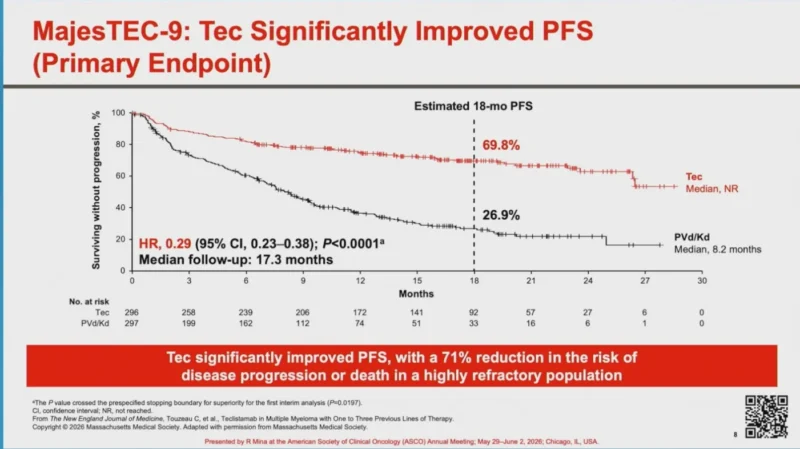
After a median follow-up of 17.3 months, Teclistamab significantly improved PFS and OS versus PVd/Kd.
Key efficacy findings included:
- 71% reduction in risk of progression or death (HR 0.29; 95% CI 0.23-0.38; P<0.0001)
- 18-month PFS rate: 69.8% vs 26.9%
- Median PFS: not reached vs 8.2 months with PVd/Kd
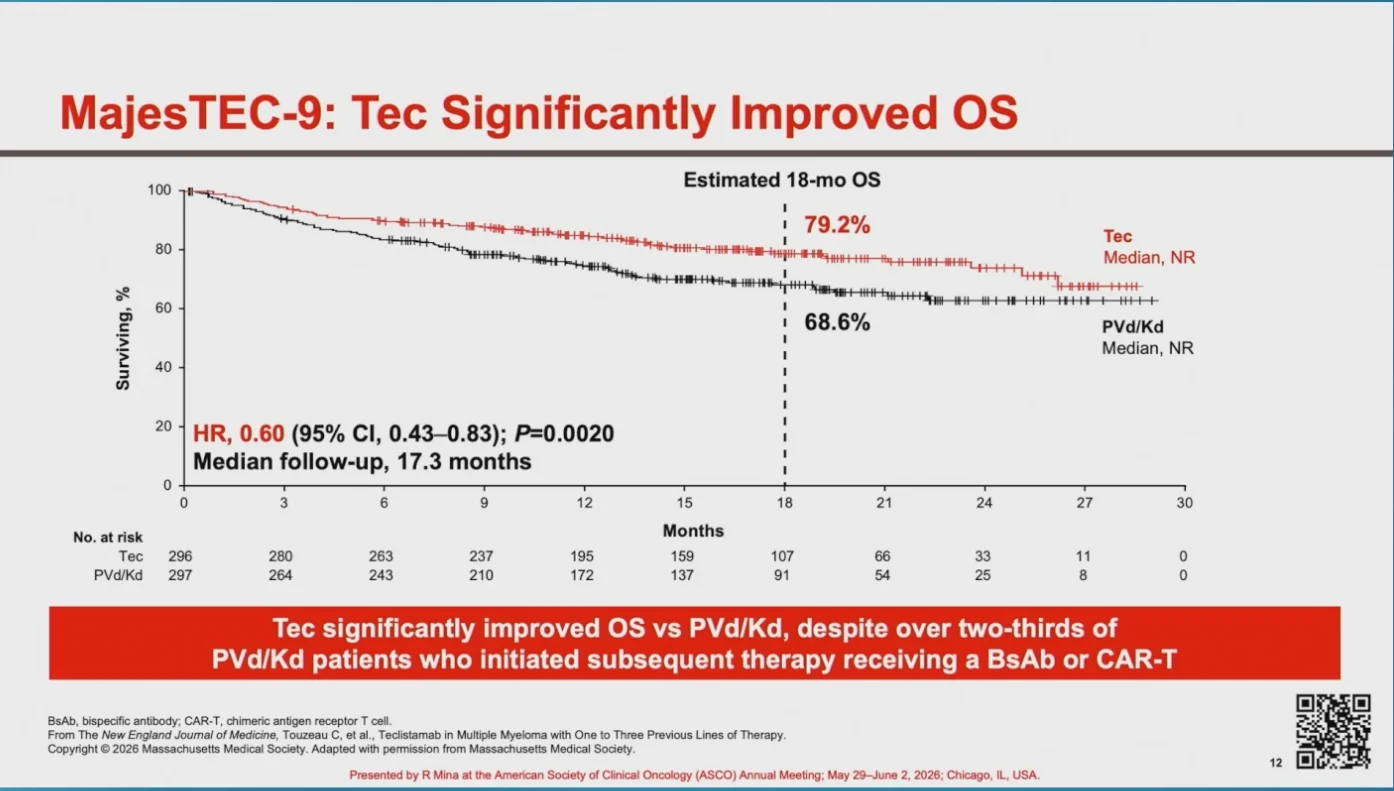
- 18-month OS rate of 79.2% versus 68.6%, respectively
- 40% reduction in risk of death
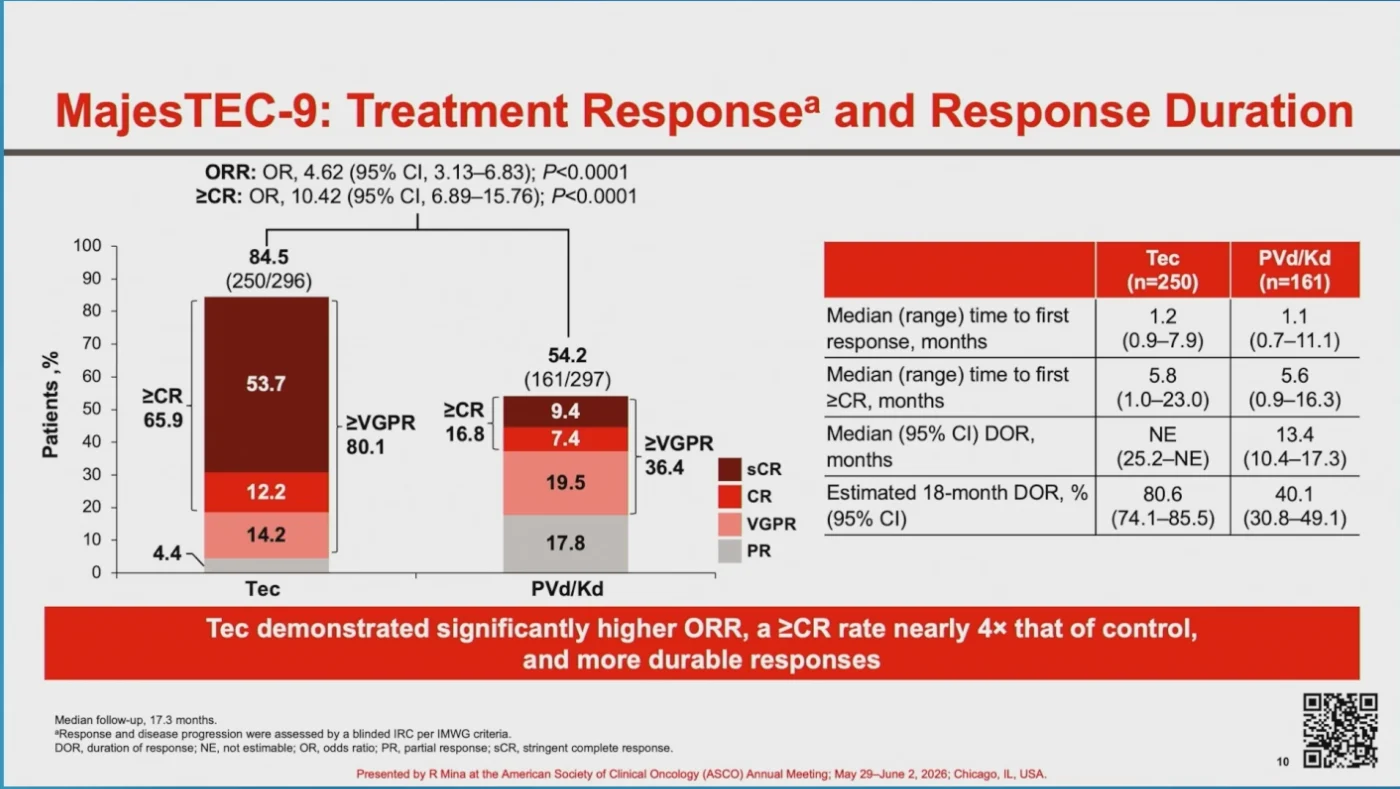
- ≥CR rate: 65.9% vs 16.8%
The PFS benefit was consistent across all prespecified subgroups. Notably, the OS advantage was observed despite subsequent BsAb or CAR-T therapy being administered in 68.4% of patients from the PVd/Kd arm who received later-line treatment. Treatment exposure was longer with teclistamab, with median treatment duration of 13.1 versus 7.0 months for PVd/Kd.
Safety Profile
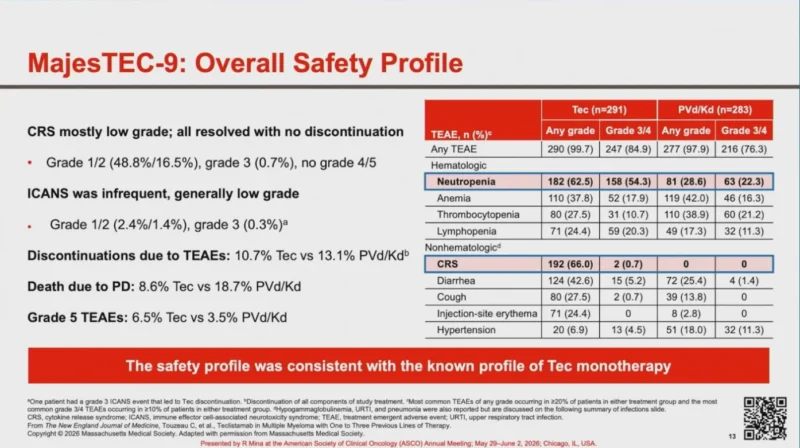
Treatment-emerged adverse events occurred in nearly all patients in both arms (99.7% vs 97.9%). Grade 3/4 AEs were more frequent with teclistamab (84.9% vs 76.3%).
- Grade 3/4 infections occurred in 41.6% of patients treated with teclistamab vs 29.0% in the standard therapy arm.
- Among hematologic toxicities, grade 3/4 neutropenia occurred in 54.3% and 22.3% of patients, respectively.
- CRS occurred in 66.0% of patients receiving teclistamab, though the majority were low grade.
- ICANS was uncommon, occurring in only 4.1% of patients, predominantly grade 1/2.
Importantly, treatment discontinuation due to TEAEs was lower with teclistamab than with PVd/Kd (10.7% vs 13.1%), suggesting that toxicity was generally manageable.
It was also noted that grade ≥3 infections declined after 6 months, consistent with improved disease control over time, and emphasized the importance of infection prophylaxis, monitoring and immunoglobulin replacement therapy.
Knowledge Generated
MajesTEC-9 demonstrated superiority of teclistamab monotherapy over PVd/Kd in earlier-line RRMM, showing significant improvements in PFS, OS, depth of response, and response durability in a highly refractory population.
Despite higher rates of hematologic toxicity, CRS, and infections, adverse events were largely manageable, with low rates of severe CRS or ICANS and relatively low treatment discontinuation rates.
The findings support teclistamab monotherapy as a potential new standard-of-care option in the 2L+ setting, including for patients with prior lenalidomide or anti-CD38 exposure.
You Can Watch More on OncoDaily TV.