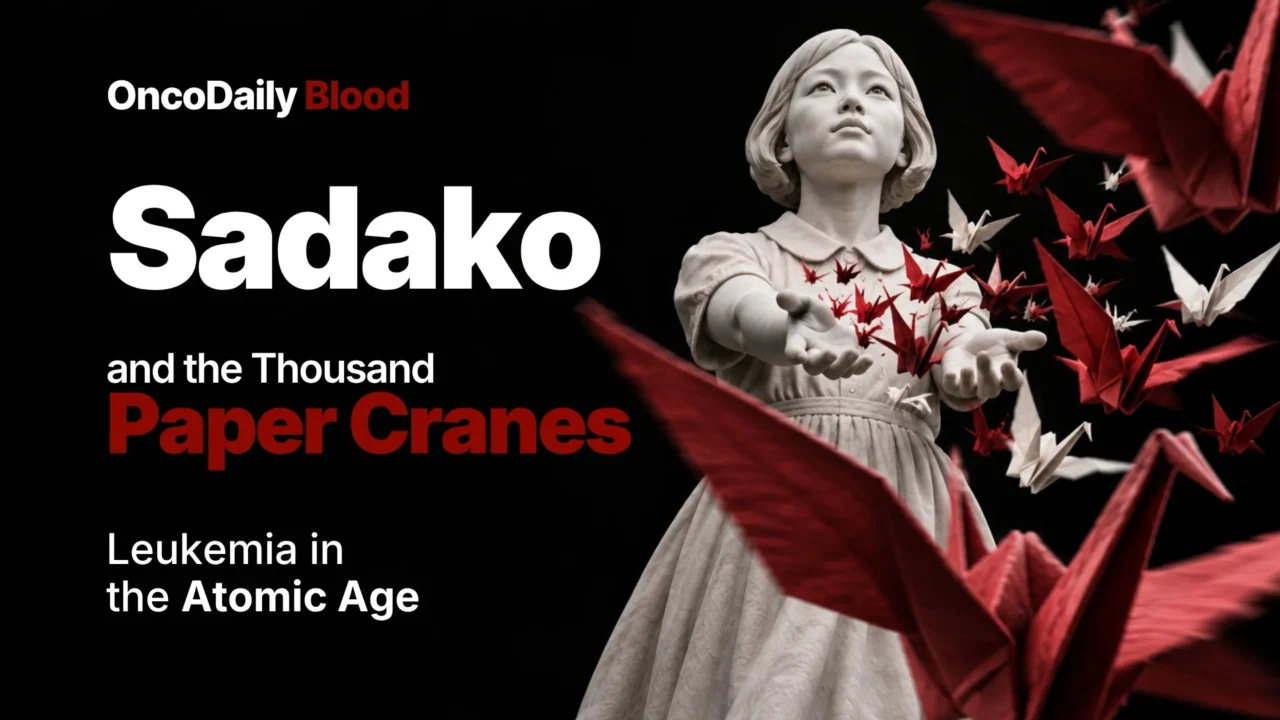
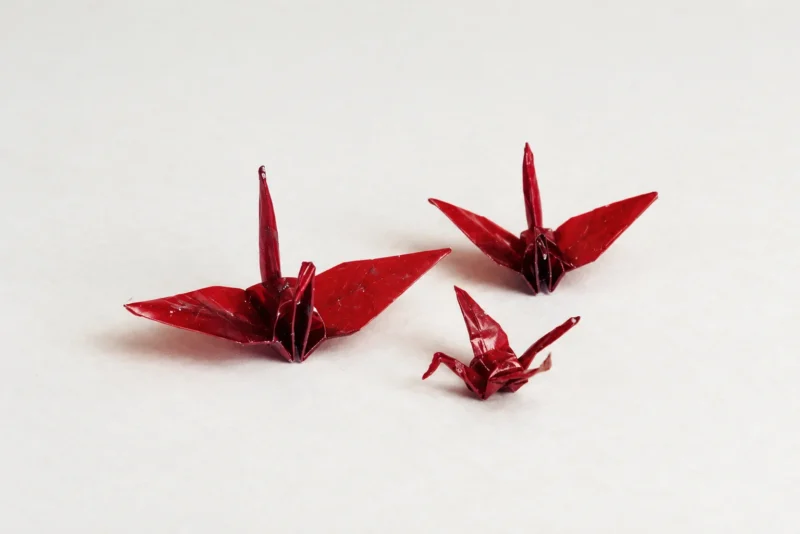
Sadako Sasaki was 12 years old when she folded a small paper crane from the wrapper of a methotrexate container while being treated for leukemia at Hiroshima Red Cross Hospital in 1955. The paper came from a medicine shipment donated from the United States. It is now part of the New York State Museum’s collection.
Sadako was two years old when the atomic bomb exploded about 1.6 kilometers from her home. Apparently uninjured, she grew into an active child, and leukemia appeared almost a decade later, as physicians were beginning to recognize an increase in the disease among survivors.
Her story became known through the tradition of folding a thousand paper cranes, but it also runs through three large threads in medicine: the identification of radiation-induced leukemia, the early development of chemotherapy for childhood leukemia, and the long-term epidemiologic research that continues to inform radiation protection.
Sadako’s Illness and The Thousand Paper Cranes
Sadako grew up during Hiroshima’s reconstruction. She was diagnosed with leukemia in early 1955, and it was described as lymphocytic leukemia, and some materials use the term subacute lymphocytic leukemia. Neither maps to a current subtype. Modern classification of acute lymphoblastic leukemia (ALL) depends on lineage markers and genetic findings that are absent from the public record.
Her care included medication and blood transfusions. The Hiroshima Peace Memorial Museum holds a sheet on which she copied her blood counts. The family had not named the disease, but Sadako understood it was a serious blood disorder.
In August that year, high school students sent a thousand paper cranes to patients at the hospital. Sadako learned of the Japanese tradition that folding a thousand cranes can make a wish come true and began folding her own. She used whatever paper was available, including medicine wrappers.
Family testimony indicates she completed more than 1,300 cranes, a number the New York State Museum documents. The illness progressed over the following months, and she died on October 25, about eight months after admission.
nippon.com
Leukemia Years After Radiation Exposure
It is typical for radiation-induced leukemia to appear years after exposure. Ionizing radiation damages DNA directly and through reactive chemical species. Misrepaired double-strand breaks are especially consequential, they can produce chromosomal rearrangements, deletions, and other genomic changes. In hematopoietic stem and progenitor cells, these changes can disrupt control of proliferation, differentiation, and survival.
Most irradiated cells do not become malignant. Some repair their DNA, and others undergo apoptosis or permanent growth arrest. Leukemia can develop when an altered cell survives, gains a selective advantage, and acquires additional alterations that allow a malignant clone to expand. Latency depends on the affected cell population, the initial damage, and how the clone evolves.
Children’s risk differs from adults’ because of tissue development, cellular proliferation, and the longer period in which malignancy can emerge. Among atomic bomb survivors, excess leukemia risk was highest in those exposed at younger ages. The Radiation Effects Research Foundation (RERF) reports that excess leukemia began appearing about two years after the bombings and peaked after six to eight years.
The Life Span Study: Establishing Radiation as a Cause of Leukemia
The Life Span Study assembled a cohort of survivors with different estimated exposures, based on their locations at the time of the bombings, shielding, and physical models of radiation. Researchers followed cancer incidence and mortality over subsequent decades and compared disease rates across dose categories. This study remains central to radiation protection standards and risk modeling.
A 2013 analysis in Radiation Research examined hematologic malignancies among 113,011 cohort members, with about 3.6 million person-years of follow-up from 1950 through 2001. Leukemia showed the strongest association with dose, and the pattern differed by subtype. Acute myeloid leukemia (AML) showed an upward-curving dose-response. ALL and chronic myeloid leukemia (CML) showed approximately linear relationships.
The timing also differed. In early follow-up, ALL and CML accounted for most of the estimated radiation-associated excess cases, about 75% during 1950-1955. Their excess declined sharply over the following decades, and by 1991-2001 AML accounted for about 78% of the estimated excess among these three subtypes. These are model-derived estimates within the cohort and not proportions of all leukemia cases in Japan.
The study found no statistically significant radiation-associated increase in Hodgkin lymphoma or multiple myeloma, and only a weak suggestion of increased non-Hodgkin lymphoma risk among men. Hematologic malignancies don’t share a single radiation sensitivity or dose-response relationship.
Leukemia Risk vs Solid Cancer Risk
Hematopoietic cells can acquire and expand oncogenic alterations relatively quickly, and many epithelial cancers need longer periods of tissue evolution and additional carcinogenic events. These are broad patterns.The early peak did not end the risk: later analyses continued to find residual excess, particularly for AML. Because leukemia is less common, a large proportional increase in incidence can still mean fewer additional cases than the excess burden of solid cancers.
A Methotrexate Wrapper and the Beginnings of Leukemia Chemotherapy
In 1948, Sidney Farber and colleagues reported temporary remissions in children with acute leukemia treated with aminopterin, a folic acid antagonist, in the New England Journal of Medicine. Ten of the 16 children treated achieved temporary remission. The responses showed that drug treatment could suppress leukemic proliferation and allow recovery of normal hematopoiesis, but suppression did not necessarily eliminate every cell capable of sustaining the disease. Relapse remained common, and toxicity could be severe.
Methotrexate emerged from the same class of antifolate agents. By inhibiting dihydrofolate reductase, it blocks the regeneration of reduced folates needed for nucleotide synthesis and DNA replication, and it later became a component of multiagent treatment for ALL.
Effective combination regimens, central nervous system-directed therapy, and risk-adapted treatment developed over the following decades. Long-term survival in childhood ALL now exceeds 85-90% in many well-resourced settings, with variation by disease biology and access to treatment.
By 1955, several antileukemic drugs were in clinical use, but chemotherapy still couldn’t produce durable remission in most children. The sources confirm that Sadako received medications and transfusions, but they don’t establish the precise drugs, doses, or schedules she received at the hospital.
The Children’s Peace Monument
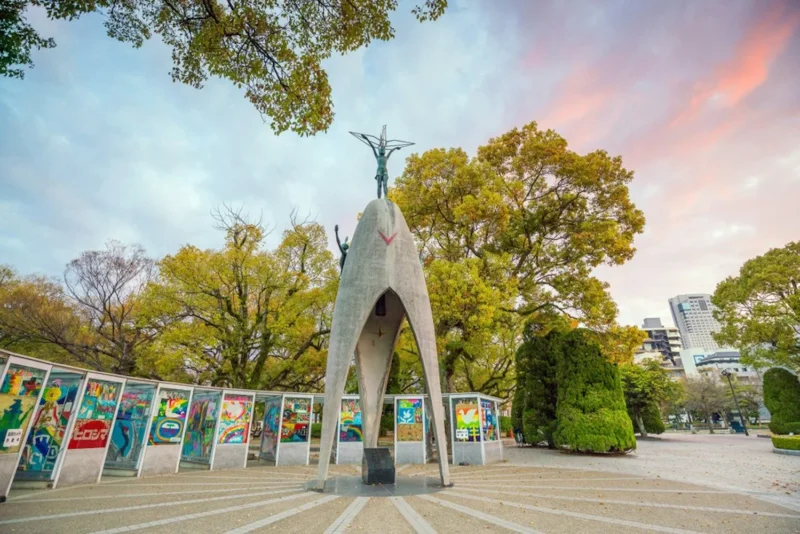
Within weeks of Sadako’s death, her classmates began a campaign for a monument to children who died because of the atomic bombing. It gained support from more than three thousand schools in Japan and nine other countries. The Children’s Peace Monument was unveiled in Hiroshima Peace Memorial Park, showing a bronze girl holding a golden paper crane above her head.
Eleanor Coerr’s novel, Sadako and the Thousand Paper Cranes, later introduced generations of readers to the story through a fictionalized account. The preserved objects support the documented history, and the novel shaped how the story is understood internationally.
triptojapan.com
The Surviving Cranes
Several of Sadako’s cranes survive in museum collections. The methotrexate-wrapper crane followed a different route. Her family donated it to families affected by the September 11 attacks in New York, where it was displayed at the 9/11 Tribute Museum. Later it was transferred to the New York State Museum. The Children’s Peace Monument continues to receive about ten million paper cranes a year from schools, organizations, and individuals around the world.
FAQ
Did Sadako Sasaki really fold 1,000 paper cranes?
Yes, and historical accounts indicate that she folded even more. According to family testimony, Sadako completed more than 1,300 cranes during her hospitalization. The familiar story that she died after folding only 644 cranes was popularized by Eleanor Coerr’s fictionalized book, Sadako and the Thousand Paper Cranes.
What type of leukemia did Sadako Sasaki have?
Historical records describe her illness as lymphocytic leukemia, sometimes using the term subacute lymphocytic leukemia. These descriptions cannot reliably be translated into a modern leukemia subtype. Today, diagnosing acute lymphoblastic leukemia requires immunophenotypic and genetic testing that was unavailable during Sadako’s lifetime.
Can a single exposure to radiation cause leukemia decades later?
Yes. A single sufficiently high exposure to ionizing radiation can increase leukemia risk long after the event. The risk depends on absorbed dose, age at exposure, and other factors. Long-term studies of atomic bomb survivors have documented radiation-associated leukemia over several decades, although the excess risk generally decreases with time.
Why are children more vulnerable to radiation-induced leukemia?
Children generally have greater lifetime radiation-related cancer risks because developing tissues contain actively dividing cells and there is more time for radiation-associated malignancies to emerge. Studies of atomic bomb survivors found particularly high excess leukemia risks among people exposed at younger ages. The magnitude of risk also depends on radiation dose and leukemia subtype.
Does radiation increase the risk of every blood cancer equally?
No. Radiation sensitivity differs across hematologic malignancies. Research involving atomic bomb survivors found significant dose-related increases in acute myeloid leukemia, acute lymphoblastic leukemia, and chronic myeloid leukemia, but their dose-response patterns and latency periods differed. Associations with lymphoma and multiple myeloma were less consistent in the same cohort.
Where can visitors see Sadako Sasaki’s original paper cranes today?
Several surviving cranes are preserved in museum collections. The Hiroshima Peace Memorial Museum holds objects associated with Sadako, while the New York State Museum preserves a crane folded from a methotrexate-container wrapper. Another crane donated by her family is associated with the Harry S. Truman Presidential Library. Visitors should check current exhibition information because preserved artifacts are not necessarily on permanent public display.