
Central nervous system (CNS) relapse is one of the most feared complications of large B-cell lymphoma (LBCL). Although relatively uncommon, occurring in 2-6% of patients, it is associated with a median survival measured in months. Considerable effort has been devoted to identifying patients at high risk and developing strategies for prevention.
Over the past two decades, intravenous high-dose methotrexate (HD-MTX) has been widely used for CNS prophylaxis. This approach is supported by methotrexate’s ability to cross the blood-brain barrier and its established role in CNS lymphoma treatment. Yet, evidence supporting this practice has been limited to retrospective studies, and its effectiveness remains controversial.
Particularly uncertain has been its role in patients classified as ultra high risk for CNS relapse. To address this question, investigators performed the largest international analysis to date examining the impact of HD-MTX prophylaxis in patients with UHR LBCL, published in the Journal of Clinical Oncology.
Study Design
The combined retrospective dataset included patients from 70 international centers treated with or without HD-MTX prophylaxis.
The primary objective was to determine whether HD-MTX reduces the risk of CNS relapse among patients with ultra high-risk features, which were defined by the presence of at least one of the following characteristics:
- CNS-IPI score of 5-6
- ≥3 extranodal disease sites
- Testicular involvement
- Renal or adrenal involvement
- Breast involvement
Patients with known CNS disease at diagnosis were excluded.
Methods
The analysis included 3,491 patients with LBCL treated with R-CHOP or R-CHOP-like immunochemotherapy regimens.
Among them, 1,923 patients met criteria for ultra high-risk disease and formed the primary study population:
- 1,051 patients received HD-MTX prophylaxis
- 872 patients did not receive HD-MTX
To reduce bias inherent to retrospective studies, investigators performed multiple statistical adjustments, including multivariable analyses, a 6-month landmark analysis among responding patients without progression at 6 months, and propensity score matching.
The primary endpoint was CNS relapse, including both isolated CNS relapse and CNS relapse occurring simultaneously with systemic disease recurrence. Secondary endpoints included event-free survival and overall survival.
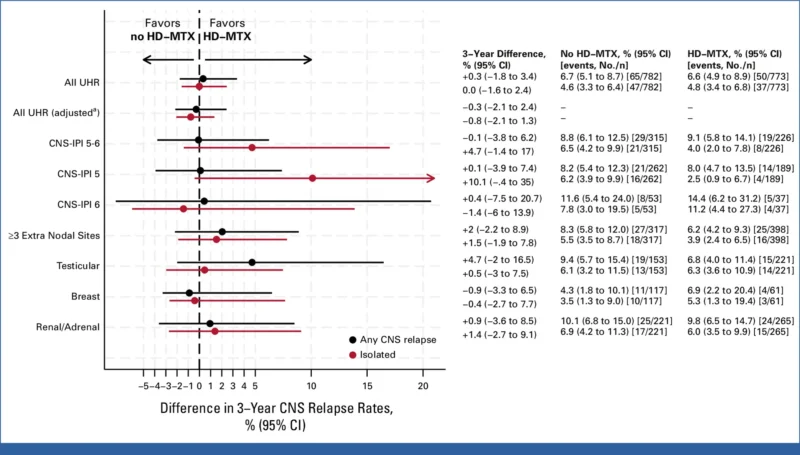
No Reduction in CNS Relapse With HD-MTX
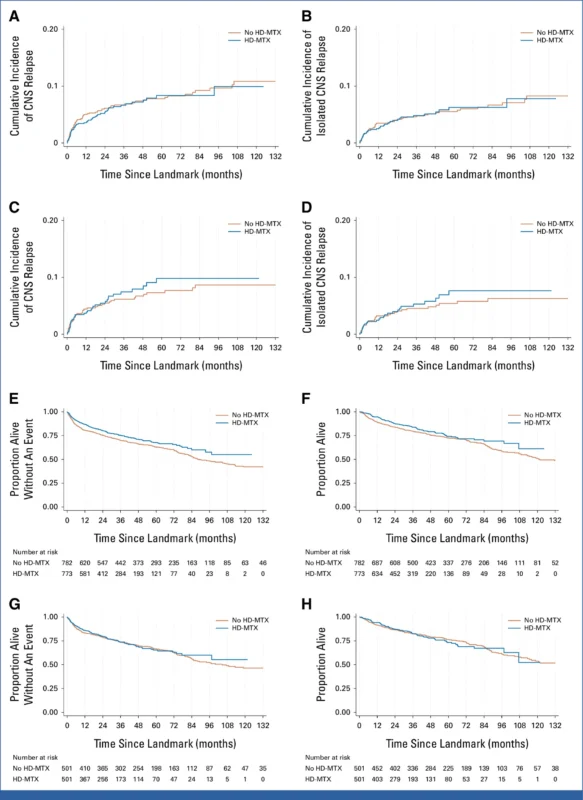
The central finding of the study was striking: HD-MTX prophylaxis did not significantly reduce the risk of CNS relapse. At three years:
- CNS relapse occurred in 9.3% of patients who did not receive HD-MTX
- CNS relapse occurred in 8.1% of patients who received HD-MTX
After adjustment for baseline differences, no statistically significant benefit was observed. The adjusted hazard ratio for CNS relapse was 1.13.
Isolated CNS Relapse Was Also Unaffected
Because prophylaxis is intended specifically to prevent isolated CNS disease, investigators separately analyzed isolated CNS relapses.
Again, no benefit was observed. Three-year isolated CNS relapse rates were:
- 5.9% without HD-MTX
- 5.7% with HD-MTX
The adjusted hazard ratio was 1.03, demonstrating essentially identical outcomes.
Findings Were Consistent Across Ultra High-Risk Subgroups
Investigators evaluated whether certain ultra high-risk populations might derive benefit from prophylaxis, and no statistically significant reduction in CNS relapse was identified.
Although a numerical trend favoring HD-MTX was observed in some analyses of testicular lymphoma, this finding was inconsistent and disappeared after propensity matching.
Higher Doses Did Not Improve Outcomes
Most patients receiving prophylaxis received a cumulative methotrexate dose of at least 6 g/m². Investigators assessed whether greater exposure to HD-MTX resulted in improved protection against CNS relapse.
No relationship was observed between the number of HD-MTX cycles, cumulative methotrexate dose and CNS relapse risk.
Survival Outcomes
Initial analyses suggested worse event-free survival and overall survival among patients who did not receive HD-MTX, but these differences disappeared after adjustment for baseline characteristics and propensity matching.
Among matched patients HD-MTX prophylaxis did not improve long-term survival outcomes, as event-free and overall survival were similar between groups.
Outcomes After CNS Relapse Remain Poor
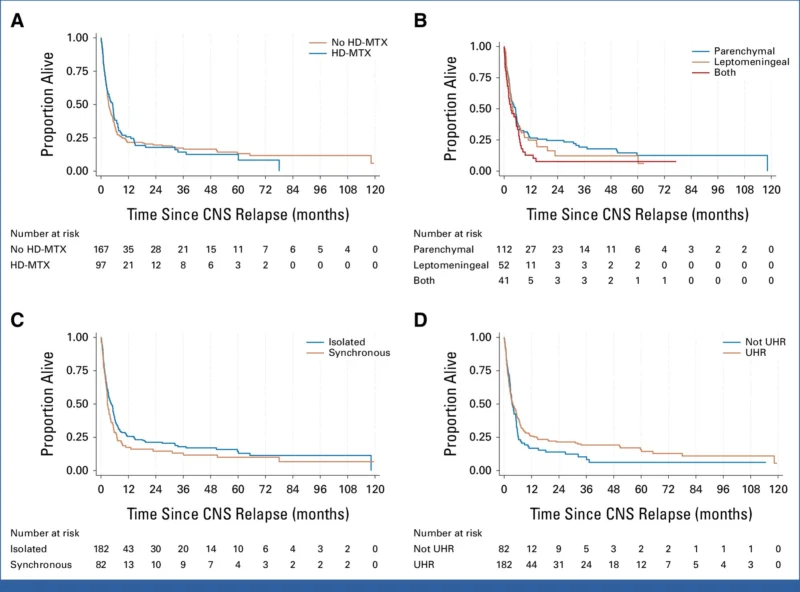
The study also evaluated outcomes following CNS relapse. Among 264 patients who developed CNS relapse:
- 221 deaths occurred
- Median OS was only 3.8 months
Importantly, survival after CNS relapse was not influenced by prior HD-MTX prophylaxis.
These findings point to the continued severity of CNS recurrence and the urgent need for more effective preventive strategies.
Addressing Uncertainty
The findings are particularly important because previous studies left uncertainty regarding the highest-risk patients. While earlier retrospective analyses questioned the value of HD-MTX overall, limited numbers of treated ultra high-risk patients prevented definitive conclusions. By specifically examining this population, the current study substantially narrows that uncertainty.
Practice Implications
The largest international analysis in this setting provides practice-informing evidence that HD-MTX prophylaxis does not meaningfully reduce CNS relapse risk, even among patients with ultra high-risk LBCL.
The absence of benefit was consistent across multiple statistical approaches, individual risk groups, and analyses of isolated CNS relapse.
These findings challenge a long-standing practice in lymphoma management. Given the toxicity, logistical burden, and healthcare resources associated with HD-MTX administration, its routine use should be carefully reconsidered in the absence of proven benefit.
Looking Ahead
Future research should focus on more effective strategies for CNS relapse prevention, including improved biologic risk stratification, sensitive CNS detection methods such as cerebrospinal fluid circulating tumor DNA analysis, and the integration of novel therapies including bispecific antibodies and CAR T-cell approaches into frontline treatment.

You can also read: Diffuse Large B-Cell Lymphoma (DLBCL): Molecular Heterogeneity and Progress in Therapy