For a rare cancer, hairy cell leukemia (HCL) has an unusually good track record. A short course of a purine analogue can put most patients into complete remission for years, and life expectancy now approaches that of the general population. Yet “cured” still isn’t the right word. Residual leukemic cells can persist after treatment looks complete, and relapse can occur years or even decades later.
For a long time, HCL was identified mainly by morphology, and the immunophenotype, rather than by cause. The discovery of BRAF V600E changed that, giving the disease a consistent, targetable molecular driver.
So the focus now isn’t how to get patients into remission, that part works. It’s how to make remission last, and understanding that starts with the nature of HCL itself.
How Does Hairy Cell Leukemia Present?
HCL is a mature B-cell neoplasm involving predominantly the bone marrow, spleen, and peripheral blood, named for the fine cytoplasmic projections of its circulating leukemic cells.
Its tissue distribution helps explain the clinical presentation. Leukemic cells accumulate extensively within the bone marrow and splenic red pulp, often resulting in splenomegaly, while prominent lymphadenopathy, common in many other mature B-cell malignancies, is relatively unusual. Marrow infiltration, changes in the marrow microenvironment, and splenic sequestration contribute to the cytopenias that frequently bring patients to medical attention.
Anemia, thrombocytopenia, and neutropenia may occur, while monocytopenia is particularly characteristic of classic HCL and can provide an early diagnostic clue. Cytopenias and impaired immune function also contribute to infection remaining an important source of morbidity.
HCL is therefore biologically indolent but not necessarily clinically inconsequential. Patients may present with profound cytopenias or serious infection. Others are identified incidentally and remain asymptomatic for prolonged periods. HCL occurs predominantly in older adults and has a marked male predominance.
BRAF V600E: The Mutation That Changed How We Understand HCL
BRAF V600E doesn’t just associate with classic HCL, it’s the central molecular lesion. The mutation is detectable in more than 90% of cases and is maintained across different disease sites and phases. Its consistency has made it both a diagnostic marker and a therapeutic target.
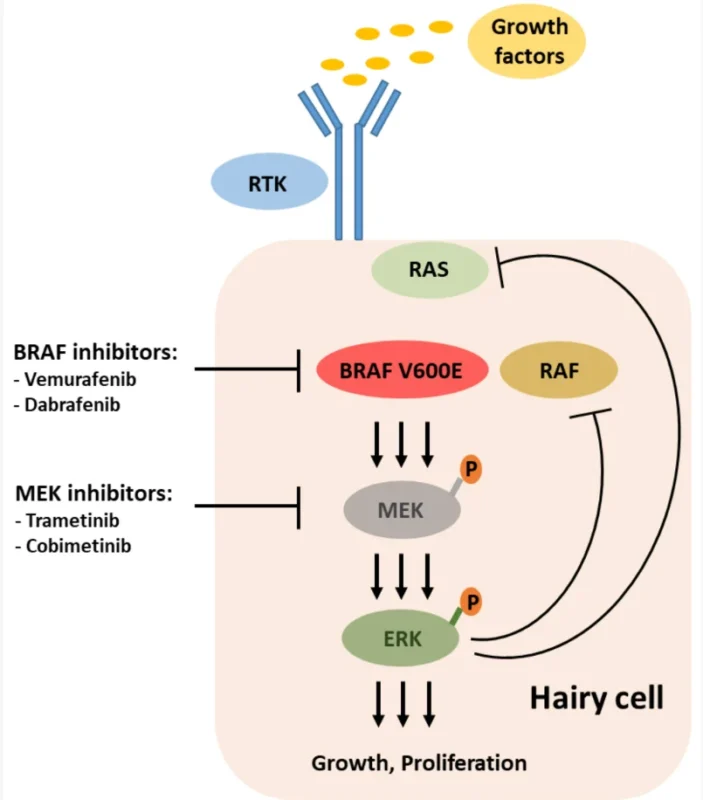
BRAF is a serine/threonine kinase. The V600E substitution produces constitutive BRAF kinase activity, allowing downstream MAPK signaling to remain active without normal upstream stimulation. In HCL, this persistent signaling supports the survival and characteristic transcriptional program of the malignant B-cell clone.
The relationship extends beyond cell survival. Experimental inhibition of BRAF or downstream MEK signaling alters the characteristic molecular phenotype and morphology of HCL cells. The classic “hairy” appearance and the molecular identity of HCL are therefore not separate stories.
BRAF V600E is not, however, a complete explanation for leukemogenesis. Additional molecular, epigenetic, and microenvironmental events appear necessary for the full HCL phenotype to emerge.
mdpi.com
How Is Hairy Cell Leukemia Diagnosed?
HCL diagnosis rests on the concordance of blood counts, morphology, immunophenotype, bone marrow findings, and molecular testing.
The first clue is often an abnormal complete blood count, with monocytopenia being particularly suggestive of classic HCL. Marked lymphocytosis is not required, and circulating leukemic cells may be scarce. When present, the characteristic cells have relatively abundant pale cytoplasm with fine circumferential projections, the morphology that gave HCL its name.
Flow cytometry narrows the diagnosis. Classic HCL expresses mature B-cell markers, together with the characteristic combination of CD11c, CD25, CD103, and CD123. Bone marrow examination remains important, particularly when circulating leukemic cells are scarce. Increased reticulin fibrosis may make aspiration difficult and produce the classic “dry tap,” while biopsy demonstrates the leukemic infiltrate and permits confirmatory immunohistochemistry.
BRAF V600E testing is now incorporated into the evaluation of suspected HCL. A negative result does not absolutely exclude classic HCL: rare cases harbor alternative alterations affecting MAPK signaling. In an atypical morphologic or immunophenotypic setting, however, BRAF negativity should raise the possibility of another splenic B-cell neoplasm.
This distinction is relevant to the entity termed hairy cell leukemia variant (HCLv). Despite its name and partial morphologic resemblance to classic HCL, HCLv is biologically distinct, and responds less reliably to conventional HCL therapy. Correct classification therefore has therapeutic consequences.
When Does Hairy Cell Leukemia Actually Need Treatment?
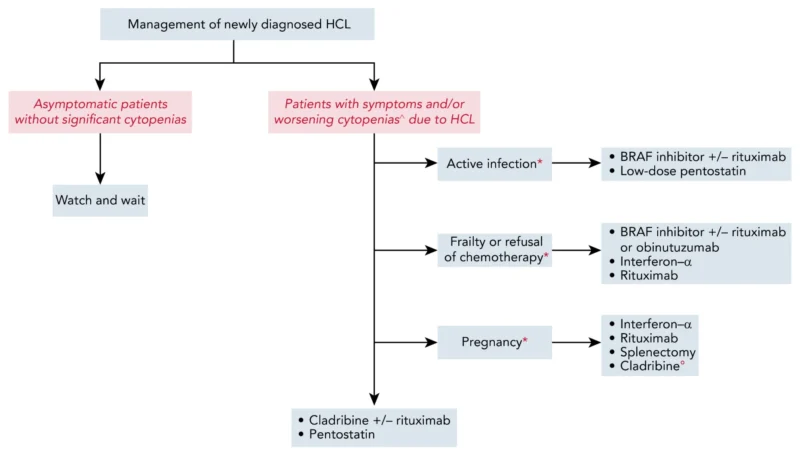
A diagnosis of HCL does not automatically require treatment. Patients with preserved blood counts and no clinically significant symptoms can be observed, because early treatment has not been shown to improve outcomes. Therapy is generally initiated when patients are symptomatic because of splenomegaly or constitutional symptoms, or have significant and worsening cytopenia:
- hemoglobin <10 g/dL
- neutrophil count <1 × 10⁹/L
- platelet count <100 × 109/L
This distinction matters because HCL can persist for years without requiring intervention. The aim is not to treat the presence of leukemic cells, but the disease when it begins to compromise normal hematopoiesis, immune function, or quality of life.
The Enduring Standard of Cladribine
Purine analogues cladribine and pentostatin produce complete responses in most previously untreated patients, often after a single treatment course, and those remissions can persist for many years. For a rare leukemia once associated with repeated splenectomy and limited systemic options, this represented an extraordinary therapeutic advance.
Cladribine remains central to first-line therapy precisely because that durability sets a high bar for anything intended to replace it. But its effectiveness comes with a cost. Purine analogues are myelosuppressive and profoundly lymphotoxic, which can complicate treatment in patients with active infection. In this setting, favorable outcomes have been reported with low-dose pentostatin. Because purine analogues are renally excreted, dose adjustment or alternative therapy may be needed in patients with renal impairment.
There is another limitation: complete remission does not necessarily mean eradication of the leukemic clone. Sensitive testing frequently detects MRD after cladribine. One strategy is to add the anti-CD20 antibody rituximab. In a randomized phase II study of previously untreated HCL, concurrent cladribine and rituximab produced an MRD-free complete response at six months in 97% of patients, compared with 24% after cladribine alone.
sciencedirect.com
Does MRD Negativity Need to Be the Goal?
MRD is attractive because it provides a measurable endpoint beyond conventional complete remission. If residual leukemic cells ultimately seed relapse, eliminating them should theoretically prolong remission. Yet HCL exposes the limitation of that reasoning: patients can remain clinically well for many years despite detectable residual disease.
MRD negativity is therefore not synonymous with cure, and MRD positivity does not by itself establish a need for additional treatment. The randomized cladribine-rituximab data show convincingly that deeper remissions are achievable, what remains less certain is whether every patient needs that additional depth, particularly when cladribine alone can already produce very prolonged disease control.
Its value may ultimately lie less in triggering immediate therapy than in identifying patients with different probabilities of relapse and refining how treatment strategies are compared.
When Hairy Cell Leukemia Returns
Relapse after HCL treatment does not erase the success of the first remission. A patient who develops recurrent disease after many treatment-free years presents a different clinical problem from one whose leukemia returns quickly or proves refractory. After a long remission, retreatment with a purine analogue, often combined with rituximab, may still provide effective disease control.
This is where the molecular identity described earlier in the article becomes therapeutically important. Because most classic HCL depends on constitutive BRAF-MEK-ERK signaling, BRAF inhibition allows treatment to attack a defining vulnerability.
Vemurafenib demonstrated that principle clearly. BRAF inhibition alone produces rapid responses in relapsed or refractory HCL, but complete responses are less frequent and relapse commonly follows discontinuation. Combining vemurafenib with rituximab substantially deepens those responses. In a phase II study of heavily pretreated patients, vemurafenib plus rituximab produced complete responses in 87%, with MRD cleared in 65% of complete responders, responses remained durable in many patients after the finite treatment course.
Targeting the pathway at two levels offers another strategy. In a phase II study of relapsed or refractory BRAF V600E-positive HCL, the BRAF inhibitor dabrafenib combined with the MEK inhibitor trametinib achieved an objective response in 89% of patients, including complete responses in approximately two thirds. These results establish MAPK-pathway inhibition as more than a molecular proof of concept: it is now a therapeutic option in appropriately selected relapsed disease.
Beyond BRAF: BTK and BCL2 Inhibition and Cellular Therapies
B-cell receptor signaling contributes to HCL cell survival and proliferation, providing a rationale for BTK inhibition. In relapsed/refractory HCL/HCLv, ibrutinib achieved a best overall response rate of 54%, with an estimated 3-year PFS of 73%. Responses and cytopenia recovery are generally slower than with BRAF inhibitors, positioning BTK inhibitors as an alternative when BRAF-directed therapy is unsuitable or unavailable, including in BRAF-wild-type disease.
BCL2 inhibition is supported by BCL2 expression and venetoclax sensitivity in HCL cells. Early clinical evidence remains limited: among six heavily pretreated patients receiving venetoclax, three responded, including two complete responses, with further improvement observed after rituximab was added in some patients. An ongoing trial is evaluating venetoclax in relapsed/refractory HCL/HCLv.
The bright expression of CD22 on HCL cells also provides a rationale for CD22-directed CAR T-cell therapy. Clinical evidence is currently limited to preliminary experience, and its place in the treatment sequence remains undefined.
Can Hairy Cell Leukemia Be Treated Without Chemotherapy?
A chemotherapy-free regimen does not become preferable merely because it is targeted, it must offer sufficient depth and durability while solving a problem that existing therapy does not. BRAF-directed combinations are particularly attractive when rapid hematologic recovery is needed or when further myelosuppressive therapy is undesirable. Vemurafenib plus rituximab, for example, produced rapid recovery of thrombocytopenia and neutropenia in relapsed or refractory disease while avoiding conventional chemotherapy.
The possibility of moving such strategies earlier is now being investigated. That does not mean HCL is simply moving from chemotherapy to targeted therapy. The more useful comparison is between: the proven long-term durability of purine analogues and the potential for targeted combinations to achieve deep disease control with less myelosuppression.
Is Hairy Cell Leukemia Curable?
For many patients, HCL behaves remarkably close to a functionally curable disease. A single treatment course may be followed by a remission measured not in months but in years or decades, and subsequent relapses can often be treated successfully. Yet neither a conventional complete response nor MRD negativity proves that every leukemic cell has been eradicated, making the distinction between “curable” and “incurable” HCL less straightforward.
The challenge for the next generation of HCL therapy is therefore unusually ambitious. It is not to rescue a leukemia for which treatment routinely fails, but to determine which patients need deeper remission, reduce infectious and hematologic toxicity, use molecularly targeted therapy more intelligently, and extend treatment-free survival without overtreating patients.
Chronic Myelomonocytic Leukemia (CMML): Beyond the Overlap, Toward the Bigger Picture
FAQ
Is hairy cell leukemia hereditary?
HCL is generally considered an acquired rather than inherited leukemia. Most patients have no family history of the disease, and the characteristic BRAF V600E mutation develops in affected cells rather than being inherited from a parent.
Why is hairy cell leukemia more common in men?
HCL has a striking male predominance, but the biological reason remains uncertain. Hormonal, genetic, immune, and environmental explanations have been proposed, but none fully explains the difference.
Can hairy cell leukemia remain untreated for years?
Yes. HCL often progresses slowly, and patients without significant cytopenias, symptomatic splenomegaly, or other disease-related symptoms may remain under observation for prolonged periods. Treatment is based on clinical need rather than the diagnosis alone.
Why are infections particularly important in hairy cell leukemia?
HCL can impair several components of immune defense through neutropenia, monocytopenia, and abnormalities in lymphocyte function. Treatment with purine analogues can add further immunosuppression, making infection an important consideration both at presentation and during therapy.
Does BRAF V600E negativity rule out hairy cell leukemia?
No. Although BRAF V600E is present in the great majority of classic HCL cases, rare BRAF V600E-negative cases occur and may harbor other alterations involving MAPK signaling. An unexpected negative result should also prompt careful consideration of other splenic B-cell neoplasms that can resemble HCL.
Can hairy cell leukemia come back after 20 years?
Yes. Relapse can occur even after very prolonged remission. A late relapse does not necessarily indicate aggressive disease, however, and patients with long first remissions may respond well to subsequent treatment.
Could hairy cell leukemia eventually be treated without chemotherapy?
Possibly. BRAF-directed combinations can already provide chemotherapy-free disease control, particularly in relapsed or refractory HCL. An important ongoing question is whether targeted approaches can reproduce the exceptionally durable remissions achieved with purine analogues while reducing myelosuppression and immunosuppression.