Follicular lymphoma is the most common indolent non-Hodgkin lymphoma and is frequently diagnosed at an advanced stage. Standard frontline treatment for patients requiring therapy typically consists of an anti-CD20 antibody combined with chemotherapy or lenalidomide-based regimens. These approaches achieve high response rates and prolonged disease control but may not be suitable for older patients or those with significant comorbidities.
For patients considered unsuitable for chemoimmunotherapy, single-agent rituximab remains an accepted frontline option, but the responses are often less durable. As a result, there remains a need for effective chemotherapy-free strategies that can improve outcomes without introducing excessive toxicity.
Bruton tyrosine kinase plays an important role in B-cell receptor signaling, a pathway implicated in the pathogenesis of follicular lymphoma. Earlier studies demonstrated that ibrutinib, a first-generation BTK inhibitor, has clinical activity in follicular lymphoma and may enhance the efficacy of rituximab. The Phase 3 PERSPECTIVE trial was designed to determine whether combining ibrutinib with rituximab could improve outcomes in previously untreated patients who were not candidates for standard chemoimmunotherapy.

Follicular Lymphoma (FL): Evolving Biology and Modern Therapeutic Paradigms
Study Design
PERSPECTIVE was a multinational, randomized, double-blind, placebo-controlled Phase 3 trial evaluating ibrutinib plus rituximab vs rituximab alone in patients with previously untreated follicular lymphoma. Patients were randomized in a 3:1 ratio to receive:
- Ibrutinib 560 mg daily plus rituximab
- Placebo plus rituximab
Rituximab was administered weekly for four doses and then every eight weeks for up to 12 cycles. The primary endpoint was PFS. Secondary endpoints included ORR, OS, duration of response, infusion-related reactions, and safety. Quality-of-life measures were also assessed.
Methods
Eligible patients had Grade 1-3A CD20-positive follicular lymphoma requiring treatment according to GELF criteria and had received no prior systemic therapy. Participants were either aged 70 years or older, or aged 60-69 years with clinically significant comorbidities, including reduced renal function or impaired performance status.
A total of 445 patients underwent randomization, including 334 assigned to ibrutinib plus rituximab and 111 assigned to placebo plus rituximab.
The study population reflected a clinically challenging group. The median age was approximately 75 years, two-thirds of patients had high-risk FLIPI scores, and more than half had Stage IV disease. Median follow-up exceeded 53 months.
Significant Improvement in Progression-Free Survival
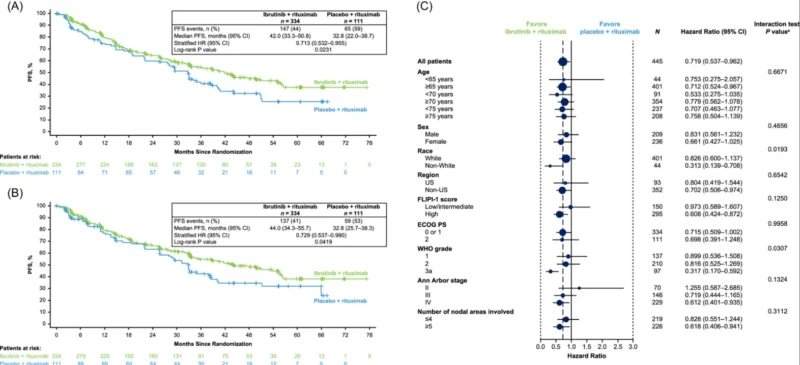
The study met its primary endpoint. Progression or death occurred in 44% of patients receiving ibrutinib plus rituximab compared with 59% of those receiving rituximab alone. Median PFS was 42.0 months with ibrutinib plus rituximab vs 32.8 months with placebo plus rituximab. This corresponded to a 29% reduction in the risk of progression or death (HR 0.71).
The benefit was sustained over time. Four-year PFS rates were 45% in the ibrutinib arm compared with 32% in the placebo arm. Importantly, the PFS advantage was observed consistently across prespecified patient subgroups, including age, disease stage, FLIPI risk category, and performance status.
Higher Response Rates and Delayed Need for Subsequent Therapy
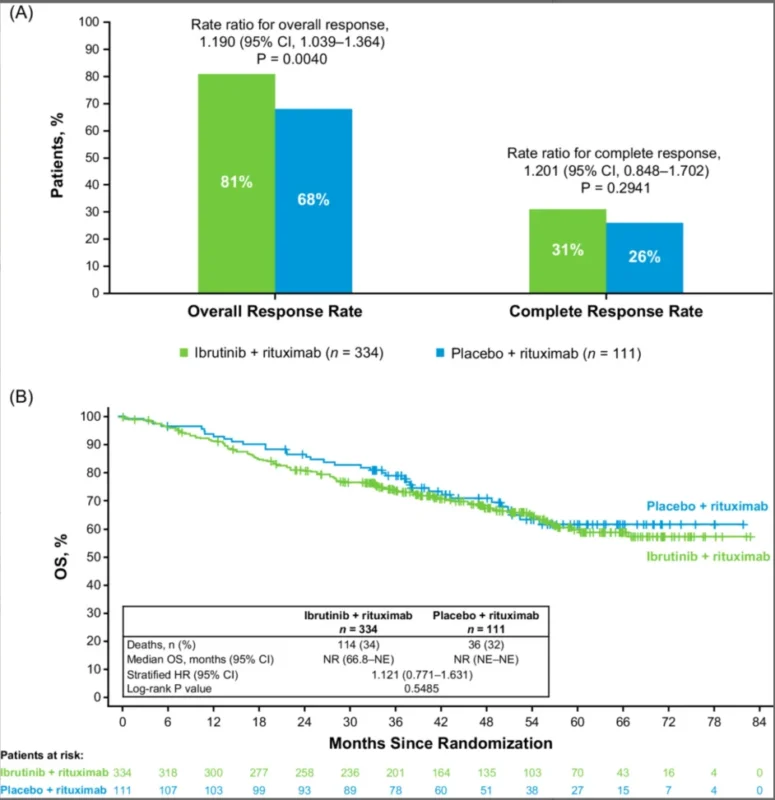
Adding ibrutinib to rituximab also improved response rates. The ORR was 81% with ibrutinib plus rituximab vs 68% with placebo plus rituximab. This difference was statistically significant. Complete response rates were numerically higher with ibrutinib, reaching 31% compared with 26% in the rituximab-alone arm, although this difference was not statistically significant.
Responses were also more durable with the combination. Median DOR reached 44.3 months with ibrutinib plus rituximab compared with 34.6 months with rituximab alone.
A clinically meaningful finding was the prolongation of time to next treatment. Median time to next treatment was not reached in the ibrutinib arm, whereas it was 43.1 months in the placebo arm. Fewer patients receiving ibrutinib required subsequent anticancer therapy, suggesting that disease control was maintained for longer periods after frontline treatment.
No Overall Survival Advantage
Despite improvements in disease control, the trial did not demonstrate an OS benefit. At the time of analysis, deaths had occurred in 34% of patients receiving ibrutinib plus rituximab and 32% of patients receiving rituximab alone. Median OS was not reached in either arm.
Four-year OS rates were similar between groups, with no statistically significant difference. As is common in frontline follicular lymphoma studies, prolonged survival and the availability of effective subsequent therapies may have limited the ability to detect an OS difference.
Safety Profile
The improved efficacy of ibrutinib came at the cost of increased toxicity. Grade 3 or higher adverse events occurred in 78% vs 57% of patients. The most frequent serious toxicities included:
- Neutropenia
- Pneumonia
- Hypertension
- COVID-19-related complications
- Diarrhea
Cardiovascular toxicity remained an important concern. Atrial fibrillation occurred in 17% of patients treated with ibrutinib, including Grade 3 or higher events in 5%. Treatment discontinuation because of adverse events was substantially more frequent with ibrutinib.
Forty-four percent of patients receiving the combination discontinued at least one study treatment because of toxicity, compared with 14% in the rituximab-alone arm. Adverse-event-related deaths were also more common in the ibrutinib group.
Impact of the COVID-19 Pandemic
Most patients received study treatment during the pandemic period, and COVID-19-related complications were more frequent in the ibrutinib arm. Investigators performed sensitivity analyses excluding COVID-19-related deaths, and these analyses suggested an even greater PFS benefit with ibrutinib. Nevertheless, no improvement in OS emerged after adjustment for COVID-19-related mortality.
Limitations
Limitations of this study include response assessments primarily based on computed tomography, with PET and bone marrow biopsies used only to confirm complete response, potentially underestimating complete response rates in the era of metabolic response assessment. Additionally, although eligibility criteria were predefined, determination of chemoimmunotherapy fitness relied partly on physician judgment in this older, comorbid population.
PERSPECTIVE in the Context of Existing Evidence
PERSPECTIVE is the first randomized, placebo-controlled Phase 3 trial to demonstrate a significant PFS benefit with a BTK inhibitor in the frontline treatment of follicular lymphoma among patients ineligible for CIT. This contrasts with the Phase 3 SELENE study in relapsed/refractory FL, where the addition of ibrutinib to chemoimmunotherapy resulted in a numerical but not statistically significant improvement in PFS.
Outcomes in the placebo-plus-rituximab arm were consistent with prior studies of rituximab monotherapy, supporting the validity of the comparator arm. Although chemotherapy-free regimens combining lenalidomide with anti-CD20 antibodies have demonstrated strong efficacy, they have largely been evaluated in younger and fitter populations and may be less suitable for older patients with significant comorbidities.
A numerical reduction in infusion-related reactions was also observed with ibrutinib plus rituximab (21% vs 27%), consistent with previous reports suggesting that BTK inhibition may attenuate inflammatory cytokine release during anti-CD20 therapy.
Key Takeaways
The Phase 3 PERSPECTIVE study demonstrated that adding ibrutinib to rituximab significantly improves progression-free survival and overall response rates in older or medically unfit patients with previously untreated follicular lymphoma who are not candidates for chemoimmunotherapy.
Median PFS was prolonged by more than nine months, responses were more frequent and durable, and the need for subsequent therapy was delayed. These benefits were not accompanied by an improvement in overall survival and were offset by substantially higher rates of serious adverse events, treatment discontinuation, atrial fibrillation, infections, and treatment-related mortality.
PERSPECTIVE therefore supports ibrutinib plus rituximab as an active chemo-free frontline option for selected older or frail patients with follicular lymphoma, while emphasizing the need for careful patient selection and close monitoring of treatment-related toxicity.