Bristol Myers Squibb (BMS) has announced the first presentation of results from the Phase 3 EXCALIBER-RRMM trial, evaluating iberdomide (ZENBEXUS) in combination with daratumumab and dexamethasone in patients with relapsed or refractory multiple myeloma (RRMM).
The findings showed that the iberdomide-based regimen achieved higher rates of minimal residual disease (MRD)-negative complete response (CR) compared with the standard combination of daratumumab, bortezomib and dexamethasone (DVd).
The data support the continued development of iberdomide, a next-generation cereblon E3 ligase modulator (CELMoD) designed to enhance anti-myeloma activity through targeted protein degradation and immune activation.
EXCALIBER-RRMM Trial Design
The EXCALIBER-RRMM trial (NCT04975997) is a Phase 3, randomized, multicenter, open-label study evaluating the efficacy and safety of iberdomide combined with daratumumab and dexamethasone compared with DVd in patients with RRMM.
The trial enrolled 939 patients who had received one to two prior lines of anti-myeloma therapy and had progressive disease.
Patients were randomized to receive:
- Iberdomide + daratumumab + dexamethasone (IberDd)
- Daratumumab + bortezomib + dexamethasone (DVd)
The study evaluated dual primary endpoints:
- Minimal residual disease (MRD) negativity
- Progression-free survival (PFS)
Additional endpoints included overall survival (OS), overall response rate (ORR), duration of response, safety, and sustained MRD negativity.
Iberdomide Combination Doubles MRD-Negative Complete Responses
The primary efficacy analysis included the first 420 randomized patients, consisting of:
- 207 patients receiving iberdomide 1 mg plus daratumumab and dexamethasone
- 213 patients receiving DVd
Results showed:
- MRD-negative complete response rate:41% with iberdomide plus daratumumab and dexamethasone
21% with DVd - This represented a statistically significant improvement in MRD-negative complete response (p < 0.0001).
MRD negativity is considered one of the deepest response measures in multiple myeloma and is increasingly used as an important endpoint in clinical trials evaluating new treatment strategies.
The EXCALIBER-RRMM trial remains ongoing to evaluate progression-free survival, another primary endpoint of the study.
Commenting on the milestone, Sagar Lonial, MD, FACP, FASCO, lead investigator of EXCALIBER-RRMM and Chief Medical Officer of Winship Cancer Institute of Emory University, said:
“Achieving deep, MRD-negative complete responses early in relapse is strongly associated with long-term clinical benefit and overall disease control for patients with multiple myeloma.”
Safety Profile Consistent With Known Treatment Effects
The safety profile of iberdomide in combination with daratumumab and dexamethasone was consistent with the known safety profiles of the individual agents and the treatment landscape for relapsed or refractory multiple myeloma.
The most commonly reported adverse events included neutropenia, anemia, thrombocytopenia, infections, fatigue, and gastrointestinal events. Hematologic toxicities, particularly neutropenia, represented the most frequently observed grade 3 or higher adverse event.
Safety findings from the EXCALIBER-RRMM trial continue to support the evaluation of iberdomide as a potential treatment option for patients with relapsed or refractory multiple myeloma, with ongoing follow-up assessing long-term tolerability and clinical outcomes.
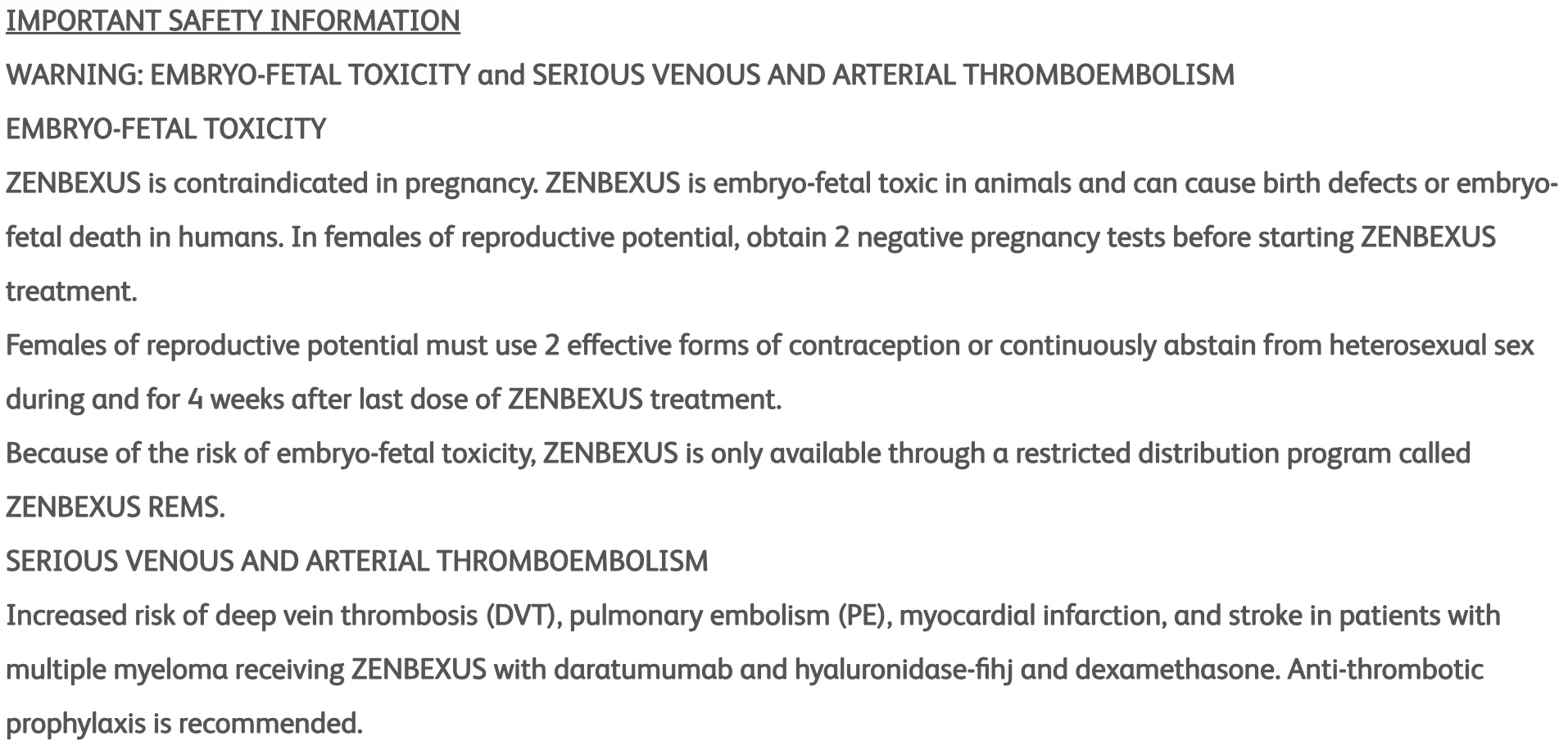
Bristol Myers Squibb. Bristol Myers Squibb Announces First Presentation of Results for Iberdomide in Combination with Daratumumab from Phase 3 EXCALIBER-RRMM Trial in Relapsed or Refractory Multiple Myeloma. 2026.
A New Generation of CELMoD Therapy
Iberdomide belongs to the CELMoD class of therapies, which build upon earlier immunomodulatory drugs by enhancing cereblon-mediated protein degradation.
The cereblon pathway plays a central role in regulating the breakdown of specific proteins involved in cancer cell survival. CELMoD agents are designed to increase this activity while also promoting immune-mediated anti-tumor responses.
BMS is developing iberdomide as part of its targeted protein degradation platform, aiming to expand therapeutic options for patients with multiple myeloma, particularly after disease relapse.
Regulatory Milestone for ZENBEXUS
In August 2026, the U.S. Food and Drug Administration (FDA) granted accelerated approval to ZENBEXUS (iberdomide) in combination with daratumumab and dexamethasone for adults with multiple myeloma who have received at least one prior therapy, including a proteasome inhibitor and an immunomodulatory agent.
The approval was based on results from EXCALIBER-RRMM, including the MRD-negative complete response findings. It marked the first multiple myeloma approval based on MRD-negative complete response data.
Looking Ahead
The EXCALIBER-RRMM trial continues to assess longer-term outcomes, including progression-free survival and durability of response.
As multiple myeloma treatment continues to evolve, investigational approaches such as CELMoD therapies aim to provide additional options for patients whose disease has returned after previous therapies.