Extramedullary disease (EMD) is among the most aggressive presentations of multiple myeloma, marked by the dissemination of clonal plasma cells into soft tissues or organs with no direct connection to bone. This distinguishes it from paraskeletal disease, which extends contiguously from an adjacent bony lesion. EMD instead arises through hematogenous spread, marking the point at which the tumor has acquired functional independence from the bone marrow microenvironment.
Clinically, EMD has long been associated with poor responses to standard anti-myeloma regimens, including those built on proteasome inhibitors, immunomodulatory drugs, and anti-CD38 antibodies. This is especially true in the relapsed or refractory setting, where conventional therapies achieve overall response rates of only around 20% in EMD patients
Research has identified several biologic changes that help myeloma cells survive outside the bone marrow and escape immune control. Recently, immune-based therapies such as CAR T-cell therapy and bispecific antibodies have shown meaningful activity in EMD, including some cases involving the central nervous system (CNS), but long-term disease control remains difficult, and EMD continues to be associated with worse survival even in the era of modern immunotherapy.
A new paper by Aimaz Afrough and colleagues takes a comprehensive look at EMD.
Overview of Extramedullary Disease
Multiple myeloma (MM) is a plasma cell malignancy characterized by clonal proliferation within the bone marrow, leading to end-organ damage such as bone destruction, cytopenias, renal dysfunction, and immune dysregulation.
EMD encompasses all forms of bone marrow-independent plasma cell dissemination and can be broadly classified into soft-tissue (non-CNS) EMD and CNS EMD. Soft-tissue EMD most commonly affects the skin, skeletal muscle, liver, lymph nodes, and pleura, whereas CNS involvement represents a distinct clinical entity and particularly poor prognosis. Both forms may be present at diagnosis (primary EMD) or develop later during disease progression (secondary EMD). The incidence increases with disease relapse, rising from 1.7-4.5% at diagnosis to 3.4-10% at relapse.
The increasing recognition of EMD is attributed not only to advances in imaging but also to changes in the natural history of multiple myeloma. While modern therapies have prolonged survival, they have also increased cumulative therapeutic pressure, creating an environment that favors clonal evolution and the emergence of marrow-independent plasma cell clones.
How Myeloma Escapes the Bone Marrow
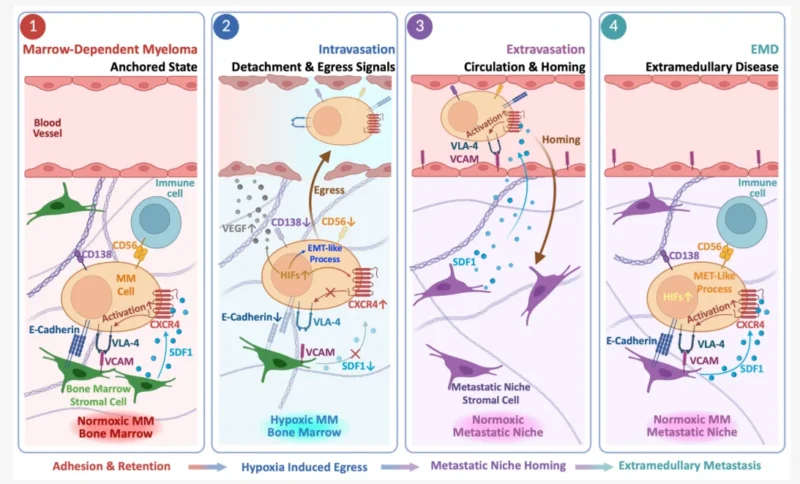
Under normal conditions, myeloma cells remain anchored within the bone marrow through a network of adhesion molecules and chemokine-mediated interactions, which not only retain plasma cells within the marrow but also provide essential survival and proliferation signals. As disease progresses, increasing tumor burden creates a hypoxic microenvironment that disrupts these retention mechanisms. Hypoxia-driven signaling reduces the expression of key adhesion molecules while enhancing migratory capacity, enabling myeloma cells to detach from the bone marrow and enter the circulation.
Once in the bloodstream, circulating plasma cells home to distant tissues through chemokine gradients and adhesive interactions similar to those involved in leukocyte trafficking. Successful colonization requires adaptation to a new microenvironment. This transition is accompanied by constitutive activation of proliferative pathways, including the RAS-MAPK, together with autocrine and paracrine signaling mechanisms that sustain growth outside the marrow niche.
Genetics of EMD
EMD tumors carry a heavier load of genetic damage than marrow-confined myeloma. It’s more like a slow accumulation of cooperating genetic hits, each one chipping away at the cell’s dependence on the bone marrow environment, until it no longer needs that environment at all.
One of the most consistent findings is the co-occurrence of 1q21 gain/amplification and activation of the RAS-MAPK signaling pathway. Analyses validated in the large CoMMpass cohort identified this combination as an independent risk factor for EMD development.
EMD is also enriched for TP53 loss and other high-risk cytogenetic alterations, while genomic features associated with lower-risk disease are less common. In a subset of patients, APOBEC-driven mutagenesis further contributes to genomic instability.
Several established immunotherapy targets are expressed at lower levels on EMD cells, while BCMA expression is generally preserved. Increased expression of immune-modulating genes, together with dysfunctional T cells and impaired natural killer cell activity, creates a strongly immunosuppressive microenvironment within extramedullary lesions.
Treatment Strategies
High-dose chemotherapy followed by autologous stem cell transplantation (ASCT) remains an important treatment option for transplant-eligible patients with newly diagnosed disease, but its benefit appears to depend on the extent of extramedullary involvement. Registry data from the European Society for Blood and Marrow Transplantation (EBMT) suggest that patients with a single extramedullary site can achieve PFS comparable to those without EMD.
In the relapsed or refractory setting, conventional therapies provide limited and often short-lived benefit. Across real-world cohorts of triple-class exposed disease, overall response rates were approximately 20-24%, with median PFS ranging from 2.7 to 6.3 months and median OS of 7.2 to 21 months.
As myeloma cells become increasingly independent of the bone marrow, therapies that rely on disrupting tumor–stromal interactions become less effective. This has brought greater attention to T-cell-redirecting immunotherapies, including bispecific antibodies and CAR T-cell therapies.
Antibody-Drug Conjugates: Limited Activity in EMD
The first generation of BCMA-targeted antibody-drug conjugates demonstrated only modest activity in patients with EMD. In the DREAMM-2 trial, single-agent belantamab mafodotin achieved responses in only 1 of 22 patients (4.5%) with soft-tissue plasmacytomas, while median PFS was 1.1 months. Real-world data confirmed these findings, with patients harboring EMD experiencing significantly shorter PFS (2 vs. 10 months) and OS (5 vs. 22 months) than those without extramedullary involvement. These results suggest that, despite targeting BCMA, antibody-drug conjugates alone are insufficient.
Bispecific Antibodies: Expanding Therapeutic Options
Across pivotal trials, teclistamab, linvoseltamab, elranatamab, and talquetamab consistently demonstrated lower response rates in patients with EMD than in the overall study populations, with overall response rates generally ranging from 35% to 53% compared with approximately 63-71% in unselected cohorts. Even among responders, progression-free survival remained shorter. Outcomes appear to be influenced not only by the presence of EMD but also by markers of tumor burden, including elevated LDH and ferritin.
No head-to-head randomized trials have compared the approved BCMA-directed bispecific antibodies. Although indirect matching-adjusted analyses suggest that elranatamab and linvoseltamab may achieve improved response rates or longer survival than teclistamab.
Dual-Targeting Improves Response
Because EMD exhibits considerable spatial and antigenic heterogeneity, simultaneously targeting more than one plasma cell antigen appears to be a promising strategy. In the RedirecTT-1 trial, the combination of teclistamab and talquetamab achieved an overall response rate of 61%.
A subsequent phase II study conducted exclusively in patients with EMD reported an overall response rate of 79%, with 54% achieving CR or better and an estimated 12-month PFS of 61%. Larger studies are needed, but dual-antigen targeting may help overcome some limitations of single-agent immunotherapy.
Trispecific antibodies represent the next step in this approach. Ramantamig (BCMA × GPRC5D × CD3) and ISB 2001 (BCMA × CD38 × CD3) are currently being evaluated in early-phase clinical trials. EMD-specific outcomes have not yet been reported. Simultaneously targeting multiple plasma cell antigens may help reduce antigen escape and improve the durability of response.
CAR T-Cell Therapy: Current Benchmark
Among currently available immunotherapies, BCMA-directed CAR T-cell therapy has produced the deepest and most durable responses in EMD, particularly when introduced earlier in the disease course before extensive T-cell exhaustion develops.
Real-world comparative data further strengthen the role of CAR T. Idecabtagene vicleucel and ciltacabtagene autoleucel achieved higher response rates (82-100% vs. 29-36%), more frequent complete resolution of extramedullary lesions (41-50% vs. 18-24%), and longer progression-free survival than currently available bispecific antibodies. Relapse patterns also differed, with 35% of patients progressing after CAR T-cell therapy maintaining control of EMD despite biochemical relapse, compared with 95% of progressions after bispecific antibodies involving recurrent extramedullary disease.
Development is already extending beyond BCMA-directed CAR T-cell therapy. GPRC5D-directed CAR T-cell therapies achieved response rates of 63–86% in early studies that included patients with EMD, while a dual-targeted BCMA/GPRC5D CAR T-cell construct produced a 100% overall response rate in a phase I study conducted exclusively in patients with EMD.
Radiation Therapy as Part of Multimodal Treatment
Traditionally used for symptom relief and local disease control, radiation therapy (RT) is gaining a broader role in the management of EMD during the immunotherapy era as a bridging strategy before CAR T-cell infusion, helping reduce tumor burden without compromising CAR T-cell manufacturing, expansion, or safety.
Beyond cytoreduction, RT may enhance antitumor immunity. Preclinical and translational studies suggest that radiation can remodel the immunosuppressive microenvironment by promoting T-cell infiltration, increasing antigen presentation, and potentially converting immunologically “cold” EMD lesions into more responsive tumors.
Optimizing the Immune Microenvironment
Immunomodulatory drugs (IMiDs) and CD38-directed antibodies exert immunoregulatory effects beyond their direct antimyeloma activity and are being explored in combination with CAR T-cell therapy and bispecific antibodies. However, IMiDs may also promote expansion of regulatory T cells and other immunosuppressive cell populations.
Newer cereblon E3 ligase modulators (CELMoDs), including mezigdomide and iberdomide, may help reverse T-cell exhaustion while maintaining direct antimyeloma activity. Other approaches under investigation include cytokine-directed therapies, such as IL-6 inhibition.
Clinical Implications
Several practical messages emerge from the available evidence. First, EMD and paraskeletal disease should be considered distinct clinical entities, as they differ in their biology, prognosis, and response to treatment. Second, the poor outcomes achieved with conventional therapies support early referral for T-cell–redirecting therapies, particularly CAR T-cell therapy, whenever feasible.
Finally, given the limited durability of current treatments, patients with EMD should be prioritized for clinical trials evaluating combination immunotherapies, novel cellular therapies, and emerging molecular targets.
CNS Myeloma: A Distinct Clinical Challenge
CNS involvement occurs in approximately 1% of patients with multiple myeloma, with plasma cells infiltrating the brain, spinal cord, leptomeninges, or cerebrospinal fluid. Historical median overall survival with conventional therapies is only 2-7 months. Non-CNS EMD is the strongest predictor of CNS involvement, warranting careful neurologic evaluation in patients with high-risk disease or new neurologic symptoms.
The blood-brain barrier limits penetration of many standard anti-myeloma agents. Most proteasome inhibitors have minimal CNS activity, and monoclonal antibodies achieve only low cerebrospinal fluid concentrations. In contrast, CAR T cells can traffic into the CNS and expand at sites of disease.
CAR T-Cell Therapy in CNS Myeloma
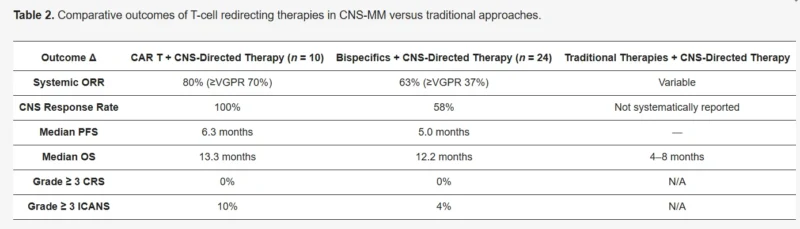
Patients with CNS myeloma were excluded from pivotal CAR T-cell registration trials, so current evidence comes mainly from retrospective studies. In multicenter series of BCMA-directed CAR T-cell therapy, CNS response rates reached 100%, with median PFS of 6.3 months and OS of 13.3 months. Rates of cytokine release syndrome and immune effector cell-associated neurotoxicity were not higher than expected. Better disease control before CAR T-cell infusion was associated with longer PFS.
Bispecific Antibodies in CNS Myeloma
Data for bispecific antibodies are also retrospective. In the largest multicenter series, the CNS response rate was 58%, with 37% of patients achieving a complete CNS response. Median PFS was 5.0 months and median OS was 12.2 months. These therapies may provide an option for patients who cannot proceed to CAR T-cell therapy.
Treatment rarely relies on T-cell-redirecting therapy alone. Most patients in the available studies also received CNS-directed radiation and, when appropriate, intrathecal therapy. The optimal sequencing of these approaches are unclear because prospective CNS-specific data are limited.
What Comes Next for EMD?
One major challenge is the biological heterogeneity of extramedullary lesions, including differences in genomic alterations and therapeutic target expression across disease sites.
Liquid biopsy, circulating tumor DNA, and circulating tumor cell analysis may provide a broader view of clonal evolution than a biopsy from a single extramedullary lesion.
Treatment strategies are also moving toward combinations that address both tumor cells and their microenvironment, including T-cell-redirecting therapies with radiation or immune-modulating agents. Several molecular targets are under investigation. CD70 and EZH2 are of interest because of their involvement in immune escape and tumor progression, with RAS-MAPK being another potential target.
For CNS myeloma, prospective studies are particularly limited. The optimal sequence of CAR T-cell therapy, bispecific antibodies, radiation, and intrathecal therapy remains unclear, as does the role of maintenance after CAR T-cell therapy. Future trials will also need standardized CNS response criteria and separate reporting of CNS and non-CNS EMD rather than grouping these patients with paraskeletal disease.