Can highly effective cellular therapy be administered safely without routine prolonged hospitalization? This is one of the most practical questions in modern myeloma care.
A new study from Germany by Christof Scheid and colleagues, published in HemaSphere, explores this question through a single-center outpatient CAR-T program. The authors report that outpatient administration of ciltacabtagene autoleucel (cilta-cel) was feasible in carefully selected patients with relapsed or refractory multiple myeloma within a structured monitoring and safety framework.
Why Outpatient CAR-T Is Being Considered
As immune-based therapies move earlier in the treatment course, more patients are becoming candidates for cellular therapy. This creates pressure not only on clinical teams, but also on inpatient beds, reimbursement systems, emergency pathways, and caregiver support structures.
CAR T-cell therapy has traditionally been linked to inpatient treatment, partly because of reimbursement requirements and partly because of concerns about cytokine release syndrome and immune effector cell-associated neurotoxicity syndrome. As a result, clinically stable patients may still spend several weeks in hospital after infusion. The present report challenges that model by showing that, in an experienced center, selected patients can be treated without planned inpatient monitoring.
About Cilta-cel in Multiple Myeloma
Ciltacabtagene autoleucel is a BCMA-directed CAR-T therapy manufactured from a patient’s own T cells. Its CAR construct incorporates two camelid-derived heavy-chain-only variable domains (VHHs) that recognize distinct BCMA epitopes, resulting in high binding avidity to myeloma cells. This design may enhance target recognition even when BCMA expression is heterogeneous, a common feature of advanced multiple myeloma.
In the pivotal CARTITUDE-1 trial, heavily pretreated patients achieved an ORR exceeding 95%, with deep and durable remissions that established cilta-cel as a major advance in cellular immunotherapy. In 2024, positive results from CARTITUDE-4 led to FDA approval of cilta-cel for lenalidomide-refractory patients with RRMM after at least one prior line of therapy.
The authors propose that ciltacabtagene autoleucel is a reasonable candidate for outpatient delivery because its toxicity profile is increasingly well characterized. Severe CRS and neurotoxicity are uncommon, particularly in lower-risk patients, while known risk factors for toxicity include high tumor burden, poor performance status, and baseline inflammation. The typical timing of CRS, often around Day 7, may also allow a structured surveillance period after infusion.

You can also read: Bispecific Antibodies vs CAR-T in Multiple Myeloma: Mechanisms, Clinical Outcomes, and Key Considerations
A Highly Selected Outpatient Cohort
Between August 2023 and June 2025, 12 patients with relapsed or refractory multiple myeloma received outpatient ciltacabtagene autoleucel. This was not a broad outpatient program for all patients. It was a risk-adapted pathway offered only to patients meeting strict clinical and logistical criteria.
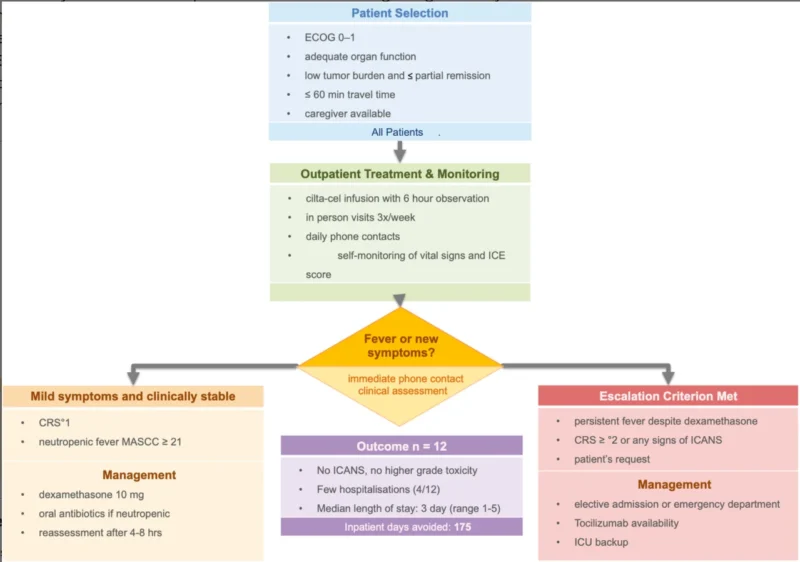
Patients needed an Eastern Cooperative Oncology Group performance status of 0-1, adequate cardiac and pulmonary function, no relevant cardiovascular or neurologic comorbidities, low tumor burden or good disease control after bridging therapy, travel time of less than 60 minutes to the center, and a dedicated caregiver living in the same household. This selection is central to interpreting the results. The program was designed around patient safety, not convenience alone.
The cohort still represented a clinically meaningful population. Median age was 61 years, 50% had high-risk cytogenetics, and two-thirds had triple- or penta-refractory disease. Patients had received a median of two prior therapy lines, with a range extending up to nine. Most received bridging therapy before infusion, and 75% achieved at least a partial response before treatment, including one-third who reached a very good partial response or better.
How the Outpatient Model Worked
Lymphodepleting chemotherapy with fludarabine and cyclophosphamide was delivered as outpatient treatment. Ciltacabtagene autoleucel was infused on Day 0 at the treatment center, followed by 6 hours of observation. Afterward, patients entered a structured monitoring program rather than being admitted for routine surveillance.
The follow-up system included in-person visits three times weekly with clinical examination and laboratory testing, daily telephone contact from trained staff, home monitoring of vital signs, and patient-performed neurologic assessment using immune effector cell encephalopathy scoring. Patients also had continuous 24/7 access to physicians experienced in cellular therapy, with immediate availability of emergency care, intensive care support, and anti-interleukin-6 treatment.
This structure is one of the most important messages of the study. Outpatient treatment did not mean reduced vigilance. It meant replacing routine admission with predefined monitoring, rapid communication, and a low threshold for hospitalization.
Fever Management Was the Core Safety Test
Fever was the most common early symptom and became the practical test of whether outpatient management could work. Patients who developed fever contacted the treating team immediately. If they were clinically stable, dexamethasone 10 mg was started after medical assessment, followed by reassessment within 4-8 hours.
If fever resolved and the patient remained stable, outpatient monitoring continued. If fever persisted, if clinical deterioration occurred, or if cytokine release syndrome Grade 2 or higher was suspected, patients were sent to the emergency department. Tocilizumab was not used at home, it was reserved for the inpatient or emergency setting.
Safety Outcomes: Mostly Low-Grade Toxicity
Cytokine release syndrome occurred in nine patients. Eight cases were Grade 1, and one case was Grade 2. No Grade 3 or 4 CRS was reported. Importantly, no patient developed immune effector cell-associated neurotoxicity syndrome.
Four patients were hospitalized within 30 days after infusion. These admissions were not considered failures of the outpatient pathway, they were part of the predefined safety strategy. Reasons included Grade 2 cytokine release syndrome, persistent fever, and persistent fever with neutropenia. All hospitalized patients received tocilizumab, with rapid symptom resolution after a single dose. Two patients also required intravenous antibiotics.
Hospital stays were short. Median inpatient stay was 3 days, with a total of only 12 inpatient days across the entire outpatient cohort.
A Major Reduction in Hospital Bed Use
The resource-use signal is one of the most important findings. In the same center, the median inpatient stay for patients treated with standard inpatient ciltacabtagene autoleucel monitoring was 16 days. For a comparable group of 12 patients, this would have translated into approximately 168-240 inpatient days. By contrast, the outpatient cohort required only 12 inpatient days in total, corresponding to a reduction of more than 90% in inpatient bed utilization.
This matters because access to cellular therapy is increasingly limited not only by drug availability, but also by hospital infrastructure. Outpatient pathways may help experienced centers treat more patients without compromising safety, provided the appropriate safeguards are in place.
Early Efficacy Remained Strong
After a median follow-up of 9.9 months, no deaths were reported, no patient required intensive care admission, and non-relapse mortality was 0%. Best overall response was CR in 11 of 12 patients, while one patient had stable disease after prior CAR T-cell therapy.
Although the study was not designed to compare efficacy between inpatient and outpatient treatment, these early outcomes are reassuring. They suggest that avoiding routine hospitalization did not reduce the expected clinical activity of ciltacabtagene autoleucel in this selected population.
What This Study Does Not Prove
The findings should not be generalized to all patients with multiple myeloma. This was a retrospective, single-center experience with only 12 patients. Rare severe toxicities could easily be missed in a cohort of this size. Home monitoring may also underdetect short, self-limited episodes such as transient oxygen desaturation or brief hypotension.
The study also reflects major institutional experience: the center had previously treated about 150 in-label patients with ciltacabtagene autoleucel, which likely contributed to safe outpatient implementation. Centers without established cellular therapy infrastructure and trained emergency pathways should not interpret these data as support for simplified outpatient treatment.
Clinical Takeaway
This first European outpatient ciltacabtagene autoleucel experience suggests that CAR T-cell therapy for multiple myeloma can move beyond the default inpatient model in selected patients. The key is not simply sending patients home after infusion. The key is structured selection, caregiver support, close monitoring, center experience, 24/7 expert access, immediate emergency readiness, and predefined admission criteria.
For myeloma programs facing rising treatment volumes, outpatient ciltacabtagene autoleucel may become an important strategy to reduce hospital burden, improve patient experience, and preserve safety. The model now needs validation in larger cohorts, but it offers a practical blueprint for experienced centers preparing for the next phase of cellular therapy delivery.
Multiple Myeloma: Symptoms, Causes, Stages, Diagnosis and Treatment