
Calreticulin (CALR) mutations characterize a distinct molecular subgroup of essential thrombocythemia (ET) and primary myelofibrosis (MF). They produce an abnormal protein that activates the thrombopoietin receptor MPL and sustains JAK-STAT signaling. Most pathogenic mutations also generate a common amino acid sequence absent from normal calreticulin. This sequence can be recognized by the immune system and targeted through vaccines, monoclonal and bispecific antibodies, and engineered T cells.
CALR Mutations and Their Immunologic Significance
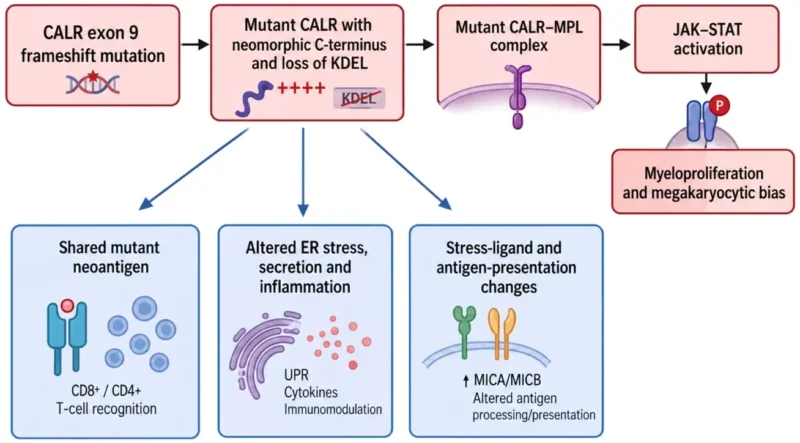
Wild-type calreticulin is an endoplasmic-reticulum chaperone involved in protein folding, calcium homeostasis and antigen presentation. Pathogenic exon 9 insertions and deletions alter its C-terminal region, remove the endoplasmic-reticulum retention signal and create a positively charged mutant sequence. The two principal variants, the type 1 52-base-pair deletion and the type 2 5-base-pair insertion, both produce the same 36-amino-acid neomorphic C-terminal sequence.
Mutant CALR binds immature glycosylated MPL and activates it without thrombopoietin. The resulting JAK-STAT signaling supports mutant stem and progenitor cells. Mutant CALR-MPL complexes also reach the cell surface, exposing a structure absent from healthy hematopoietic cells. This opens two routes: mutant CALR-derived peptides presented by human leukocyte antigen (HLA) molecules for T-cell recognition, and extracellular mutant CALR targeted directly by antibodies or engineered cells. The second does not depend on a patient’s ability to present a particular peptide through a suitable HLA molecule.
CALR-mutated essential thrombocythemia generally has higher platelet counts and lower thrombotic risk than JAK2-mutated disease. In myelofibrosis, CALR mutations, particularly type 1-like variants, are frequently associated with more favorable survival, but progressive fibrosis, anemia, splenomegaly and leukemic transformation remain risks. No current treatment specifically inhibits mutant CALR. Hydroxyurea and interferon provide cytoreduction, and JAK inhibitors improve symptoms and spleen size in MF, with variable effects on the mutant stem-cell population.
frontiersin.org
Immune Surveillance of CALR-Mutant Clones
The shared mutant sequence is a genuine neoantigen. CD4+ and CD8+ T cells recognizing mutant CALR peptides have been identified, including cells that recognize autologous mutant hematopoietic cells, and mutant CALR-reactive memory T cells also occur in healthy individuals. This fits surveillance of emerging clones, but cross-reactive recognition is an alternative explanation, and antigen-specific T cells do not establish protection.
In established disease, spontaneous T-cell responses are often weak. Some studies found stronger responses in healthy donors than in patients, and others found T cells that recognize synthetic mutant peptides but act poorly against cells presenting naturally processed antigen. A peptide predicted to bind HLA may not be displayed by a malignant stem cell, and a chronically inflamed marrow, where immune activation and suppression coexist, sharpens these constraints.
HLA Variation and Immune Recognition
HLA class I molecules support recognition by CD8+ cytotoxic T cells, and class II molecules present longer peptides to CD4+ T cells. CD4+ responses predominate in several mutant CALR vaccination studies, which suggests class II presentation matters, although eliminating malignant stem cells may need stronger cytotoxic activity.
A Bulgarian study of 42 CALR-mutated patients reported reduced HLA-C*06:02 representation versus healthy controls, a nominally significant finding that has not been independently replicated. A UK Biobank analysis of about 380,000 participants found no consistent association between predicted HLA binding and the prevalence or size of common clonal hematopoiesis variants. CALR exon 9 frameshifts were not examined, so CALR-specific effects are not excluded, but stronger predicted presentation cannot be assumed to mean better surveillance. HLA genotype cannot currently predict susceptibility or select patients for immunotherapy.
Natural Killer Cells and Inherited Immune Regulation
Natural killer (NK) cell activity depends on the balance between activating signals from stressed cells and inhibitory signals tied to normal HLA expression. The activating receptor NKG2D recognizes stress ligands including MICA and MICB. In a cohort of 43 CALR-mutated patients, MICA*004:001 was associated with susceptibility after multiple-testing correction, and an exploratory KLRK1 haplotype association was also reported. In another analysis of 30 patients, the inhibitory receptor KIR2DL2 and its HLA-C2 ligand group were associated with CALR-mutated disease (odds ratio 7.91). The studies were small, drew largely on overlapping cohorts and lacked functional confirmation.
TIGIT as an NK-Cell Checkpoint in CALR-Mutant MPNs
A 2026 study in Leukemia identified TIGIT as a potential immunotherapeutic target in CALR-mutant myeloproliferative neoplasms. NK cells from CALR-mutant patients kept their degranulation capacity and showed an activated, memory-like NK3 transcriptional signature, but expressed significantly more of the inhibitory checkpoint TIGIT than NK cells from JAK2-mutant patients.
Higher TIGIT expression came with lower expression of the activating receptor DNAM-1 and higher levels of the TIGIT ligand CD112 on CD34-positive hematopoietic cells, which suggests immune evasion. Plasma from CALR-mutant patients was also enriched in interleukin-18 and S100 proteins, which may raise TIGIT expression through inflammatory signaling. TIGIT blockade enhanced NK-cell killing of CALR-mutant cells in vitro and produced a trend toward lower platelet counts and megakaryocytic disease burden in a mouse transplantation model.
How CALR-Mutated Cells Evade Immune Control
Persistence despite detectable immune recognition points to several escape mechanisms:
Extracellular mutant CALR: The protein can be secreted into the circulation and, experimentally, interferes with phagocytosis and antitumor responses. Its contribution in patients is incompletely characterized.
TGF-β signaling: In CALRdel52 experimental systems and patient samples, mutant CALR was associated with increased TGF-β expression and regulatory T-cell expansion through an ERK–Sp1-dependent mechanism. Blocking this pathway improved antitumor T-cell activity in preclinical models.
Platelet-T-cell aggregates: These impair CD8+ T-cell function in myeloproliferative neoplasms. Their specific contribution in CALR-mutated disease needs study.
Antigen presentation: Studies do not support uniform loss of HLA class I in CALR-mutated cells, and abnormalities depend on lineage and experimental context.
Marrow access: Mutant-specific T cells in blood may be underrepresented in the marrow compartments that hold malignant stem cells.
Raising circulating antigen-specific T cells may accomplish little if they cannot reach malignant progenitors or stay cytotoxic within the marrow.
CALR Vaccines: Immunogenic, Without Consistent Disease Control
In the first study of the 36-amino-acid CALRLong36 peptide vaccine, eight of ten patients developed new or amplified mutant CALR-specific T-cell responses, but no meaningful hematologic or molecular responses occurred. T-cell receptor analyses explained this: vaccine-induced T cells were not substantially enriched in marrow, were far outnumbered by malignant target cells and were predominantly CD4+, which limits direct cytotoxicity.
The phase I VAC85135 program tested a vector-based vaccine encoding mutant CALR and JAK2 V617F neoantigens, with or without ipilimumab. Among 14 patients, 12 with CALR-mutated disease, five had mutant CALR-specific T-cell responses, mutant allele burden did not fall and clinical activity was limited. Development was discontinued. Other peptide strategies with different adjuvants have not established molecular disease control.
Mutant CALR Antibodies: Early Molecular Activity
Antibodies have produced the most substantial clinical findings so far. They recognize extracellular mutant CALR without HLA-restricted presentation, and some block the mutant CALR-MPL interaction. The preclinical antibody 4D7 disrupted this signaling, inhibited megakaryocytic differentiation and improved survival in experimental models. This supported INCA033989, an Fc-silent human IgG1 antibody designed to antagonize mutant CALR while limiting antibody-mediated immune-cell recruitment and complement activation.
INCA033989 in Essential Thrombocythemia
Results presented at the European Hematology Association (EHA) Congress in 2026 included 110 patients with CALR-mutated ET across two studies. Complete hematologic remission (platelets ≤400 × 10⁹/L, leukocytes <10 × 10⁹/L) occurred in 68% and partial remission in another 17%, with a median time to complete remission of about 2.1 weeks.
Among 38 patients in complete remission with post-baseline molecular data, 71% had a reduction of at least 25% in CALR-mutant variant allele frequency. Lower allele burden accompanied durable hematologic responses, and marrow analyses showed less megakaryocyte clustering.
At doses of at least 750 mg, type 1-mutated patients had higher platelet-response rates than those with other variants, consistent with preclinical differences in antibody binding between mutation classes. Fatigue and headache were the most frequent adverse events, and early safety data suggested limited myelosuppression, pending longer follow-up.
INCA033989 in Myelofibrosis
In 70 patients with CALR-mutated MF on monotherapy, 31% of evaluable patients had a spleen volume reduction of at least 35% at 24 weeks, 37% had a reduction of at least 50% in total symptom score, and 58% of evaluable patients meeting exposure criteria had an anemia response. Mutant allele frequency fell in 91% of those assessed, and exploratory single-cell analyses showed fewer mutant CALR-positive CD34+ stem and progenitor cells.
A translational analysis suggested that co-mutations such as ASXL1 did not preclude response, with limited sample sizes. With ruxolitinib, 63% of 16 evaluable patients had a spleen volume reduction of at least 25% at 24 weeks, and six reached the 35% threshold. Falling allele burden and progenitor numbers support an effect on the clone, but durable disease modification, prevention of progression and survival benefit have not been shown.

Bispecific Antibodies and T-Cell Redirection
Bispecific antibodies link CALR-mutant cells to cytotoxic T cells. JNJ-88549968, a mutant CALR-directed T-cell engager, is in early clinical investigation. Preclinical work showed selective recognition of CALR-mutated cells and cytotoxicity against mutant CD34+ populations across mutation types. INCA035784 binds an extracellular region of mutant CALR, not the mutant C-terminal sequence itself, and in preclinical experiments activated T cells and killed CALR-mutant progenitors, including patient-derived cells, while sparing some normal hematopoietic populations. Other bispecific constructs depleted mutant stem and progenitor cells in animal models.
By placing cytotoxic T cells in direct contact with targets, these agents address a limitation of vaccination, but they still depend on functional effector cells. Cytokine release syndrome, neurotoxicity and prolonged cytopenias need careful evaluation, and clinical efficacy is not established.
CAR-T Cells and Other Emerging Approaches
Mutant CALR-specific CAR-T cells selectively eliminated malignant cells in experimental systems and controlled disease in xenograft models. Increased BCL-2 expression emerged as a resistance mechanism, and adding venetoclax restored cytotoxicity. Humanized marrow models showed selective depletion of CALR-mutant populations, including cells with additional high-risk mutations. Open questions include antigen density, circulating mutant CALR, inflammatory toxicity, and whether residual normal stem cells can restore hematopoiesis after substantial clone depletion, which matters most in advanced MF, where mutant hematopoiesis may occupy much of the stem-cell compartment.
Mutant CALR-directed antibodies linked to degraders of SMARCA2/4 or CDK9 killed malignant progenitors selectively in experimental systems. NK-cell-directed strategies, including NKG2D-based approaches and MICA/MICB or KIR modulation, are more speculative and rest on immunogenetic associations and evidence from other malignancies.
Clinical Implications and Open Questions
Mutant CALR antibodies antagonize the mutant CALR-MPL complex, while T-cell engagers aim to eliminate cells that express the abnormal protein. Allele burden has fallen alongside hematologic and clinical responses with INCA033989, but molecular response criteria from JAK2-mutated MPN cannot be applied automatically to CALR-mutated disease. A modest fall in variant allele frequency does not show eradication of the initiating clone, and assessment must account for mutation subtype, co-mutations, baseline clone size and distribution across hematopoietic compartments
None of the proposed immunogenetic markers is suitable for patient selection. The platforms differ clinically: Fc-silent antibodies may have a favorable toxicity profile but need repeated dosing, bispecifics are off-the-shelf, and CAR-T offers prolonged activity at the cost of complexity and potentially substantial immune toxicity. In indolent CALR-mutated ET, the safety threshold for an experimental immune therapy is high, whereas advanced MF and blast-phase disease, with limited conventional options, set a different one.
Reference
- Shivarov V, Ivanova M. Immune Surveillance and Emerging Immunogenetic Modifiers in CALR-Mutated Myeloproliferative Neoplasms. 2026.
- Hertz C, Spyrou N, Hoffman R, et al. Immunotherapeutic Targeting of Calreticulin Mutant Myeloproliferative Neoplasms. Leukemia. 2026;40:2107–2117.
- Witalisz-Siepracka A, Harm T, Klampfl T, et al. Mutant Calreticulin-Driven Myeloproliferative Neoplasms Favour the Emergence of TIGIT-Positive NK Cells. Leukemia. 2026.