
Cytarabine plus daunorubicin, “7+3”, has anchored induction therapy for fit patients with newly diagnosed AML for more than four decades. That is not simply inertia: the regimen reliably induces marrow aplasia and remission, and no alternative has convincingly surpassed it.
“SAB”, “same as before”, was a term coined in 2002 to describe improving outcomes in AML despite little change in the daunorubicin-cytarabine backbone. Most of that improvement came from better supportive care, not a better regimen. It’s a useful reminder for today’s single-arm data too: results only look like progress when the comparator is a real one, not a historical control.
Where intensive therapy has genuinely improved, it’s been through refinement: higher daunorubicin doses, gemtuzumab ozogamicin, FLT3 inhibitors layered onto 7+3. CPX-351 improved OS in selected secondary AML, especially for patients who reached alloSCT. Each of these gains landed in a specific molecular or cytogenetic subgroup, which is itself the point: AML doesn’t respond to induction as one disease.
Venetoclax Changes the Calculus
Venetoclax changed the intensive-vs-lower-intensity balance. VIALE-A showed azacitidine-venetoclax outperformed azacitidine alone on response and overall survival in patients unfit for intensive chemotherapy, and venetoclax has since paired well with low-dose cytarabine too, confirming BCL2 inhibition as a legitimate backbone.
It’s not uniform, though. NPM1- and IDH-mutated disease and FLT3-wild-type AML respond well, monocytic and FLT3-ITD-mutated disease respond less well. How long to treat is still an open question, with progression or toxicity usually the thing that ends therapy.
What separates venetoclax from earlier lower-intensity regimens is the combination: high response rates, deep MRD responses, fast cytoreduction, mostly outpatient delivery. That combination is what raises a genuinely new question, does a patient fit enough for 7+3 actually need it?
You can also read about
Venetoclax-Decitabine in Younger Adults
NCT05177731, a Phase IIb trial from Suzhou, China, randomized 188 adults aged 18-59 to venetoclax-decitabine or idarubicin-cytarabine. Venetoclax-decitabine was noninferior and actually produced a higher composite CR rate (89% vs 79%), with comparable MRD negativity, fewer transfusions, less G-CSF, and lower rates of severe pneumonia, febrile neutropenia, and sepsis.
The benefit wasn’t even across subtypes. It looked strongest in adverse-risk disease and in U2AF-mutated AML, while core-binding factor AML actually did worse on venetoclax-decitabine. Noninferior overall doesn’t mean equivalent in every subgroup, this trial makes that concrete.
Azacitidine-Venetoclax in Older Fit Patients
NCT06066242 randomized adults 60-75 to azacitidine-venetoclax, intensive chemotherapy, or a hybrid intensive/venetoclax approach. EFS and OS were similar across arms at early follow-up, though adverse-risk patients appeared to fare better with azacitidine-venetoclax, and toxicity looked comparable overall.
Two things complicate the interpretation: transplant rates were low, and patients who reached remission still went on to intensive consolidation. So this trial shows the lower-intensity approach is feasible, but it does not yet show that it can replace intensive therapy more broadly.
PARADIGM Offers the Cleanest Comparison Yet
PARADIGM (NCT04801797) is the most direct head-to-head so far, comparing azacitidine-venetoclax with conventional induction in fit adults, most with adverse-risk disease by ELN 2022.
Azacitidine-venetoclax outperformed 7+3 or CPX-351 in terms of EFS and response rates, with lower early mortality, fewer severe infections and bleeding events, better patient-reported outcomes, less healthcare utilization, and a higher rate of patients reaching alloSCT.
The trial enrolled a population skewed toward patients expected to do poorly on intensive chemotherapy anyway, so the result may partly reflect that enrichment. Longer follow-up will tell whether the early EFS gain holds up as an OS gain.
The Real Question: Which AML Needs Which Induction
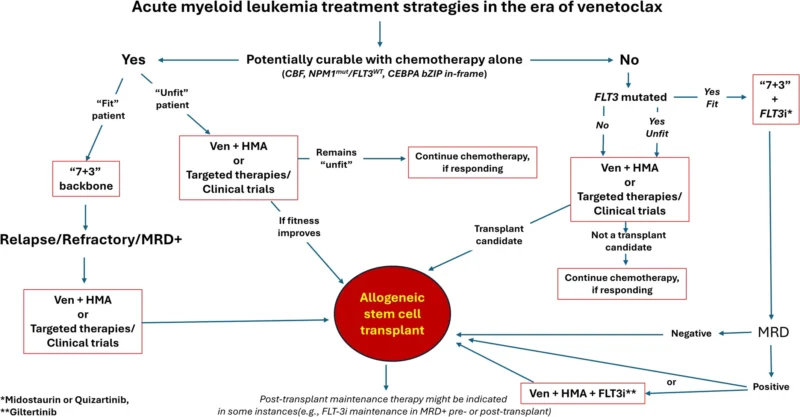
None of this evidence supports dropping 7+3. What it does is undercut the fit-vs-unfit framework itself. Fitness tells whether a patient can tolerate intensive chemotherapy, not whether intensive chemotherapy is the best treatment for their leukemia.
For favorable-risk disease, intensive induction still has a clear role. 7+3 or an intensified backbone remains the preferred approach outside clinical trials for core-binding factor AML, NPM1-mutated/FLT3-wild-type AML, and favorable CEBPA-mutated disease, with MRD helping guide the need for alloSCT.
Adverse-risk AML is different. AlloSCT often offers the best chance of cure, so the goal of induction is to control the disease while getting the patient to transplant in the best possible condition. A regimen that provides effective disease control with less toxicity may therefore be preferable even in a patient who could tolerate 7+3.
But adverse-risk AML is not a single disease. TP53-mutated and MECOM-rearranged AML remain particularly difficult to control with either approach, and the favorable results seen with venetoclax in broader adverse-risk populations may not necessarily apply to these subtypes.
wiley.com
Intermediate-Risk AML Is the Hard Case
This is where the decision gets genuinely difficult: some intermediate-risk patients are cured by intensive chemotherapy alone, others carry enough relapse risk to need transplant. At baseline relapse risk ≥50% and HCT-CI ≤2, alloSCT cuts relapse risk, at the cost of 20%-30% non-relapse mortality.
Adding FLT3, IDH1, or menin inhibitors to either backbone complicates the picture further. The likely path forward isn’t a single strategy for all intermediate-risk patients, but targeted therapy plus MRD tracking to select who needs transplant and which induction gets them to alloSCT.
Focusing on Specific AML Subtypes
The next wave of trials is testing these approaches within specific molecular subgroups instead of across an unselected “fit” population.
VINCENT compares azacitidine-venetoclax with 7+3 plus gemtuzumab ozogamicin in NPM1-mutated/FLT3-wild-type AML, ages 18-70. VICTOR tests venetoclax plus low-dose cytarabine against daunorubicin-cytarabine plus gemtuzumab ozogamicin in an older population with the same mutation profile, with endpoints built around molecular disease control.
QUIZZICAL takes the concept to FLT3-ITD-mutated AML: quizartinib plus azacitidine-venetoclax vs 7+3 plus quizartinib, in fit patients 50 and older. These trials may show whether the optimal induction backbone differs by molecular subtype.
Is MRD Negativity Enough?
Detectable pretransplant MRD generally means higher relapse risk and worse survival, but not always, some MRD-positive patients don’t relapse, especially if they clear disease during conditioning or through donor immune effects. MRD status before transplant is a moving target, shaped by conditioning intensity, immune reconstitution, and maintenance therapy after the fact.
Two recent randomized trials found similar rates of MRD negativity after intensive and lower-intensity induction, but it’s not clear MRD negativity means the same thing regardless of how you got there. Flow cytometry misses some residual disease, and we don’t yet know if MRD-negative patients from lower-intensity induction relapse post-transplant at the same rate as those from intensive chemotherapy. PARADIGM should help answer that.
Is 7+3 Still the Standard?
For now, yes, just not by default for every fit patient. The evidence doesn’t yet support calling venetoclax-based therapy the new universal standard, but in selected fit populations, ven-based therapy now matches intensive induction on response and MRD, sometimes with less toxicity and better EFS.
That’s the core argument: the next era of AML treatment will be less about finding one winner and more about matching the right induction approach to each subtype.
You can also read about