
At the ESMO Congress 2026, Sophie Merrick (London, United Kingdom) presented patient-reported outcomes from the RAMPART trial (NCT03288532), comparing adjuvant durvalumab with active monitoring in patients with resected renal cell carcinoma (RCC) at intermediate-high risk of recurrence or with completely resected metastatic disease.
The analysis, presented in the Rapid Oral session (3590RO), assessed quality of life, functioning, and symptoms at Week 16 and Month 15.
Why Was the RAMPART Analysis Conducted?
RAMPART evaluates one year of adjuvant durvalumab in patients with resected RCC. The primary quality-of-life analysis showed no evidence of a difference in overall health and quality of life (OHQL) between durvalumab and active monitoring from baseline to Month 15.
This additional analysis examined individual functioning and symptom domains to identify statistically significant and clinically meaningful differences between treatment groups.

Study Design and Methods
RAMPART was a randomized trial comparing active monitoring, adjuvant durvalumab, and durvalumab plus tremelimumab, with a 3:2:2 allocation ratio. The present quality-of-life analysis focused on durvalumab monotherapy versus active monitoring.
The optional quality-of-life substudy was conducted in the United Kingdom and Australia. Eligible participants completed the EORTC QLQ-C30 questionnaire at baseline and at least one follow-up assessment at Week 16 or Month 15.
Secondary outcomes included overall health and quality of life (OHQL) at Week 16, as well as functioning, symptoms, and financial difficulties at Week 16 and Month 15. Clinically meaningful difference thresholds were predefined for individual scales and items.
Analyses used linear regression adjusted for baseline quality-of-life score and sex. All analyses were exploratory, without adjustment for multiple testing.
Key Findings
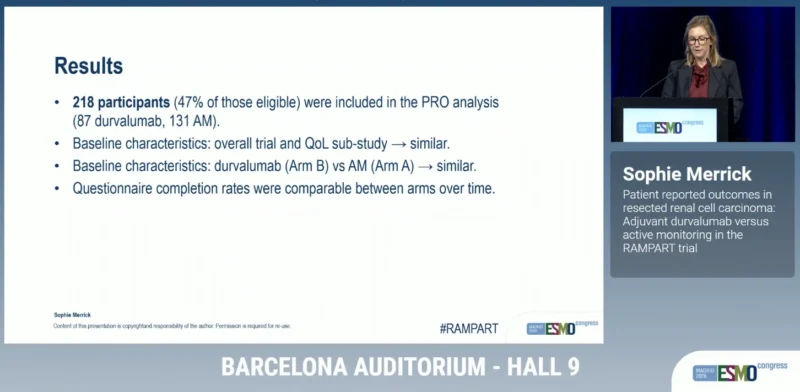
A total of 218 patients were included: 131 receiving active monitoring and 87 receiving durvalumab. Baseline characteristics were similar between groups.
Quality of Life and Functioning
At Week 16, durvalumab was associated with worse outcomes compared with active monitoring in several domains:
- Overall health and quality of life: −7.4 points (95% CI −11.5 to −3.3; p=0.0005).
- Role functioning: −7.1 points (95% CI −12.6 to −1.6; p=0.0112).
- Cognitive functioning: −5.3 points (95% CI −9.6 to −0.9; p=0.0174).
- Fatigue: 5.5 points (95% CI 0.7–10.2; p=0.0239).
- Appetite loss: 5.8 points (95% CI 1.0–10.6; p=0.0186).
All these differences met predefined thresholds for small clinically meaningful differences.
 Outcomes at Month 15
At Month 15, the primary OHQL outcome showed no evidence of a difference between the treatment groups, and the role-functioning difference observed at Week 16 was no longer statistically significant and clinically meaningful. However, differences persisted in cognitive functioning (−7.1 points; 95% CI −12.7 to −1.5; p=0.0135) and appetite loss (7.4 points; 95% CI 1.6–13.2; p=0.0124). Additional worsening was observed in dyspnoea (7.5 points; 95% CI 0.6–14.5; p=0.0341) and constipation (12.2 points; 95% CI 5.5–18.8; p<0.0001). No other domains met both statistical significance and predefined clinical meaningfulness thresholds at either assessment.
Conclusions
The RAMPART quality-of-life analysis found that adjuvant durvalumab was associated with early worsening in overall health and quality of life, role functioning, cognitive functioning, fatigue, and appetite loss compared with active monitoring.
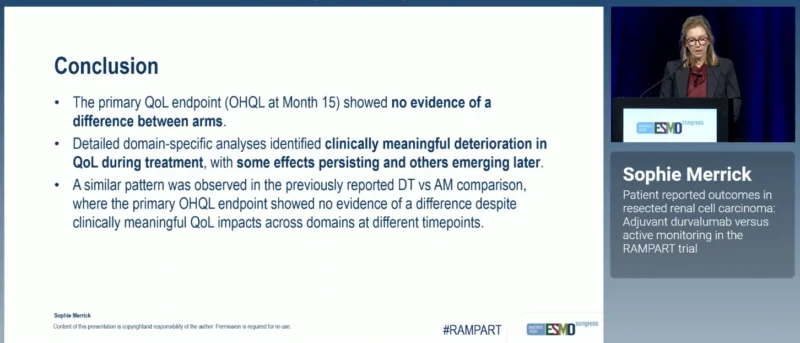
Although the primary OHQL endpoint at Month 15 showed no evidence of a difference between groups, clinically meaningful differences persisted in cognitive functioning and appetite loss, while worsening in dyspnoea and constipation emerged at Month 15. These findings indicate that domain-specific quality-of-life analyses identified effects not captured by the primary OHQL endpoint. However, the analyses were exploratory and were not adjusted for multiple testing. The Month 15 findings for dyspnoea and constipation should also be interpreted cautiously because they were based on single-item scales.
Source: ESMO Congress 2026 – Abstract 3590RO, RAMPART

Read more about KEYNOTE-564 at ESMO 2026 on OncoDaily.