At the ESMO Congress 2026, Toni K. Choueiri (Boston, USA) presented the final protocol-prespecified analysis of the Phase III KEYNOTE-564 trial (NCT03142334), evaluating adjuvant pembrolizumab versus placebo in patients with clear cell renal cell carcinoma (ccRCC) at increased risk of recurrence following surgery.
The analysis, presented in the Rapid Oral session (3589RO), reported updated disease-free survival (DFS) and overall survival (OS) outcomes, including results across protocol-defined risk subgroups and according to the presence of sarcomatoid features.
Why Was KEYNOTE-564 Conducted?
Patients with clear cell renal cell carcinoma who are at increased risk of recurrence following surgery may receive adjuvant treatment to improve long-term outcomes.
The Phase III KEYNOTE-564 trial evaluated pembrolizumab compared with placebo in patients with ccRCC at increased risk of recurrence following nephrectomy, with or without metastasectomy.
The primary endpoint was DFS, assessed by investigators. Overall survival was a key secondary endpoint. Both endpoints had met their respective statistical significance criteria at earlier interim analyses and were not formally retested at the final protocol-prespecified analysis. The final analysis provided updated DFS and OS results for the overall population and evaluated outcomes across protocol-defined recurrence-risk subgroups and according to the presence or absence of sarcomatoid features.
Based on these findings, adjuvant pembrolizumab became a standard-of-care treatment for patients with ccRCC at increased risk of recurrence after surgery. The final protocol-prespecified analysis evaluated whether the previously demonstrated DFS and OS benefits were maintained with longer follow-up, including in key patient subgroups.
KEYNOTE-564 Study Design and Methods
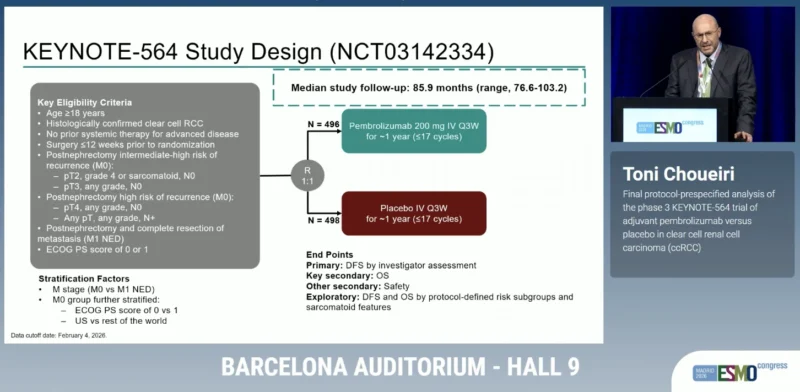
KEYNOTE-564 was a randomized Phase III trial enrolling adults with clear cell renal cell carcinoma at increased risk of recurrence following nephrectomy, with or without metastasectomy.
Patients were randomized in a 1:1 ratio to receive one of two adjuvant treatment regimens:
- Pembrolizumab arm: Pembrolizumab 200 mg intravenously every three weeks for up to 17 cycles.
- Placebo arm: Placebo administered intravenously every three weeks for up to 17 cycles.
The primary endpoint was DFS, assessed by investigators. Overall survival was a key secondary endpoint. Both endpoints had met their respective statistical significance criteria at earlier interim analyses. The final protocol-prespecified analysis provided updated DFS and OS results for the overall population and evaluated outcomes across protocol-defined recurrence-risk subgroups and according to the presence or absence of sarcomatoid features.
Key Findings from KEYNOTE-564
A total of 994 patients were randomized, including 496 assigned to pembrolizumab and 498 to placebo. At the February 4, 2026 data cutoff, median study follow-up was 85.9 months (range 76.6–103.2). The final analysis showed that the previously established DFS and OS benefits with adjuvant pembrolizumab were maintained.
Disease-Free Survival
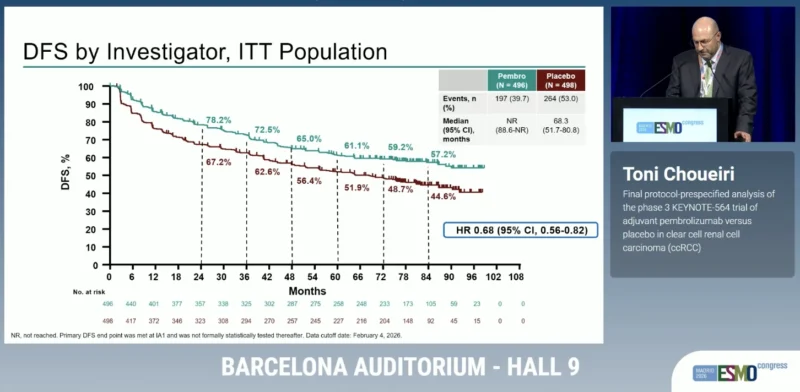
At the final analysis, 197 DFS events had occurred in the pembrolizumab group compared with 264 in the placebo group. Median DFS was not reached with pembrolizumab, compared with 68.3 months with placebo. The DFS hazard ratio was 0.68 (95% CI 0.56–0.82), indicating a lower observed hazard of disease recurrence or death with adjuvant pembrolizumab.
At seven years, the estimated DFS rate was 57.2% with pembrolizumab compared with 44.6% with placebo. These updated findings were consistent with the DFS benefit previously established at the first interim analysis.
Overall Survival
The final protocol-prespecified analysis also demonstrated a sustained overall survival benefit with pembrolizumab. A total of 86 OS events occurred in the pembrolizumab group compared with 118 in the placebo group.
Median OS was not reached in either treatment arm. The OS hazard ratio was 0.70 (95% CI 0.53–0.92). At seven years, the estimated OS rate was 82.3% with pembrolizumab versus 76.6% with placebo. These results were consistent with the statistically significant OS benefit previously established at an earlier interim analysis.
Disease-Free Survival Across Risk Subgroups
The final analysis reported DFS outcomes across the protocol-defined intermediate-high-risk, high-risk, and M1 no-evidence-of-disease (M1 NED) subgroups. In the intermediate-high-risk subgroup, 422 patients were assigned to pembrolizumab and 433 to placebo. Median DFS was not reached with pembrolizumab compared with 76.7 months with placebo (HR 0.71; 95% CI 0.58–0.87). At seven years, the estimated DFS rates were 59.8% versus 48.3%, respectively.
In the high-risk subgroup, 40 patients were assigned to pembrolizumab and 37 to placebo. Median DFS was 22.4 months with pembrolizumab compared with 13.7 months with placebo (HR 0.54; 95% CI 0.31–0.94). The estimated seven-year DFS rates were 44.6% and 19.4%, respectively.
Among patients in the M1 NED subgroup, 29 were assigned to pembrolizumab and 28 to placebo. Median DFS was 55.3 months with pembrolizumab compared with 11.5 months with placebo (HR 0.50; 95% CI 0.26–0.96). At seven years, the estimated DFS rates were 36.2% versus 23.0%, respectively. The DFS hazard ratios favoured pembrolizumab across all three protocol-defined risk subgroups.
Outcomes According to Sarcomatoid Features
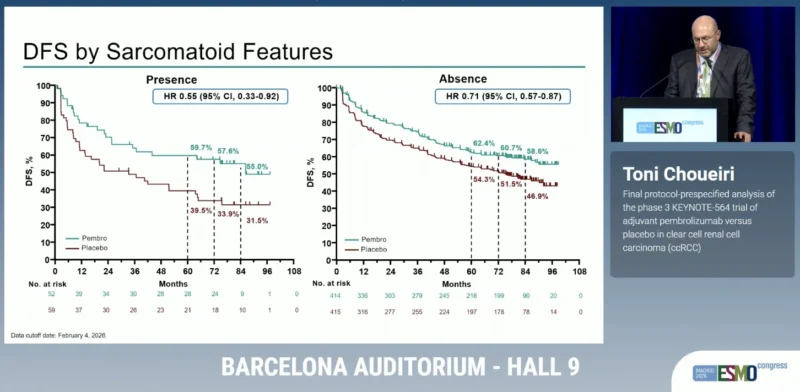
The analysis also evaluated DFS according to the presence or absence of sarcomatoid features. Among patients with sarcomatoid features, 52 were assigned to pembrolizumab and 59 to placebo. Median DFS was 86.4 months with pembrolizumab compared with 33.4 months with placebo (HR 0.55; 95% CI 0.33–0.92). At seven years, the estimated DFS rate was 55.0% with pembrolizumab versus 31.5% with placebo.
Among patients without sarcomatoid features, 414 were assigned to pembrolizumab and 415 to placebo. Median DFS was not reached with pembrolizumab compared with 75.3 months with placebo (HR 0.71; 95% CI 0.57–0.87). The estimated seven-year DFS rates were 58.6% versus 46.9%, respectively.
Overall survival outcomes were also reported across the protocol-defined risk and sarcomatoid subgroups. The OS hazard ratios for pembrolizumab versus placebo were:
- Intermediate-high risk: HR 0.66 (95% CI 0.48–0.91).
- High risk: HR 0.92 (95% CI 0.44–1.90).
- M1 NED: HR 0.54 (95% CI 0.19–1.53).
- Sarcomatoid features present: HR 0.93 (95% CI 0.44–1.94).
- Sarcomatoid features absent: HR 0.68 (95% CI 0.50–0.93).
The investigators concluded that the updated DFS and OS findings remained consistent with earlier reports in the overall population and key subgroups. The subgroup estimates should be interpreted in the context of their respective confidence intervals.
Safety Outcomes
At the final protocol-prespecified analysis, no new serious treatment-related adverse events were reported. This finding was consistent with the safety observations reported in the updated trial analysis.
Conclusions
The final protocol-prespecified analysis of the Phase III KEYNOTE-564 trial demonstrated sustained disease-free survival and overall survival benefits with adjuvant pembrolizumab compared with placebo in patients with clear cell renal cell carcinoma at increased risk of recurrence following surgery.
After a median follow-up of 85.9 months, median DFS remained not reached with pembrolizumab compared with 68.3 months with placebo (HR 0.68; 95% CI 0.56–0.82). The estimated seven-year DFS rates were 57.2% and 44.6%, respectively. Overall survival also continued to favour pembrolizumab, with an OS hazard ratio of 0.70 (95% CI 0.53–0.92). Median OS was not reached in either group, while seven-year OS rates were 82.3% with pembrolizumab and 76.6% with placebo.
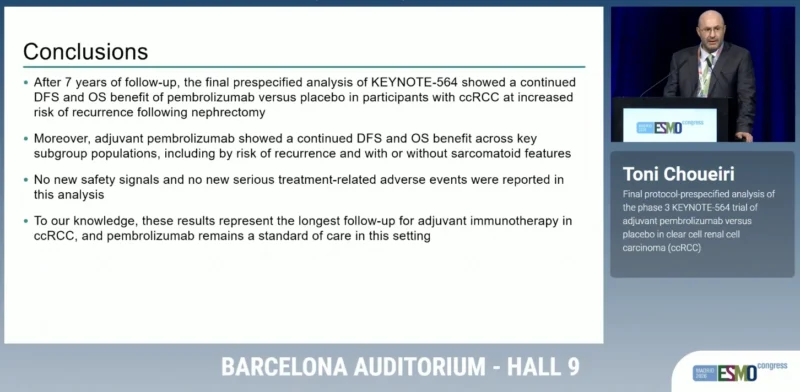
Updated analyses across protocol-defined risk subgroups and according to sarcomatoid features were reported, with the investigators concluding that the DFS and OS findings remained consistent with earlier study results. No new serious treatment-related adverse events were reported.
The investigators concluded that the final planned analysis of KEYNOTE-564 continued to support adjuvant pembrolizumab as a standard-of-care treatment for patients with clear cell renal cell carcinoma at increased risk of recurrence following surgery.
Source: ESMO Congress 2026 – Abstract 3589RO, Phase III KEYNOTE-564