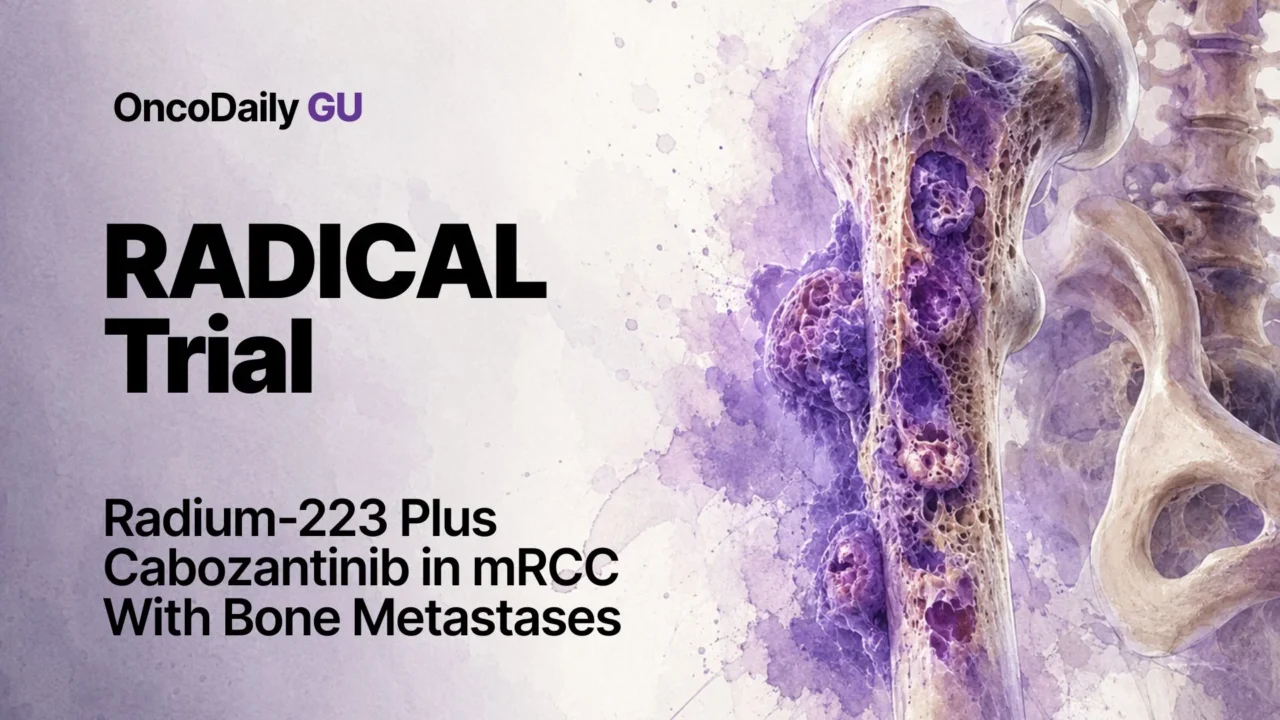
Bone metastases occur in approximately 30% of patients with metastatic renal cell carcinoma and are associated with poorer survival, pain, pathological fractures, spinal cord compression, and other symptomatic skeletal complications.
Results from the phase 2 RADICAL trial showed that adding the bone-targeted radiopharmaceutical radium-223 to cabozantinib did not improve symptomatic skeletal event–free survival compared with cabozantinib alone. The trial crossed its prespecified futility boundary during an interim analysis and was subsequently closed to further enrolment.
The article, titled “Phase II Randomized Trial of Radium-223 Dichloride and Cabozantinib in Patients With Renal Cell Carcinoma With Bone Metastases: RADICAL (Alliance A031801),” was published in the Journal of Clinical Oncology on July 27, 2026.
Authors: Rana R. McKay, Karla V. Ballman, Pamela J. Atherton, Archana Ajmera, Tareq Al Baghdadi, Brian C. Baumann, Himisha Beltran, Stephanie Berg, Ronald C. Chen, Atish D. Choudhury, Suzanne Cole, Heather A. Jacene, Joshua M. Lang, Deepak Kilari, Young Kwok, Bradley McGregor, Michael J. Morris, Mamta Parikh, Umang Swami, Alan Tan, Yuanquan A. Yang, Tian Zhang, Matthew Galsky, Jonathan Rosenberg, Daniel George, and Toni K. Choueiri.
Rationale for Targeting Bone Metastases
Bone metastases in renal cell carcinoma have traditionally been characterised as predominantly osteolytic. However, both bone resorption and bone formation are dysregulated within the tumour microenvironment, providing a rationale for treatments targeting both the cancer and the surrounding bone niche.
Cabozantinib inhibits several tyrosine kinases, including vascular endothelial growth factor receptor 2, MET, and AXL, and has demonstrated activity in patients with metastatic renal cell carcinoma involving the bone.
Radium-223 is an alpha-emitting radiopharmaceutical that acts as a calcium mimetic and selectively accumulates in areas of increased bone turnover. Its localised radiation induces DNA double-strand breaks at the bone–tumour interface. Previous studies in prostate cancer and an earlier pilot study in renal cell carcinoma provided the rationale for evaluating radium-223 alongside vascular endothelial growth factor–targeted therapy.
RADICAL Trial Design
RADICAL, also known as Alliance A031801 and NCT04071223, was a phase 2, open-label, randomised trial conducted through the Alliance for Clinical Trials in Oncology and supported by the National Cancer Institute.
Eligible patients had metastatic renal cell carcinoma of any histological subtype and at least one bone metastasis that had not previously been treated with radiotherapy. Both treatment-naïve and previously treated patients were eligible, although previous treatment with cabozantinib or radium-223 was not permitted.
Patients with an imminent pathological fracture or spinal cord compression were excluded. Concurrent osteoclast-targeted treatment with a bisphosphonate or denosumab was required unless contraindicated.
Participants were randomly assigned 1:1 to:
- Cabozantinib plus radium-223
- Cabozantinib alone
In the combination group, cabozantinib was initiated at 40 mg once daily during the first 28-day cycle and could be increased to 60 mg from cycle 2 when tolerated. Radium-223 was administered intravenously on day 1 of each cycle for up to six cycles.
Patients in the control group received cabozantinib at 60 mg once daily.
The primary endpoint was symptomatic skeletal event–free survival, defined as the time from randomisation to the first symptomatic skeletal event or death from any cause. Symptomatic skeletal events included radiotherapy for bone pain, symptomatic pathological fracture, spinal cord compression related to bone metastases, or tumour-related orthopaedic surgery.
Secondary endpoints included safety, objective response rate, progression-free survival, overall survival, time to the first symptomatic skeletal event, and time to subsequent systemic anticancer therapy. The trial originally planned to enrol 124 evaluable patients. A prespecified interim futility analysis was planned after approximately half of the expected primary endpoint events had occurred, with the study required to stop if the stratified hazard ratio exceeded 1.0.

Trial Closed After Interim Futility Analysis
A total of 98 patients were enrolled between December 2019 and December 2025. Of these, 48 were assigned to cabozantinib plus radium-223 and 50 to cabozantinib alone.
The median age was 63 years, 82.7% of participants had clear cell histology, and 87.8% had received previous systemic therapy. Approximately two-thirds had intermediate-risk disease according to the International Metastatic Renal Cell Carcinoma Database Consortium classification, while 79.6% were receiving osteoclast-targeted therapy at baseline.
The prespecified interim analysis was conducted after 90 patients had been enrolled and 50 symptomatic skeletal event–free survival events had occurred. The stratified hazard ratio was 1.24, crossing the protocol-defined futility boundary.
Based on a recommendation from the Alliance Data and Safety Monitoring Board, enrolment was stopped. The final analysis included all 98 enrolled patients.
No Improvement in SSE-FS
At a median follow-up of 13.1 months, 56 symptomatic skeletal event–free survival events had occurred. Median symptomatic skeletal event–free survival was:
- 16.7 months with cabozantinib plus radium-223
- 17.6 months with cabozantinib alone
The stratified hazard ratio was 1.46, with a 90% confidence interval of 0.86–2.51 and a one-sided p value of 0.12.
Twelve patients in the combination group and eight in the cabozantinib-alone group experienced a symptomatic skeletal event. Prespecified subgroup analyses did not identify a subgroup with a consistent benefit from adding radium-223, although the confidence intervals were wide because of the limited number of patients.
Median progression-free survival was also similar between the groups:
- 10.3 months with cabozantinib plus radium-223
- 10.5 months with cabozantinib alone
The stratified hazard ratio for progression or death was 1.37, with a 95% confidence interval of 0.74–2.53 and a p value of 0.32.
The confirmed objective response rate among evaluable patients was 19.4% with the combination and 25.0% with cabozantinib alone, with no significant difference between the groups.
Median overall survival was 28.3 months with cabozantinib plus radium-223 and 19.7 months with cabozantinib alone. However, the stratified hazard ratio was 1.40, with a wide 95% confidence interval of 0.70–2.79 and a p value of 0.34.
The investigators emphasised that the overall survival findings could not support a meaningful conclusion because of the small sample size, limited follow-up, wide confidence intervals, and instability between the stratified and unstratified analyses.
Methodological Uncertainty in the Primary Analysis
A notable feature of the study was the difference between the stratified and unstratified analyses of the primary endpoint. The stratified hazard ratio for symptomatic skeletal event–free survival was 1.46, whereas a post hoc unstratified analysis produced a hazard ratio of 0.97.
The authors suggested that using four stratification factors in a relatively small trial may have overparameterised the stratified statistical model. This discrepancy complicates interpretation of the precise treatment effect but does not provide evidence that radium-223 improved the primary endpoint.
The symptomatic skeletal event rate was also lower than anticipated when the trial was designed. Mandatory osteoclast-targeted therapy, exclusion of patients with imminent fractures or spinal cord compression, earlier use of palliative radiotherapy, and improvements in systemic treatment may all have reduced skeletal morbidity across both groups.
These factors may have limited the trial’s ability to detect an incremental benefit from radium-223 and suggest that future studies of bone-targeted therapies may need to consider alternative endpoints.
Safety Findings
The safety population included 95 patients who received at least one dose of study treatment.
Grade 3 or higher adverse events occurred in:
- 69.6% of patients receiving cabozantinib plus radium-223
- 75.5% of patients receiving cabozantinib alone
Grade 3 or higher adverse-event rates were similar between the treatment groups. However, haematological adverse events were more frequent with the combination. Grade 3 or higher decreases in lymphocyte counts occurred in 26.1% of patients in the combination group and 14.3% in the cabozantinib-alone group. Three cases of grade 3 or higher sepsis were reported with the combination, compared with none in the control group, although the investigators stated that attribution to treatment was uncertain.
Limitations and Clinical Interpretation
The study had several limitations. Enrolment extended from 2019 to 2025, during which the first-line treatment landscape for metastatic renal cell carcinoma changed substantially with the widespread adoption of immune checkpoint inhibitor–based combinations.
This evolution introduced heterogeneity in previous treatments and may also have produced selection bias, as patients who had already received cabozantinib were not eligible. The modest sample size reduced the reliability of analyses incorporating multiple stratification factors. The study also did not account for the anatomical location of bone metastases, which may influence the likelihood of symptomatic skeletal complications.
Finally, the median follow-up of 13.1 months was shorter than the estimated median symptomatic skeletal event–free and overall survival durations, resulting in wide confidence intervals and immature survival estimates. According to the investigators, RADICAL was, to their knowledge, the first randomised trial specifically designed to evaluate a bone-targeted therapeutic strategy in patients with metastatic renal cell carcinoma and bone metastases, as well as the largest prospective study of a therapeutic radiopharmaceutical in metastatic renal cell carcinoma. Despite its negative result, RADICAL provides prospective evidence on skeletal outcomes and may help inform the design and endpoint selection of future bone-directed studies.
Conclusion
The findings do not support adding radium-223 to cabozantinib for patients with metastatic renal cell carcinoma and bone metastases. Although the combination demonstrated a manageable safety profile and no fracture signal was observed, it did not improve symptomatic skeletal event–free survival and showed no advantage in progression-free survival or objective response rate over cabozantinib alone.
The unmet need in this population remains substantial. Future studies should investigate alternative bone-directed strategies and consider endpoints that reflect contemporary systemic treatment and improvements in skeletal care.
The full article is available on the Journal of Clinical Oncology.