
 Algeria
Key takeaways
- Life expectancy is a treatment variable. The same risk group gets a different standard at ≥10 years than at 5–10 years or less.
- Active surveillance is a protocol, not a shrug: PSA every 6 months, MRI, rectal exam and biopsy at most yearly, and no metastatic work-up unless risk rises.
- Observation is different: yearly clinical review without PSA, biopsy or imaging until symptoms appear.
- High-risk localized disease combines radiotherapy with 12–36 months of LHRH analogue, with abiraterone for 24 months in very high-risk or cN1M0 disease.
- Metastatic castration-sensitive disease is treated with an LHRH analogue plus an intensifying agent chosen by tumor volume. Plain androgen deprivation alone is reserved for patients who cannot take anything else.
- Offer bone protection in metastatic disease, with denosumab for bone metastases and dental assessment beforehand.
Prostate cancer is the third most common cancer in Algerian men, and one of the few where doing less is often the right answer. The 2026 Algerian National Therapeutic Guidelines organize care around risk group and life expectancy. As Movember draws attention to men’s health, the update is a good moment to look at what that means in practice.
A Common Cancer with a Good Prognosis, and a Real Decision Problem
According to the 2026 guidelines, prostate cancer ranks third among cancers in Algerian men. Incidence keeps rising, which the guidelines attribute to an ageing population, more sensitive diagnostic techniques and the spread of PSA testing, while mortality is falling thanks to more effective treatment. Relative 5-year survival is estimated at close to 80%, which keeps it a cancer of good prognosis overall.
That combination is what makes prostate cancer treatment decisions challenging. Many men have indolent disease and will die of something else; others have aggressive or metastatic disease that needs the full systemic arsenal. The chapter is built to separate the two, and it names its decision criteria explicitly:
- the D’Amico prognostic classification (TNM, ISUP grade, initial PSA);
- the length and number of positive biopsy cores;
- performance status;
- life expectancy, comorbidities, G8 score and functional status;
- patient choice and preferences. Where several options exist, the guidelines say they must always be explained and shared with the patient.
Every case is to be presented at an RCP with clinical, biological and radiological data before any treatment is decided.
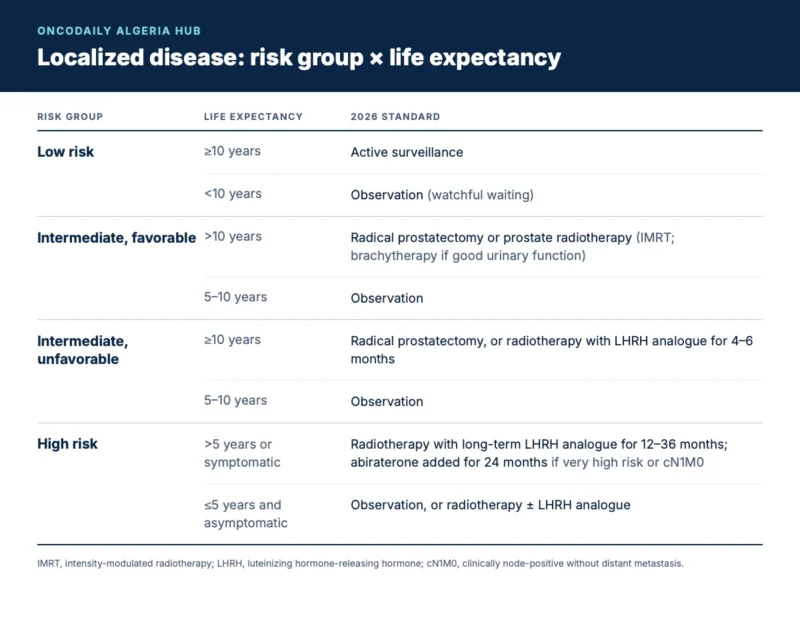
Radical prostatectomy (± extended pelvic lymph node dissection in a multimodal approach for cN0M0) is an option in high-risk disease. LHRH analogue alone is reserved for patients who cannot receive local treatment and have a PSA doubling time under 12 months, PSA above 50 ng/mL or a poorly differentiated tumor.
Active Surveillance and Observation in Prostate Cancer
The protocols are specific, and they are not the same thing:
- Active surveillance: PSA at least every 6 months, digital rectal exam and prostate MRI every 12 months at most, and biopsy every 12 months at most (the interval can be lengthened after 3 years without progression), unless clinically indicated. Staging for metastases is not requested unless the risk category worsens or unexplained symptoms appear. Patients move to observation if life expectancy falls below 10 years.
- Observation: clinical review at least every 12 months, with no biopsy, imaging or PSA monitoring until symptoms develop. Then the work-up is updated and treatment or palliative care discussed.
Prostate Cancer Management After Surgery and Radiotherapy
- Adjuvant: radiotherapy is listed as standard for pN0M0 patients with ISUP grade group 4–5 and pT3 disease, with or without positive margins. For pN1M0 after extended dissection, options include LHRH analogue alone, LHRH analogue with radiotherapy, or surveillance if there are two or fewer positive nodes and PSA is undetectable.
- Biochemical relapse after prostatectomy: salvage prostate radiotherapy is the standard, with LHRH analogue added in the options. Enzalutamide plus androgen deprivation is an option for high-risk biochemical recurrence. Surveillance is possible in low EAU risk (PSA doubling time over 12 months, ISUP grade group below 4).
- Biochemical relapse after radiotherapy: there is no standard. For documented prostatic relapse without metastases, selected patients can be discussed for surveillance or local treatment (cryotherapy, high-intensity ultrasound, re-irradiation, or salvage radical prostatectomy with extended node dissection).
Advanced Disease: a Systemic-Therapy Ladder
Non-metastatic castration-resistant (M0). Continue the LHRH analogue. If PSA doubling time is 10 months or less, add enzalutamide; if longer than 10 months, surveillance. Apalutamide is listed as an option.
Metastatic castration-sensitive (M1). LHRH analogue plus one of the following, depending on tumor volume:
- low volume: abiraterone (with prostate radiotherapy if metastases are synchronous) or enzalutamide;
- high volume: docetaxel plus abiraterone (synchronous metastases), abiraterone, enzalutamide or apalutamide.
Metastatic castration-resistant (M1).
- Before an androgen-receptor pathway inhibitor: abiraterone, enzalutamide, or docetaxel for symptomatic metastases.
- After an androgen-receptor pathway inhibitor and before docetaxel: docetaxel.
- After both: cabazitaxel.
- Docetaxel rechallenge can be discussed after an initial response longer than 6 months.
- Platinum-based chemotherapy is an option for small-cell or neuroendocrine histology.
- In metastatic castration-resistant prostate cancer with bone metastases, denosumab may be used to reduce the risk of skeletal-related events, according to the 2026 Algerian guidelines.
What Changed From 2024
Comparing the 2024 and 2026 prostate chapters, several differences are clear:
- Active surveillance is now the standard for low-risk disease with life expectancy of 10 years or more. In 2024, surgery, external radiotherapy and brachytherapy were the standards, and surveillance was an option for very low risk.
- The structure is simpler and organized by risk group and life expectancy, with intermediate risk split into favorable and unfavorable in the headings themselves. The 2024 text used 6 months of hormone therapy for unfavorable intermediate risk; 2026 specifies 4–6 months.
- Adjuvant radiotherapy after prostatectomy for pN0M0 ISUP 4–5 pT3 disease is a 2026 standard. In 2024, close PSA monitoring with delayed radiotherapy at biochemical relapse was the standard, with no adjuvant treatment indicated.
- Salvage and non-metastatic castration-resistant disease: enzalutamide plus androgen deprivation appears as an option in high-risk biochemical recurrence, and apalutamide as an option in M0 castration-resistant disease.
- Sources: the 2024 guide cites AFU, EAU and NCCN recommendations; the 2026 guide cites ESMO, EAU and NCCN.
What the Chapter Does Not Cover
The 2026 prostate chapter does not discuss PSMA PET, germline or somatic BRCA testing, PARP inhibitors, or radioligand therapy, and prostate MRI appears only in the active surveillance protocol. That is a statement about the Algerian chapter, not about other guidelines. Whether these tools are accessible nationally is not something the documents answer.
The Algerian Context: What the Documents Show
Burden. The Cancer Dashboard 2025–2035 confirms that prostate cancer is the third most common cancer diagnosis and the fifth most common cause of cancer death among Algerian men. Among the 28 countries in the WHO Northern Africa, Central and Western Asia hub, Algeria has the 12th highest incidence rate and the 17th highest mortality rate.
Screening. There is no organized prostate cancer screening in Algeria. Men aged 50–70 can have a digital rectal exam and a PSA test, but the Dashboard states that no information is available on how widely they are used. It also notes the usual caveat: PSA testing mainly finds low-grade cancer, so used alone it can lead to overdiagnosis and overtreatment, and the 2015–2019 National Cancer Plan described PSA screening as typically inefficient. The 2025 National Strategy nonetheless proposes developing a national organized prostate cancer screening program, with:
- informed consent first;
- a target population of men aged 50 and over, or 45 with a family history of cancer;
- digital rectal exam plus PSA as tools;
- a 2- to 4-year interval depending on risk and initial PSA;
- involvement of general practitioners and patient associations, a defined care network for screened men, dedicated funding and periodic evaluation.
The Dashboard’s recommendation is to consider awareness campaigns on symptoms and the benefits of early detection, and to choose the target population and method carefully if screening is implemented.
Survival. Using Concord-3 data for patients diagnosed in 2010–2014, the Dashboard reports that Algerian patients with breast, colon, rectal and prostate cancer had lower survival than Jordanian patients, and that the largest gap was in prostate cancer, at 22 percentage points. These are older data and a comparison with one country, but they are a reminder that the 80% relative survival cited in the guidelines is not guaranteed for every patient.
Capacity. Much of the guideline’s localized-disease pathway depends on radiotherapy. Algeria had 57 external beam radiotherapy units as of the latest count (79% public), against an estimated need of about 98 using IAEA benchmarks, or a shortfall of 103 units in a separate global forecast. Of 60 new cancer medicines approved by the EMA in 2015–2020, 16 (27%) had been approved in Algeria as of March 2025. The Dashboard also reports 8 PET scanners and 2 PET-MRI units nationally. The documents do not say how these figures translate into access for prostate patients specifically.
Clinical Perspective
The 2026 prostate chapter is a lesson in proportionality. Its most consequential recommendations are about restraint: active surveillance as the standard for low-risk disease, observation for men with limited life expectancy, and a specific, structured surveillance protocol so that “doing nothing” is a plan rather than a lapse. At the other end, advanced prostate cancer has a clearly sequenced treatment pathway involving androgen-receptor pathway inhibitors and taxanes.
For Algerian clinicians, the practical risk sits at both ends. Without organized screening, men may arrive with advanced disease, or conversely be diagnosed with low-risk cancer through opportunistic PSA and offered more treatment than they need. Applying the guideline well means giving each man a decision based on risk group, life expectancy and preference, discussed at RCP, and having the radiotherapy and imaging capacity to deliver the plan.
FAQ
Is prostate cancer screening organized in Algeria?
No. Men aged 50–70 can request a digital rectal exam and PSA, but there is no organized program and no available data on uptake. The 2025–2035 National Strategy recommends developing one, with informed consent, a target population of men aged 50 and over (45 with a family history), and a 2- to 4-year interval.
Why is PSA screening debated?
Because PSA mainly detects low-grade cancers that may never cause harm, so screening on PSA alone can lead to overdiagnosis and overtreatment. The Dashboard notes that the WHO makes no general screening recommendation and that the EU Council advocates stepwise, research-integrated screening with PSA followed by MRI.
Does low-risk prostate cancer require immediate treatment?
Not "no treatment", but active surveillance if life expectancy is 10 years or more, and observation if shorter. Surgery or radiotherapy remain options when active surveillance isn't suitable for a patient.
When is hormone therapy added to radiotherapy?
In unfavorable intermediate-risk disease it is given for 4–6 months, and in high-risk disease for 12–36 months. Abiraterone for 24 months is added in very high-risk or cN1M0 disease.
What treatment options exist for metastatic hormone-sensitive disease?
An LHRH analogue combined with abiraterone, enzalutamide, apalutamide or docetaxel plus abiraterone, depending on tumor volume and whether metastases are synchronous. Local prostate radiotherapy can be added in low-volume synchronous disease.
Are the newer drugs and tools available in Algeria?
The guidelines say indications are based on treatments registered in Algeria, but the national documents don't give agent-by-agent availability. Broader data show a gap between international approval and Algerian registration: 27% of recent EMA-approved cancer drugs as of March 2025.