Free PSA and total PSA are blood tests used to assess prostate health and help estimate the risk of prostate cancer. While total PSA measures all prostate-specific antigen circulating in the blood, free PSA measures only the portion that is not attached to other proteins.
The relationship between these two measurements can provide additional information when total PSA is elevated, particularly in the borderline range of 4–10 ng/mL. A lower free-to-total PSA ratio is associated with a higher likelihood of prostate cancer, while a higher ratio is generally more reassuring.
However, neither total PSA nor free PSA can confirm prostate cancer on its own. Doctors interpret these results alongside age, prostate size, medical history, and other examinations to determine whether further testing is needed.
What Is the Difference Between Free PSA and Total PSA?
Total PSA measures the overall amount of prostate-specific antigen in the blood, while free PSA measures the portion that circulates without being attached to blood proteins.
Prostate-specific antigen (PSA) is a protein produced by cells in the prostate gland. Its main function is to help liquefy semen, although small amounts naturally enter the bloodstream.
In the blood, PSA exists in two main forms: free PSA, which circulates independently, and complexed PSA, which is attached to proteins. Total PSA includes both forms and is the standard measurement used during prostate cancer screening and initial risk assessment.
Higher total PSA levels may indicate prostate cancer, but they can also occur in benign prostatic hyperplasia (BPH), prostatitis, and other non-cancerous conditions. This limits the ability of total PSA testing to distinguish malignant from benign prostate changes.
Free PSA provides additional information because men with prostate cancer tend to have a lower proportion of free PSA compared with men who have benign prostate enlargement.
The free-to-total PSA ratio is particularly helpful when total PSA is moderately elevated and doctors need to decide whether further investigation is appropriate. Rather than replacing total PSA, it helps refine the interpretation of an abnormal result
What Is a Normal Free PSA Percentage?
There is no single free PSA percentage that definitively separates prostate cancer from benign conditions. However, a higher percentage of free PSA is generally associated with a lower likelihood of prostate cancer, particularly when total PSA is between 4 and 10 ng/mL.
The percentage represents how much of the total PSA in the bloodstream is circulating freely rather than being attached to other proteins.
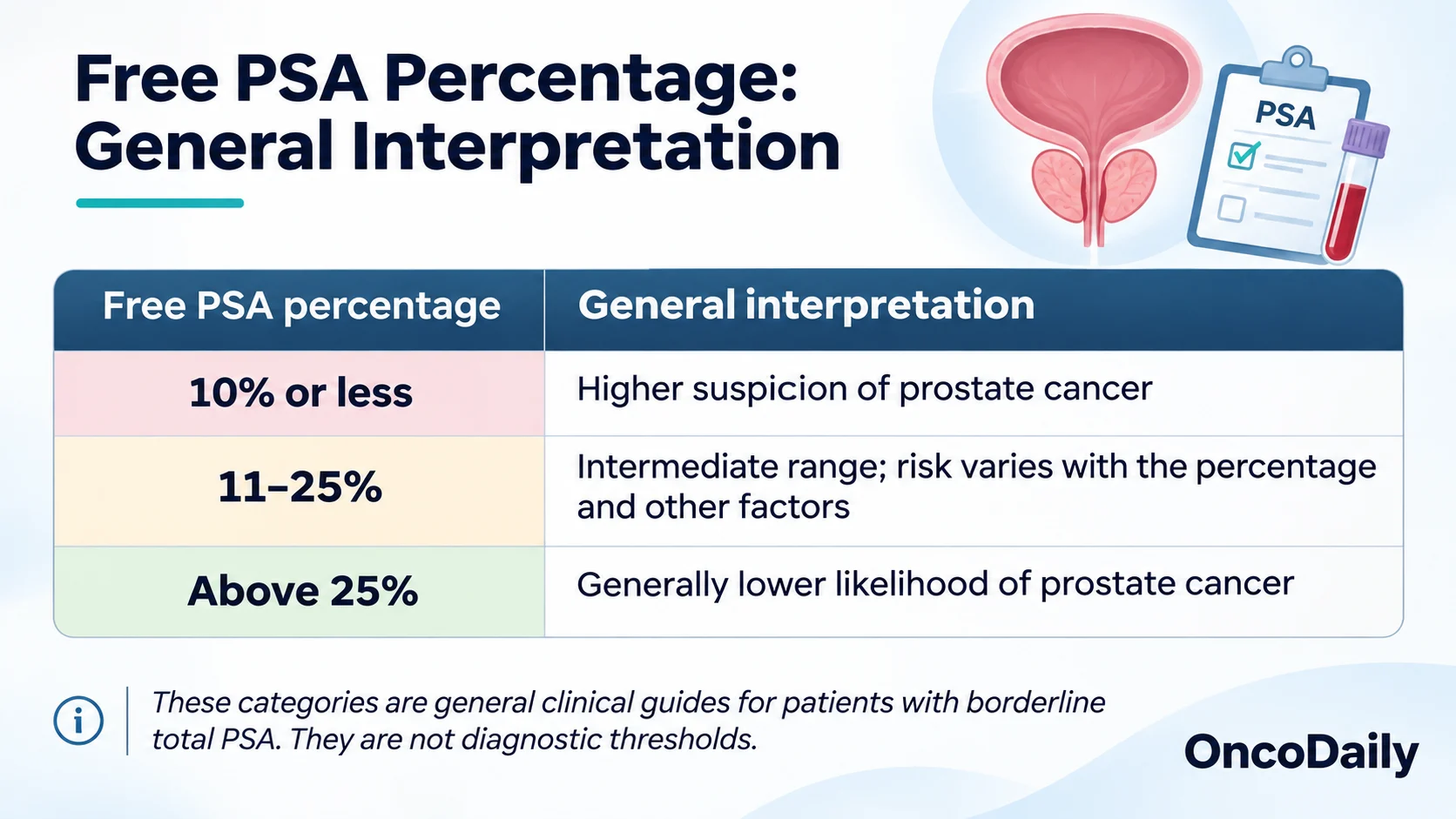
According to the American Cancer Society, many doctors recommend considering a prostate biopsy when percent-free PSA is 10% or less. When results fall between 10% and 25%, a biopsy may also be considered depending on the patient’s overall risk.
Nevertheless, these thresholds are not universally applied. The interpretation depends on total PSA concentration, age, previous test results, prostate volume, and other clinical findings.
A free PSA percentage above 25% is generally more reassuring, but it does not completely exclude cancer. Similarly, a result below 10% raises suspicion without confirming that cancer is present.
The free PSA percentage is most useful when interpreted as part of an overall risk assessment rather than as an isolated laboratory value (American Cancer Society, n.d.; College of American Pathologists, 2025).
Does Low Free PSA Indicate Prostate Cancer?
A low free-to-total PSA ratio is associated with an increased likelihood of prostate cancer, but it does not establish a diagnosis.
Men with prostate cancer often have a smaller proportion of circulating free PSA than those with benign prostate conditions. This difference is thought to reflect changes in how PSA is produced, processed, and released into the bloodstream.
For example, two patients may have the same total PSA level of 6 ng/mL but different free PSA percentages. A patient with a free PSA percentage of 8% would generally be considered at higher risk than someone with a percentage of 28%, assuming other clinical characteristics are comparable.
However, free PSA is not a direct measure of tumor size, cancer stage, or aggressiveness. A low percentage does not necessarily mean that cancer is advanced, and the test cannot determine whether a tumor has spread outside the prostate.
Its usefulness is also influenced by the total PSA level. The College of American Pathologists recommends interpreting free PSA only within the total PSA range validated by the testing laboratory, commonly between approximately 2–10 ng/mL or 4–10 ng/mL.
Outside this range, the ratio may be less reliable for distinguishing prostate cancer from benign conditions.
Doctors therefore use low free PSA as a reason to consider additional risk assessment, rather than as proof of malignancy (College of American Pathologists, 2025; Prostate Cancer Foundation of Australia, n.d.).
How Is the Free-to-Total PSA Ratio Calculated?
The free-to-total PSA ratio is calculated by dividing the free PSA concentration by the total PSA concentration. The result is usually expressed as a percentage to make it easier to interpret.
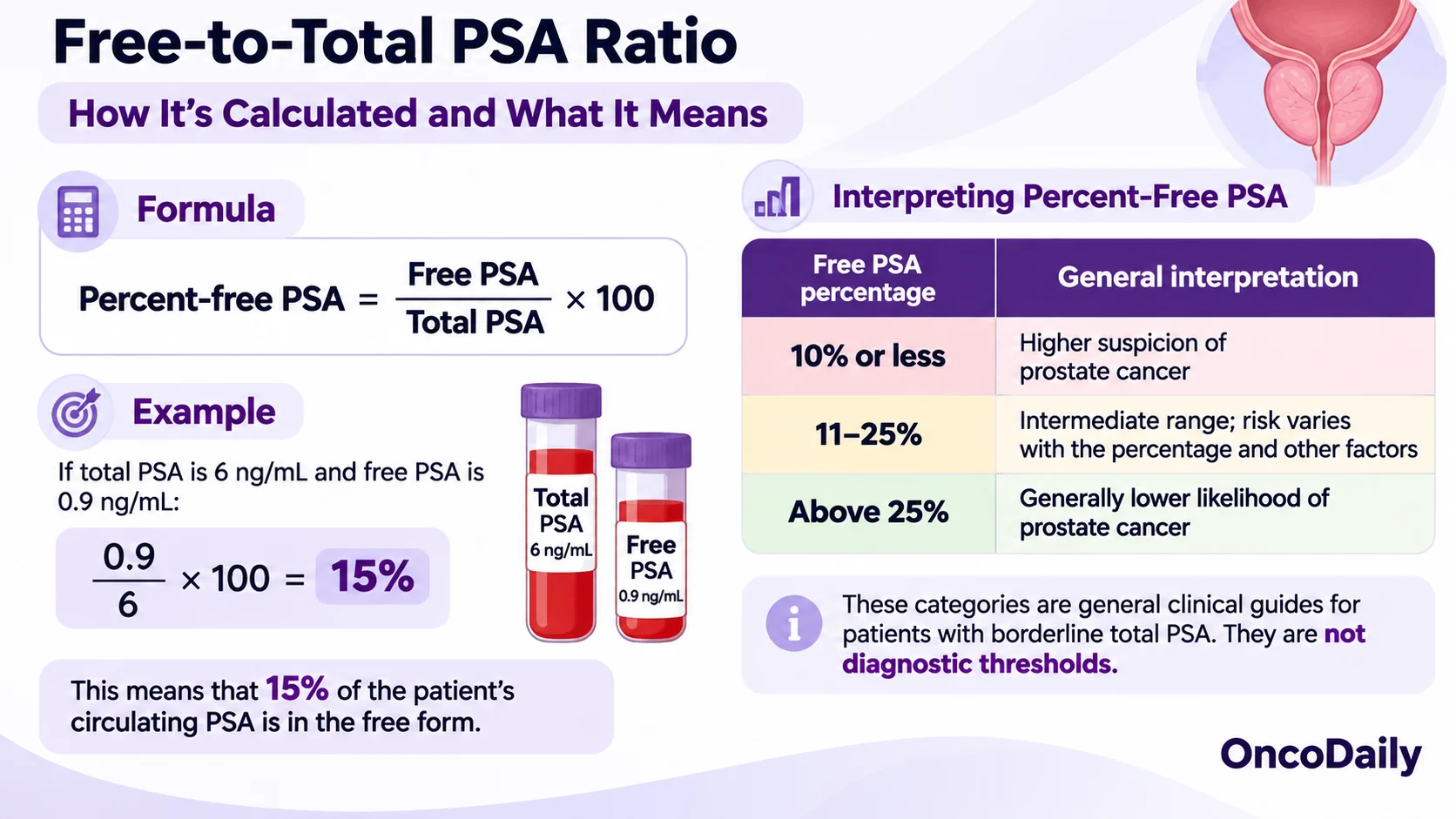
In clinical practice, laboratories usually calculate the percentage automatically when both free and total PSA are measured. The result is included in the blood test report and can help doctors determine whether further testing is appropriate.
The same percentage can have different clinical implications depending on the patient’s age, total PSA concentration, prostate size, and previous results. For example, a free PSA percentage of 15% may prompt different recommendations in a younger patient with a strong family history of prostate cancer than in an older patient with known benign prostate enlargement.
The ratio should also be calculated using free and total PSA measurements obtained from the same blood sample and appropriate laboratory methods. Differences between assays can affect the result.
The free-to-total PSA ratio is a risk assessment tool, not a calculation of an individual’s exact probability of having cancer.It should be interpreted according to the laboratory’s validated reference ranges and the patient’s clinical circumstances (College of American Pathologists, 2025).
When Is a Prostate MRI or Biopsy Recommended?
Further testing may be recommended when total PSA remains elevated, particularly when a low free-to-total PSA ratio or other clinical findings suggest an increased risk of prostate cancer.
However, an elevated PSA result does not automatically lead to a biopsy. Doctors often begin by repeating the PSA test to confirm that the increase is persistent, especially when the patient has no concerning symptoms.
If PSA remains elevated, additional assessment may include a digital rectal examination, PSA density measurement, prostate MRI, or other blood and urine biomarkers.
Multiparametric prostate MRI (mpMRI) is commonly used to identify suspicious areas and help determine whether a biopsy is necessary. MRI findings are generally classified using the PI-RADS scoring system, which estimates the likelihood of clinically significant prostate cancer.
PI-RADS 3 findings are considered uncertain and require assessment alongside other risk factors, while PI-RADS 4 and 5 findings carry higher levels of suspicion and generally warrant targeted biopsy.
A low free PSA percentage may strengthen the case for further investigation, particularly when it occurs alongside persistently elevated total PSA, increased PSA density, or suspicious MRI findings.
If biopsy is recommended, tissue samples are collected from the prostate and examined by a pathologist. This examination is necessary to confirm the presence of cancer and determine its histological grade.
A negative MRI does not completely exclude prostate cancer. Patients with a sufficiently high clinical risk may still require biopsy, even when imaging does not identify a suspicious lesion.
The decision should consider the patient’s overall health, family history, personal preferences, and the possible benefits and risks of further testing (National Cancer Institute, n.d.; Wei et al., 2023).

Can PSA Levels Be Abnormal Without Cancer?
Yes. Elevated total PSA levels are common in several non-cancerous prostate conditions, and an abnormal PSA result does not necessarily indicate prostate cancer.
One of the most frequent causes is benign prostatic hyperplasia (BPH), a non-cancerous enlargement of the prostate that becomes increasingly common with age. As prostate volume increases, more PSA may enter the bloodstream, leading to higher total PSA levels.
Prostatitis, or inflammation of the prostate, can also cause PSA concentrations to rise. Urinary tract infections may temporarily affect PSA results, particularly when the infection involves the prostate.
Other factors that can influence PSA measurements include recent ejaculation, certain prostate procedures, and activities that place pressure on the perineal region, such as prolonged cycling.
Medications are another important consideration. Finasteride and dutasteride, commonly prescribed for prostate enlargement, can substantially lower total PSA concentrations. Doctors need to account for these effects when interpreting results.
PSA levels may also fluctuate naturally between measurements. For this reason, the National Cancer Institute notes that repeating an elevated PSA test is often appropriate before proceeding with more invasive investigations.
Although free PSA testing can help distinguish benign enlargement from possible malignancy, it cannot identify the exact cause of an abnormal PSA level.
A persistently elevated PSA, particularly when accompanied by a low free PSA percentage, should be discussed with a urologist. Further evaluation may be appropriate even when there are no urinary symptoms.
The most informative assessment combines PSA results with the patient’s medical history, examination findings, and imaging when indicated, rather than relying on a single laboratory threshold (National Cancer Institute, n.d.; American Cancer Society, n.d.).
FAQ
What is the difference between free PSA and total PSA?
Total PSA measures all prostate-specific antigen in the blood, while free PSA measures only the portion not bound to proteins. Their ratio helps assess prostate cancer risk.
What is a normal free PSA percentage?
A free PSA percentage above 25% generally suggests a lower likelihood of prostate cancer, particularly when total PSA is between 4–10 ng/mL.
Does low free PSA mean prostate cancer?
No. A low free PSA percentage is associated with a higher likelihood of prostate cancer, but it cannot confirm a diagnosis. Further testing may be necessary.
Is a total PSA of 4–10 ng/mL dangerous?
Not necessarily. This is considered a borderline range in which prostate cancer risk is increased, but benign prostate enlargement and inflammation can also cause elevated levels.
Can free PSA levels help avoid an unnecessary prostate biopsy?
Yes. Free PSA testing can help doctors assess cancer risk and determine whether a biopsy is appropriate, particularly when total PSA is borderline. It cannot rule out cancer completely.