At the ESMO Congress 2026, Karim Fizazi (Lille, France) presented long-term overall survival (OS) results from the Phase III PEACE-1 trial (NCT01957436), evaluating the addition of abiraterone acetate plus prednisone to standard-of-care treatment in patients with de novo metastatic castration-sensitive prostate cancer (mCSPC).
The analysis, presented in the Proffered Paper session (2215O), reported updated survival outcomes after a median follow-up of 7.7 years, including results according to docetaxel use and metastatic disease volume.
Why Was the Long-Term PEACE-1 Analysis Conducted?
Systemic treatment intensification has demonstrated survival benefits in patients with mCSPC. However, long-term follow-up data remain limited. Previous PEACE-1 results demonstrated an overall survival benefit with the addition of abiraterone to standard-of-care treatment. The current long-term analysis evaluated survival outcomes after a median follow-up of 7.7 years, including among patients receiving ADT plus docetaxel and according to metastatic disease volume.
PEACE-1 Study Design and Methods
PEACE-1 was a randomized Phase III trial with a 2×2 factorial design, evaluating the addition of abiraterone acetate plus prednisone and/or prostate radiotherapy (RT) to standard-of-care treatment consisting of ADT with or without docetaxel. A total of 1,173 men with de novo mCSPC were randomized 1:1:1:1 to four treatment groups:
- Standard of care (SOC)
- SOC plus abiraterone
- SOC plus prostate radiotherapy
- SOC plus abiraterone and prostate radiotherapy
At baseline, 57% of patients had high-volume metastatic disease and 43% had low-volume disease. The long-term analysis assessed overall survival after a median follow-up of 7.7 years.
Key Findings from PEACE-1
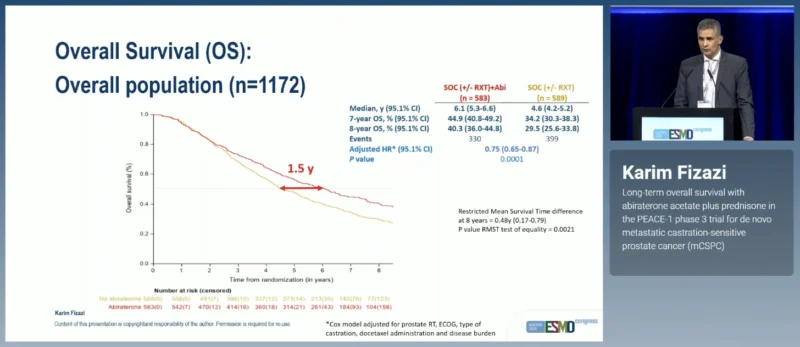
After a median follow-up of 7.7 years, adding abiraterone to standard-of-care treatment significantly improved overall survival in the overall analysis population (n=1,172; HR 0.75; 95% CI 0.65–0.87; p=0.0001). Median OS was 6.1 years (95% CI 5.3–6.6) among patients receiving abiraterone versus 4.6 years (95% CI 4.2–5.2) among those not receiving abiraterone. At eight years, estimated OS rates were 40.3% (95% CI 36.0–44.8) versus 29.5% (95% CI 25.6–33.8), respectively.
Overall Survival With Triplet Therapy
Among 710 patients who received ADT plus docetaxel as their standard-of-care treatment, the addition of abiraterone was associated with improved overall survival (HR 0.68; 95% CI 0.56–0.82).
Median OS was 4.4 years (95% CI 4.0–4.9) with ADT plus docetaxel (doublet therapy), compared with 6.2 years (95% CI 5.2–7.3) with ADT plus docetaxel and abiraterone (triplet therapy).
At eight years, overall survival rates were:
- Doublet therapy: 27.1% (95% CI 22.1–32.9).
- Triplet therapy: 40.3% (95% CI 34.3–46.6).
These findings showed higher long-term survival rates with the addition of abiraterone to ADT plus docetaxel.
Overall Survival According to Metastatic Disease Volume
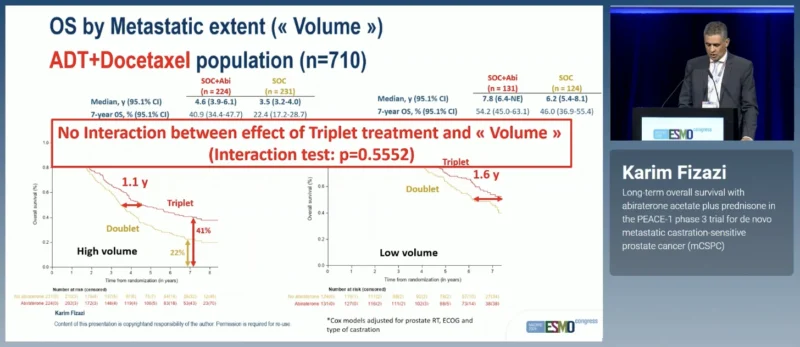
The long-term analysis also evaluated the effect of triplet therapy according to metastatic disease volume. The treatment effect did not show evidence of a statistically significant interaction with metastatic extent (interaction p=0.56).
High-volume metastatic disease
Among patients with high-volume disease receiving ADT plus docetaxel as standard of care, median OS was 3.5 years (95% CI 3.2–4.0) with doublet therapy versus 4.6 years (95% CI 3.9–6.1) with triplet therapy (HR 0.67; 95% CI 0.54–0.85; p=0.0007). At seven years, estimated OS rates were 22.4% (95% CI 17.2–28.7) with doublet therapy versus 40.9% (95% CI 34.4–47.7) with triplet therapy.
Low-volume metastatic disease
Among patients with low-volume disease receiving ADT plus docetaxel as standard of care, median OS was 6.2 years (95% CI 5.4–8.1) with doublet therapy versus 7.8 years (95% CI 6.4–not estimable) with triplet therapy (HR 0.74; 95% CI 0.51–1.05; p=0.091). The hazard ratio numerically favoured triplet therapy, although the difference was not statistically significant in this subgroup.
Conclusions
The long-term follow-up of the Phase III PEACE-1 trial demonstrated a sustained overall survival benefit with the addition of abiraterone acetate plus prednisone to standard-of-care treatment in patients with de novo metastatic castration-sensitive prostate cancer. Among patients receiving ADT plus docetaxel, triplet therapy was associated with longer median OS (6.2 vs 4.4 years) and higher eight-year survival rates (40.3% vs 27.1%) compared with doublet therapy.
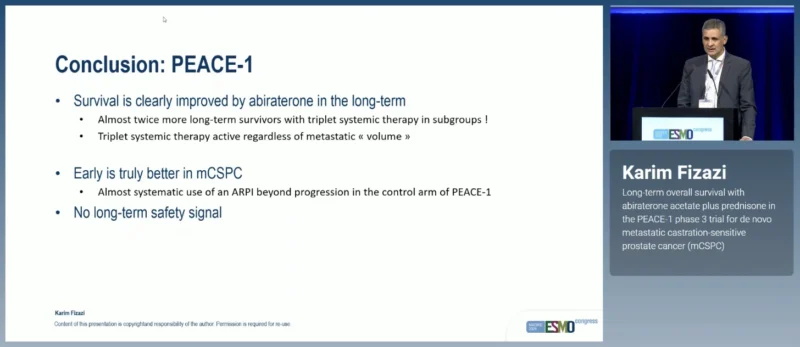
The survival outcomes favoured triplet therapy in both high- and low-volume metastatic disease, with no statistically significant interaction according to metastatic extent. However, the confidence interval for the low-volume subgroup hazard ratio included 1. These long-term findings support the survival benefit associated with adding abiraterone to standard-of-care treatment, including ADT plus docetaxel, in patients with de novo mCSPC.
Source: ESMO Congress 2026 – Abstract 2215O, PEACE-1
Read more about TALAPRO-3 at ESMO 2026 on OncoDaily.