
At the ESMO Congress 2026, Matthew D. Galsky (New York, USA) presented an exploratory molecular analysis from the Phase III NIAGARA trial (NCT03732677), evaluating the association between genomic alterations, transcriptome-defined molecular subtypes, and treatment outcomes in patients with muscle-invasive bladder cancer (MIBC).
The analysis, presented in the Rapid Oral session (4741RO), assessed event-free survival (EFS) outcomes with perioperative durvalumab plus neoadjuvant chemotherapy according to tumour molecular characteristics.
Why Was the NIAGARA Molecular Analysis Conducted?
Muscle-invasive bladder cancer is molecularly heterogeneous, with known genomic drivers and transcriptome-defined subtypes that influence prognosis and treatment response.
The Phase III NIAGARA trial previously demonstrated significant improvements in EFS and overall survival (OS) with perioperative durvalumab plus neoadjuvant chemotherapy compared with neoadjuvant chemotherapy alone in patients with MIBC. The current exploratory analysis evaluated molecular drivers and transcriptome-defined subtypes in relation to treatment outcomes.
NIAGARA Study Design and Methods
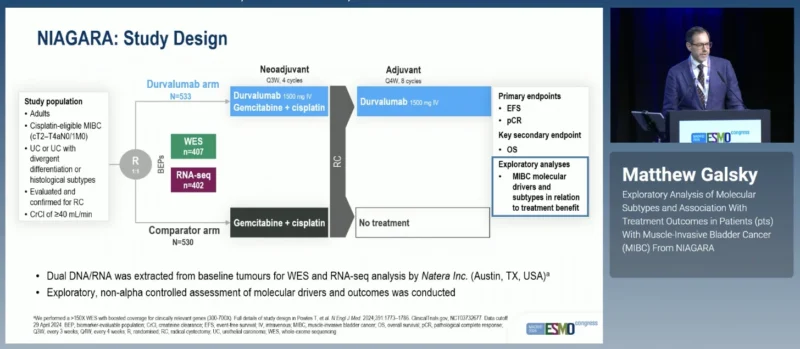
NIAGARA enrolled 1,063 cisplatin-eligible patients with MIBC (cT2–T4aN0/1M0) who were planned for radical cystectomy. Patients were randomized 1:1 to receive perioperative durvalumab plus neoadjuvant gemcitabine and cisplatin followed by radical cystectomy, or neoadjuvant chemotherapy followed by radical cystectomy without durvalumab.
Event-free survival was a primary endpoint. For the exploratory molecular analysis, DNA and RNA were extracted from baseline tumour samples. Whole-exome sequencing (WES) was performed in 407 patients, while RNA sequencing was performed in 402 patients. The analyses were conducted by Natera, Inc.
The investigators evaluated associations between molecular alterations, transcriptome-defined subtypes, and EFS outcomes. These analyses were exploratory and not alpha-controlled.
Key Findings from NIAGARA
In the intention-to-treat population (N=1,063), the 24-month EFS rate was 68% with durvalumab plus neoadjuvant chemotherapy versus 60% with chemotherapy alone (HR 0.68; 95% CI 0.56–0.82).
Event-Free Survival According to Genomic Alterations
In the WES population, EFS hazard ratios favoured durvalumab plus neoadjuvant chemotherapy across the reported mutation-defined subgroups. Among patients with TP53-mutated tumours (n=204), the 24-month EFS rate was 77% with durvalumab plus chemotherapy versus 64% with chemotherapy alone (HR 0.51; 95% CI 0.32–0.81).
In patients with FGFR3-mutated tumours (n=44), the corresponding EFS rates were 90% versus 66% (HR 0.24; 95% CI 0.07–0.87). TP53 and FGFR3 mutations were largely mutually exclusive. For patients with alterations in cell-cycle pathway genes (TP53, RB1, or CDKN2A/B; n=254), 24-month EFS rates were 76% versus 67% (HR 0.58; 95% CI 0.38–0.88).
Among patients with RTK/RAS/PI3K pathway alterations (n=168), 24-month EFS rates were 80% versus 73% (HR 0.49; 95% CI 0.28–0.85). In patients with high tumour mutational burden (TMB; n=161), the 24-month EFS rate was 84% with durvalumab plus chemotherapy versus 62% with chemotherapy alone (HR 0.44; 95% CI 0.25–0.76).
The investigators observed numerically greater EFS treatment effects in several molecularly defined subgroups, including patients with TP53- or FGFR3-mutated tumours and those with high TMB, compared with the overall intention-to-treat population. These subgroup analyses were exploratory and not alpha-controlled.
Event-Free Survival According to Molecular Subtypes
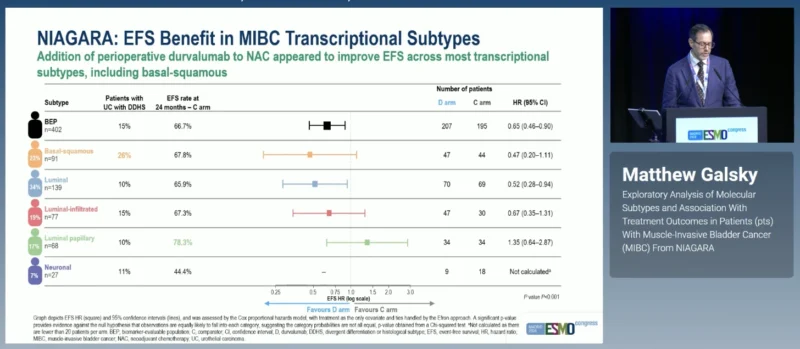
RNA sequencing identified transcriptome-defined molecular subtypes using The Cancer Genome Atlas classification. EFS hazard ratios numerically favoured durvalumab plus chemotherapy in the basal-squamous, luminal, and luminal-infiltrated subgroups, but not in the luminal-papillary subgroup. An EFS hazard ratio was not calculated for the neuronal subtype.
Among patients with the basal-squamous subtype (n=91), 24-month EFS rates were 83% with durvalumab plus chemotherapy versus 68% with chemotherapy alone (HR 0.47; 95% CI 0.20–1.11).
In patients with the luminal subtype (n=139), 24-month EFS rates were 79% versus 66%, respectively (HR 0.52; 95% CI 0.28–0.94). For patients with luminal-infiltrated tumours (n=77), the corresponding EFS rates were 63% versus 67% (HR 0.67; 95% CI 0.35–1.31). In the luminal-papillary subgroup (n=68), 24-month EFS rates were 70% with durvalumab plus chemotherapy and 78% with chemotherapy alone (HR 1.35; 95% CI 0.64–2.87).
Among patients with the neuronal subtype (n=27), 24-month EFS rates were 78% versus 44%, although an EFS hazard ratio was not calculated.
Molecular Characteristics of the Basal-Squamous Subtype
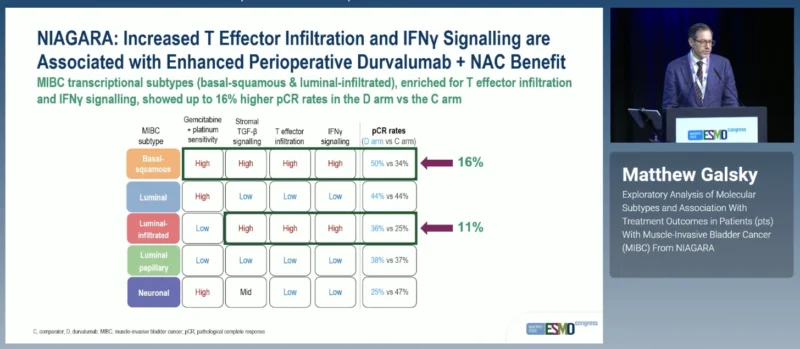
Among the transcriptome-defined subtypes with calculable hazard ratios, the basal-squamous subgroup had the lowest numerical EFS hazard ratio with durvalumab plus neoadjuvant chemotherapy (HR 0.47; 95% CI 0.20–1.11).
This subtype was characterized by a higher frequency of TP53 mutations (60% versus 50% or less in other subtypes), an enriched immune-infiltration gene signature, and a higher prevalence of variant histology (26% versus 15% or less in other subtypes). Although the EFS hazard ratio numerically favoured durvalumab plus chemotherapy, the confidence interval included 1. The findings were exploratory and do not establish a statistically significant treatment benefit within this subgroup.
Conclusions
The exploratory molecular analysis of the Phase III NIAGARA trial suggested broadly favourable EFS outcomes with perioperative durvalumab plus neoadjuvant chemotherapy across multiple genomic and transcriptomic subgroups in patients with muscle-invasive bladder cancer. EFS hazard ratios favoured durvalumab plus chemotherapy across the reported mutation-defined subgroups, including tumours with TP53, FGFR3, cell-cycle pathway, and RTK/RAS/PI3K pathway alterations, as well as high TMB.
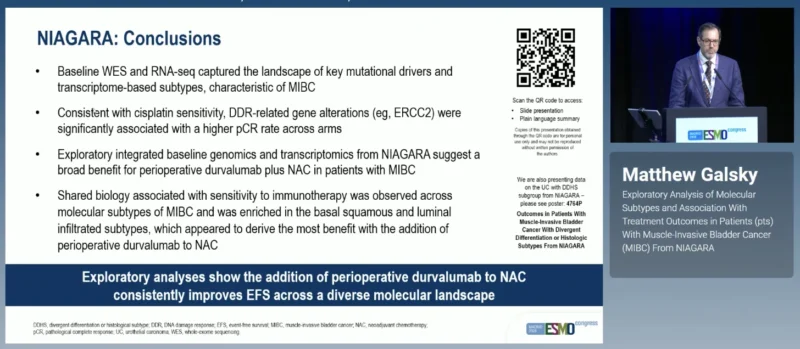
Across transcriptome-defined subtypes, EFS hazard ratios numerically favoured durvalumab plus chemotherapy in the basal-squamous, luminal, and luminal-infiltrated groups, but not in the luminal-papillary group. The basal-squamous subtype had the lowest numerical EFS hazard ratio among the transcriptomic subtypes with calculable hazard ratios (HR 0.47; 95% CI 0.20–1.11).
These exploratory findings suggest a broad EFS treatment effect with perioperative durvalumab plus neoadjuvant chemotherapy across a diverse molecular landscape in MIBC. However, the molecular analyses were not alpha-controlled, and the subgroup findings should be interpreted accordingly.
Source: ESMO Congress 2026 – Abstract 4741RO, NIAGARA
Read more about Phase Ib/II EV-103 at ESMO 2026 on OncoDaily.