At the ESMO Congress 2026, Jose Pablo Maroto Rey (Barcelona, Spain) presented long-term follow-up results from the Phase Ib/II EV-103/KEYNOTE-869 study (NCT03288545), evaluating enfortumab vedotin (EV) with or without pembrolizumab as first-line treatment in patients with cisplatin-ineligible locally advanced or metastatic urothelial carcinoma (la/mUC).
The analysis, presented in the Rapid Oral session (4740RO), reported updated efficacy and safety outcomes, with approximately seven years of follow-up in the dose-escalation and Cohort A populations and five years in Cohort K.
Why Was the Long-Term EV-103 Analysis Conducted?
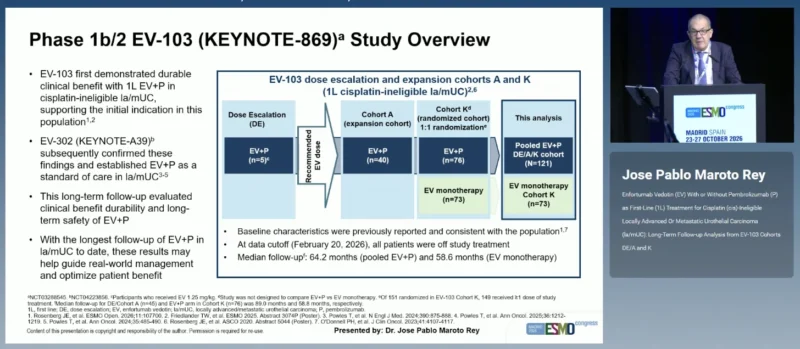
The Phase Ib/II EV-103 study previously demonstrated clinical activity with EV plus pembrolizumab in cisplatin-ineligible patients with previously untreated la/mUC. These findings were subsequently confirmed by the Phase III EV-302 trial, establishing EV plus pembrolizumab as a preferred first-line standard of care regardless of cisplatin eligibility. The current analysis reported long-term outcomes from EV-103 Cohorts DE/A and K.
EV-103 Study Design and Methods
Patients with cisplatin-ineligible la/mUC received EV 1.25 mg/kg on Days 1 and 8 plus pembrolizumab 200 mg on Day 1 of each three-week cycle. In Cohort K, patients were randomized 1:1 to EV plus pembrolizumab or EV monotherapy. The analysis included pooled EV plus pembrolizumab data from Cohorts DE/A and K, alongside EV monotherapy data from Cohort K.
Cohort-specific primary endpoints had been previously reported. Per protocol, no formal between-arm statistical comparisons were performed in Cohort K. The data cutoff was February 20, 2026.
Key Findings from EV-103
A total of 121 patients received EV plus pembrolizumab across the pooled DE/A/K cohorts, while 73 received EV monotherapy in Cohort K. At the February 20, 2026 data cutoff, all patients were off study treatment. The median number of treatment cycles was 10 with EV plus pembrolizumab and eight with EV monotherapy.
Long-Term Efficacy Outcomes
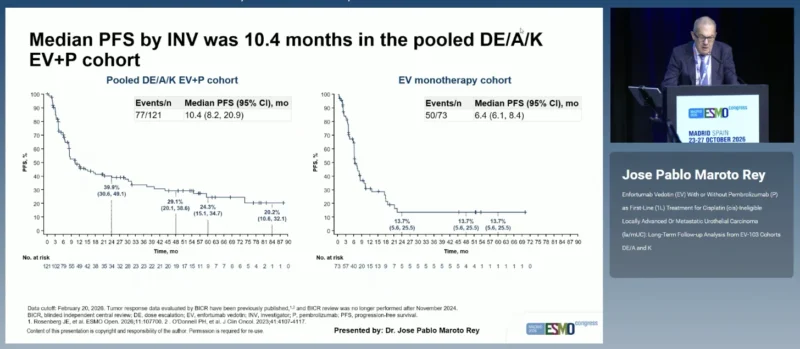
In the pooled EV plus pembrolizumab population, median duration of response (DOR) was 29.6 months (95% CI 10.3–71.9), median progression-free survival (PFS) was 10.4 months (95% CI 8.2–20.9), and median overall survival (OS) was 27.7 months (95% CI 20.9–39.6). With EV plus pembrolizumab, investigator-assessed DOR rates were 53.7% at 24 months, 37.0% at 60 months, and 30.8% at 84 months. Investigator-assessed PFS rates were 39.9%, 24.3%, and 20.2% at the corresponding time points.
Long-Term Overall Survival
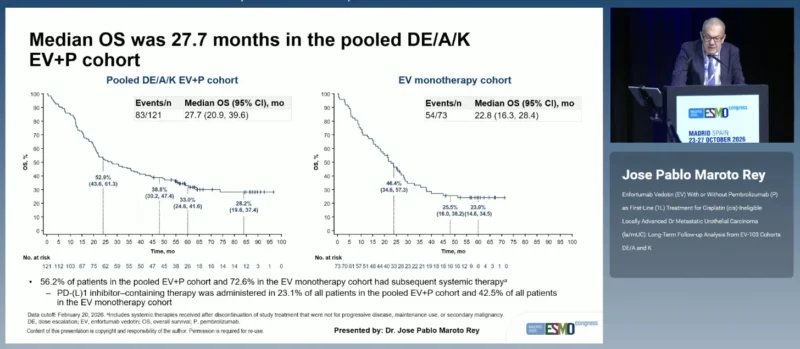
In the pooled EV plus pembrolizumab population, estimated OS rates were 52.9% (95% CI 43.6–61.3) at 24 months, 33.0% (95% CI 24.6–41.6) at 60 months, and 28.2% (95% CI 19.6–37.4) at 84 months. In Cohort K, EV monotherapy was associated with OS rates of 46.4% (95% CI 34.6–57.3) at 24 months and 23.9% (95% CI 14.6–34.5) at 60 months.
Median follow-up for survival was 64.2 months (95% CI 58.8–86.6) in the pooled EV plus pembrolizumab population and 58.6 months (95% CI 52.3–60.8) with EV monotherapy.
Safety Outcomes
Grade 3 or higher treatment-related adverse events occurred in 78 patients (64.5%) receiving EV plus pembrolizumab and 35 patients (47.9%) receiving EV monotherapy. Among patients experiencing peripheral neuropathy, skin reactions, or hyperglycemia, resolution of these events was reported in 21.8%, 84.0%, and 62.5%, respectively, with EV plus pembrolizumab.
In the EV monotherapy group, the corresponding resolution rates were 35.0%, 93.9%, and 75.0%. The investigators reported resolution or improvement of most treatment-related adverse events of special interest associated with EV.
Conclusions
The long-term follow-up of the Phase Ib/II EV-103/KEYNOTE-869 study demonstrated sustained responses and survival with first-line EV plus pembrolizumab in patients with cisplatin-ineligible locally advanced or metastatic urothelial carcinoma. In the pooled DE/A/K population, median DOR was 29.6 months, median PFS was 10.4 months, and median OS was 27.7 months. The estimated seven-year OS rate was 28.2%.
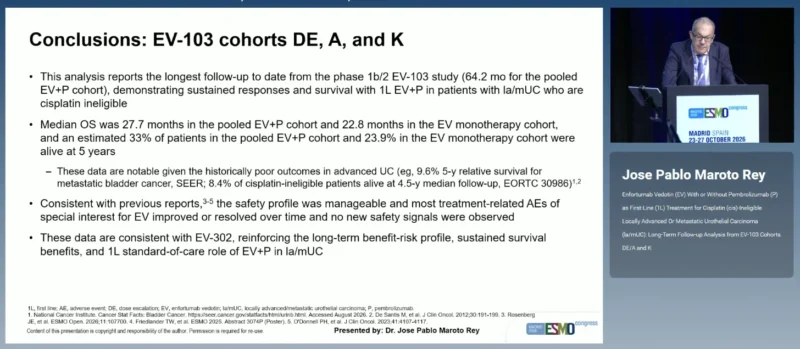
According to the investigators, these findings represent the longest follow-up to date for first-line EV plus pembrolizumab and reinforce its favourable long-term benefit–risk profile as a standard-of-care treatment for la/mUC. No formal between-arm statistical comparisons were performed in Cohort K.
Source: ESMO Congress 2026 – Abstract 4740RO, EV-103/KEYNOTE-869

Read more about KEYNOTE-B15/EV-304 at ESMO 2026 on OncoDaily.