
At the ESMO Congress 2026, Alfonso Gomez de Liano Lista (Las Palmas de Gran Canaria, Spain) presented health-related quality of life (HRQoL) results from the Phase III KEYNOTE-B15/EV-304 trial (NCT04700124), evaluating neoadjuvant and adjuvant enfortumab vedotin (EV) plus pembrolizumab in patients with cisplatin-eligible muscle-invasive bladder cancer (MIBC).
The prespecified analysis, presented in the Rapid Oral session (4738RO), assessed patient-reported outcomes (PROs), including global health status, physical and role functioning, and urinary, bowel, and sexual function.
Why Was the KEYNOTE-B15 HRQoL Analysis Conducted?
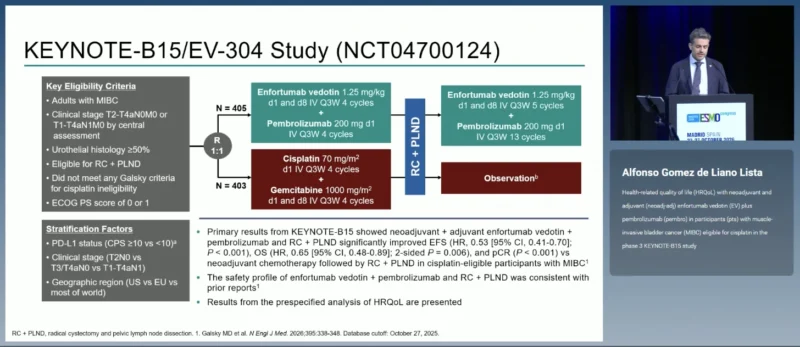
The Phase III KEYNOTE-B15/EV-304 trial previously demonstrated significant improvements in event-free survival (EFS), overall survival (OS), and pathological complete response (pCR) with neoadjuvant and adjuvant EV plus pembrolizumab and radical cystectomy with pelvic lymph node dissection (RC + PLND), compared with neoadjuvant cisplatin plus gemcitabine followed by surgery in patients with cisplatin-eligible MIBC.
The current analysis evaluated prespecified patient-reported outcomes to assess HRQoL changes and time to definitive deterioration across selected domains.
KEYNOTE-B15 Study Design and Methods
KEYNOTE-B15/EV-304 was a randomized Phase III trial involving patients with T2–T4aN0M0 or T1–T4aN1M0 muscle-invasive bladder cancer who were eligible for cisplatin-based chemotherapy.
Patients were randomized 1:1 to receive neoadjuvant and adjuvant EV plus pembrolizumab with radical cystectomy and pelvic lymph node dissection (RC + PLND), or neoadjuvant cisplatin plus gemcitabine followed by RC + PLND. HRQoL was assessed using the European Organisation for Research and Treatment of Cancer Quality of Life Questionnaire (EORTC QLQ-C30) and the Bladder Cancer Index (BCI).
Prespecified secondary patient-reported outcome endpoints included change from baseline to postoperative Week 42 and time to definitive deterioration (TTD) in selected domains. These analyses were not controlled for multiplicity. For the EORTC QLQ-C30, deterioration thresholds were defined as decreases of at least 10 points in global health status/quality of life (GHS/QoL), physical functioning (PF), or role functioning (RF).
For the BCI, the corresponding thresholds were decreases of at least 7.5 points in urinary scores, 6.5 points in bowel scores, and 9 points in sexual scores. Definitive deterioration required confirmation at a subsequent assessment and persistence at all subsequent visits without recovery. At postoperative Week 42, PRO completion and compliance rates were approximately 60% and 80%, respectively, based on blinded data. The data cutoff was October 27, 2025.

Key Findings from KEYNOTE-B15
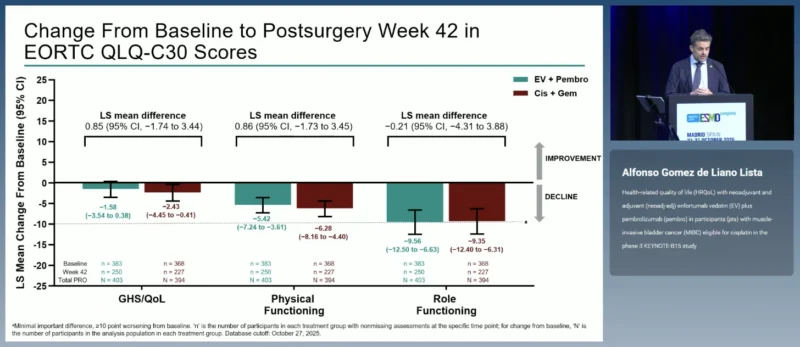
At postoperative Week 42, least-squares (LS) mean changes from baseline were similar between the treatment groups across the assessed EORTC QLQ-C30 domains.
For global health status/quality of life, the LS mean change was −1.58 points (95% CI −3.54 to 0.38) with EV plus pembrolizumab versus −2.43 points (95% CI −4.45 to −0.41) with cisplatin plus gemcitabine. The between-arm LS mean difference was 0.85 points (95% CI −1.74 to 3.44). For physical functioning, LS mean changes were −5.42 points (95% CI −7.24 to −3.61) versus −6.28 points (95% CI −8.16 to −4.40), respectively, with a between-arm difference of 0.86 points (95% CI −1.73 to 3.45).
For role functioning, LS mean changes were −9.56 points (95% CI −12.50 to −6.63) with EV plus pembrolizumab versus −9.35 points (95% CI −12.40 to −6.31) with cisplatin plus gemcitabine. The between-arm difference was −0.21 points (95% CI −4.31 to 3.88).
Urinary, Bowel, and Sexual Function
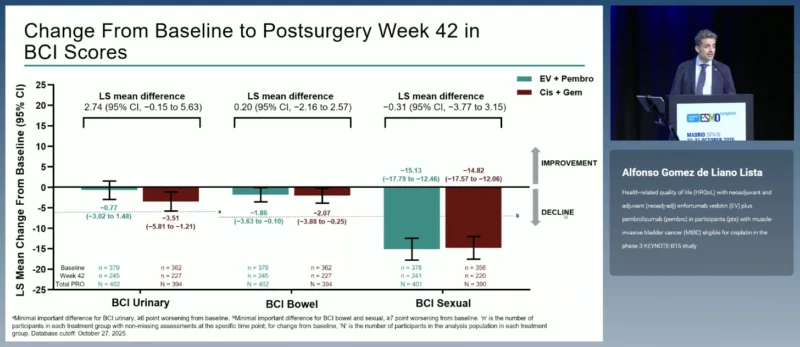
BCI scores also showed similar changes between treatment groups at postoperative Week 42. For urinary scores, the LS mean change was −0.77 points (95% CI −3.02 to 1.48) with EV plus pembrolizumab versus −3.51 points (95% CI −5.81 to −1.21) with cisplatin plus gemcitabine. The between-arm difference was 2.74 points (95% CI −0.15 to 5.63).
For bowel scores, LS mean changes were −1.86 points (95% CI −3.63 to −0.10) versus −2.07 points (95% CI −3.88 to −0.25), respectively, with a between-arm difference of 0.20 points (95% CI −2.16 to 2.57). Sexual scores decreased in both treatment groups. The LS mean change was −15.13 points (95% CI −17.79 to −12.46) with EV plus pembrolizumab and −14.82 points (95% CI −17.57 to −12.06) with cisplatin plus gemcitabine. The between-arm difference was −0.31 points (95% CI −3.77 to 3.15).
Time to Definitive Deterioration
Time to definitive deterioration was similar between treatment groups across the assessed EORTC QLQ-C30 and BCI domains. For EORTC QLQ-C30 outcomes, the hazard ratios comparing EV plus pembrolizumab with cisplatin plus gemcitabine were:
- Global health status/quality of life: HR 0.84 (95% CI 0.61–1.14).
- Physical functioning: HR 0.88 (95% CI 0.66–1.18).
- Role functioning: HR 0.80 (95% CI 0.61–1.04).
For BCI outcomes, the hazard ratios were:
- Urinary scores: HR 0.93 (95% CI 0.70–1.25).
- Bowel scores: HR 1.11 (95% CI 0.83–1.49).
- Sexual scores: HR 1.17 (95% CI 0.94–1.47).
The reported 95% confidence intervals included 1 across all six domains.
Conclusions
The prespecified HRQoL analysis of the Phase III KEYNOTE-B15/EV-304 trial found no clinically meaningful between-arm differences in the selected HRQoL domains assessed at postoperative Week 42 among evaluable patients receiving perioperative EV plus pembrolizumab or neoadjuvant cisplatin plus gemcitabine. Time to definitive deterioration was also similar between treatment groups across the assessed EORTC QLQ-C30 and BCI domains.
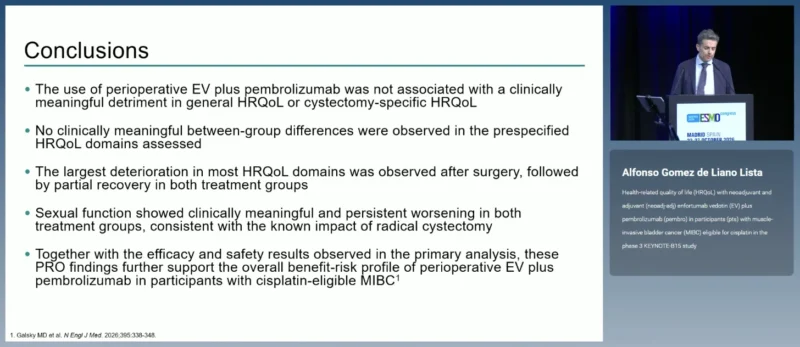
The largest deterioration in most HRQoL domains occurred after surgery, followed by partial recovery in both treatment groups. Sexual function showed clinically meaningful and persistent worsening in both arms, consistent with the known impact of radical cystectomy. Together with the previously reported efficacy and safety findings, the investigators concluded that these patient-reported outcomes further support the positive benefit–risk profile of perioperative EV plus pembrolizumab in cisplatin-eligible patients with muscle-invasive bladder cancer.
Source: ESMO Congress 2026 – Abstract 4738RO, KEYNOTE-B15/EV-304