At the 2026 ASCO Annual Meeting, Yohann Loriot, MD, PhD, from University Paris-Saclay and Gustave Roussy, presented interim analysis results from Duravelo-2, a randomized phase 2 study evaluating zelenectide pevedotin plus pembrolizumab in patients with previously untreated locally advanced or metastatic urothelial carcinoma.
Zelenectide pevedotin, also known as BT8009, is a highly selective Bicycle Drug Conjugate targeting Nectin-4, a protein overexpressed in locally advanced or metastatic urothelial carcinoma. The interim analysis focused on dose selection for zelenectide pevedotin plus pembrolizumab in previously untreated patients.
Read more about Immunotherapy for Urothelial Cancer on OncoDaily.
Study Design
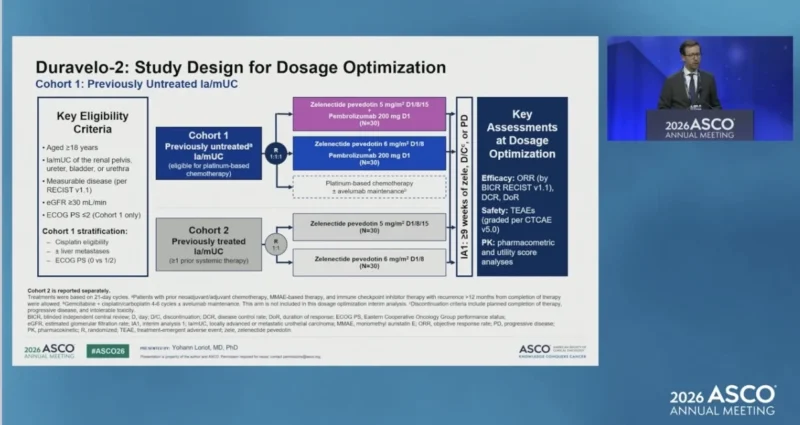
Duravelo-2 enrolled adults with locally advanced or metastatic urothelial carcinoma into two cohorts. Cohort 1 included previously untreated patients who were eligible for platinum-based chemotherapy, while Cohort 2 included patients with at least one prior systemic therapy. This analysis reported results from Cohort 1.
Patients in Cohort 1 were randomized 1:1:1 to receive zelenectide pevedotin 5 mg/m² on Days 1, 8, and 15 plus pembrolizumab 200 mg on Day 1; zelenectide pevedotin 6 mg/m² on Days 1 and 8 plus pembrolizumab 200 mg on Day 1; or platinum-based chemotherapy with or without avelumab maintenance. The dosage optimization analysis included efficacy, safety, pharmacokinetic, pharmacometric, and utility score assessments.
Results
As of July 23, 2025, 30 patients had been treated in each zelenectide pevedotin plus pembrolizumab dose group. Median follow-up was 7.0 months in both groups, with a range of 1.1 to 12.6 months in the 5 mg/m² group and 1.2 to 10.5 months in the 6 mg/m² group.
Among patients randomized with measurable disease at baseline and included in the efficacy analysis, the confirmed objective response rate by blinded independent central review was 55.2% with zelenectide pevedotin 5 mg/m² plus pembrolizumab and 57.7% with zelenectide pevedotin 6 mg/m² plus pembrolizumab.
In the 5 mg/m² group, responses included 7 complete responses and 9 partial responses. In the 6 mg/m² group, responses included 8 complete responses and 7 partial responses.
Stable disease was reported in 10 patients in the 5 mg/m² group and 5 patients in the 6 mg/m² group. Progressive disease was reported in 1 patient and 4 patients, respectively.
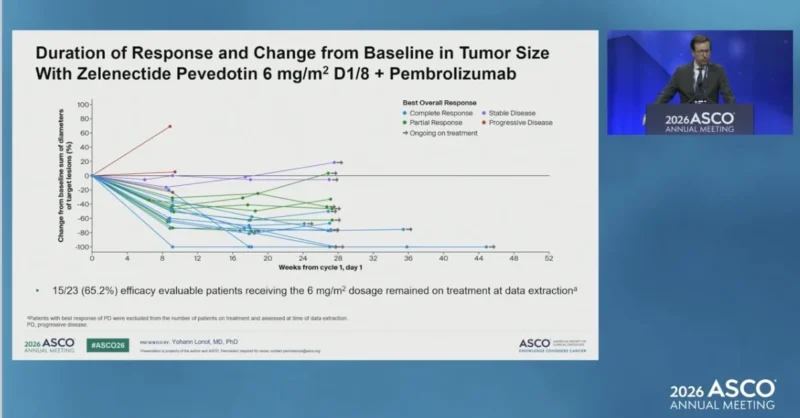
For the 6 mg/m² regimen, median duration of zelenectide pevedotin treatment was 6.3 months. At data extraction, 15 of 23 efficacy-evaluable patients receiving the 6 mg/m² dose remained on treatment.
Safety
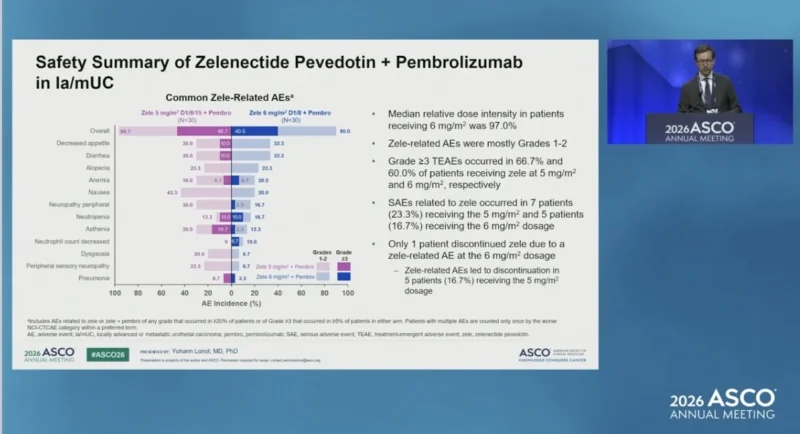
Zelenectide pevedotin-related adverse events were reported in 96.7% of patients in the 5 mg/m² group and 90.0% of patients in the 6 mg/m² group. Grade 3 or higher zelenectide pevedotin-related adverse events occurred in 46.7% and 40.0% of patients, respectively.
Grade 3 or higher treatment-emergent adverse events occurred in 66.7% of patients receiving the 5 mg/m² dose and 60.0% receiving the 6 mg/m² dose. Serious adverse events related to zelenectide pevedotin occurred in 7 patients and 5 patients, respectively.
At the 6 mg/m² dose, zelenectide pevedotin-related adverse events of clinical interest included peripheral neuropathy in 36.7% of patients, skin reactions in 16.7%, and eye disorders in 10.0%. No Grade 3 or higher skin reactions, eye disorders, or hyperglycemia were reported. No zelenectide pevedotin-related severe skin reactions of any grade were reported, and no cases of Stevens-Johnson syndrome or toxic epidermal necrolysis occurred.
Conclusion
In this interim analysis of Duravelo-2, zelenectide pevedotin plus pembrolizumab showed encouraging response rates and favorable safety profiles in previously untreated locally advanced or metastatic urothelial carcinoma.
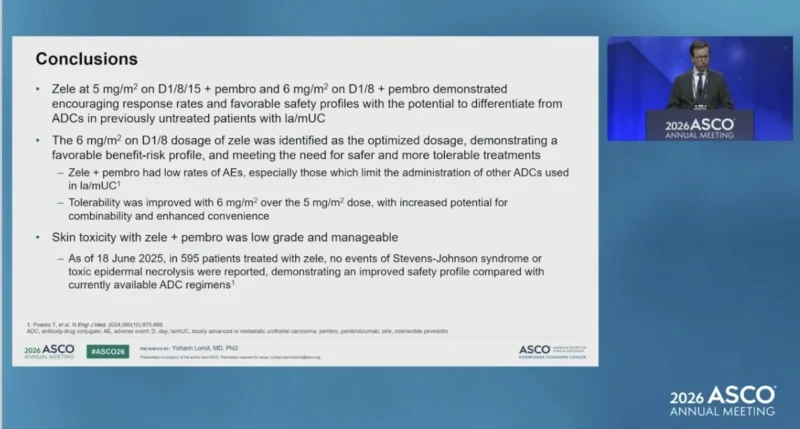
The 6 mg/m² Days 1 and 8 regimen was identified as the optimized dose, with a favorable benefit-risk profile, improved tolerability compared with the 5 mg/m² schedule, and greater convenience. The regimen was associated with low-grade, manageable skin toxicity and favorable tolerability.
The full abstract is available on the official ASCO website.
Find more videos on OncoDaily Youtube TV.