
First-line treatment of advanced bladder cancer has changed substantially in recent years. Platinum-based chemotherapy was the mainstay of systemic treatment for decades, followed by the introduction of maintenance immunotherapy. More recently, antibody–drug conjugates (ADCs), particularly enfortumab vedotin combined with pembrolizumab, have changed the treatment landscape.
Updated findings from the phase 3 EV-302/KEYNOTE-A39 trial in 2025 and 2026 have provided longer-term survival data for enfortumab vedotin plus pembrolizumab. Meanwhile, the phase 3 RC48-C016 trial has introduced a HER2-directed ADC–immunotherapy approach in HER2-expressing advanced urothelial carcinoma.
These developments have expanded treatment options, but important questions remain. Which patients are suitable for ADC-based treatment? When should platinum-based chemotherapy remain part of the treatment strategy? And how should clinicians balance efficacy, toxicity, comorbidities and treatment availability when making these decisions?
Enfortumab Vedotin Plus Pembrolizumab: A New First-Line Standard
Enfortumab vedotin is an ADC targeting nectin-4, a cell-surface protein expressed in urothelial carcinoma. It delivers the microtubule-disrupting agent monomethyl auristatin E (MMAE) to tumor cells, while pembrolizumab blocks the PD-1 immune checkpoint.
In 2024, the phase 3 EV-302/KEYNOTE-A39 trial evaluated enfortumab vedotin plus pembrolizumab versus platinum-based chemotherapy in 886 patients with previously untreated locally advanced or metastatic urothelial carcinoma.
Median overall survival (OS) was 31.5 months with enfortumab vedotin plus pembrolizumab compared with 16.1 months with chemotherapy (HR 0.47; 95% CI 0.38–0.58; P<0.001). Median progression-free survival (PFS) was 12.5 versus 6.3 months (HR 0.45; 95% CI 0.38–0.54; P<0.001). The objective response rate was 67.7% versus 44.4%, with complete responses in 29.1% and 12.5% of patients, respectively. (Powles et al., NEJM, 2024)
These findings established enfortumab vedotin plus pembrolizumab as the preferred first-line treatment for eligible patients with locally advanced or metastatic urothelial carcinoma. The ESMO Clinical Practice Guideline interim update recommended the combination irrespective of cisplatin eligibility, while retaining chemotherapy-based strategies when the combination could not be used. (Powles et al., Annals of Oncology, 2024)
What the 2025 and 2026 EV-302 Updates Show
Longer follow-up has provided additional information about the durability of benefit with enfortumab vedotin plus pembrolizumab.
The 2025 EV-302 analysis reported outcomes after a median follow-up of 29.1 months. Median OS was 33.8 months with enfortumab vedotin plus pembrolizumab versus 15.9 months with chemotherapy (HR 0.51; 95% CI 0.43–0.61). Median PFS was 12.5 versus 6.3 months (HR 0.48; 95% CI 0.41–0.57). The survival benefit was maintained with longer follow-up, including across subgroups defined by cisplatin eligibility, and the updated safety findings were consistent with the primary analysis. (Powles et al., Annals of Oncology, 2025)
At the 2026 ASCO Annual Meeting, a further EV-302 analysis reported outcomes after a median follow-up of 42.8 months. Median OS remained favorable at 33.6 months with enfortumab vedotin plus pembrolizumab compared with 15.9 months with chemotherapy (HR 0.53; 95% CI 0.45–0.63). At 42 months, estimated OS rates were 44.0% and 24.6%, respectively.
The report also included exploratory response analyses based on an earlier data cutoff. Among patients in the combination arm who achieved a confirmed complete response, 66.2% had initially experienced a partial response before converting to a complete response. The median number of additional enfortumab vedotin cycles between partial and complete response was five. (Powles et al., Journal of Clinical Oncology, 2026, Abstract 4507)
These exploratory findings show that some patients achieve deeper responses during treatment. However, they do not establish the optimal duration of enfortumab vedotin or demonstrate that extending treatment improves survival in patients who have already responded.
With more than three years of median follow-up, EV-302 continues to demonstrate an overall survival benefit for enfortumab vedotin plus pembrolizumab compared with the chemotherapy-based control strategy.
Where Platinum-Based Chemotherapy Still Fits
Although enfortumab vedotin plus pembrolizumab is the preferred first-line approach, platinum-based chemotherapy remains relevant for patients who cannot receive the combination because of contraindications, tolerability concerns or treatment availability. One alternative is nivolumab combined with gemcitabine and cisplatin, followed by nivolumab maintenance.
In the phase 3 CheckMate 901 trial, 608 cisplatin-eligible patients with previously untreated unresectable or metastatic urothelial carcinoma were randomized to nivolumab plus gemcitabine–cisplatin or chemotherapy alone. Median OS was 21.7 months with nivolumab plus chemotherapy versus 18.9 months with chemotherapy alone (HR 0.78; 95% CI 0.63–0.96; P=0.02). Median PFS was 7.9 versus 7.6 months (HR 0.72; 95% CI 0.59–0.88; P=0.001). (van der Heijden et al., NEJM, 2023)
Another established approach is platinum-based chemotherapy followed by avelumab maintenance in patients without disease progression after four to six cycles.
The phase 3 JAVELIN Bladder 100 trial evaluated avelumab plus best supportive care versus best supportive care alone following first-line gemcitabine-based platinum chemotherapy. In an updated analysis, median OS measured from maintenance randomization was 23.8 months with avelumab versus 15.0 months in the control group (HR 0.76; 95% CI 0.63–0.91; P=0.0036). (Powles et al., Journal of Clinical Oncology, 2023)
Subsequent exploratory analyses have examined avelumab maintenance in specific populations, including older patients. A 2025 analysis reported outcomes across older age subgroups, providing additional information about maintenance treatment in this population, although subgroup findings should be interpreted within the limitations of an exploratory analysis. (Gupta et al., ESMO Open, 2025)
The survival results from EV-302, CheckMate 901 and JAVELIN Bladder 100 cannot be compared directly. The studies enrolled different populations and evaluated different treatment strategies. In JAVELIN Bladder 100, only patients without progression following initial chemotherapy were randomized, and survival was measured from the start of maintenance treatment. These differences are important when interpreting the evidence and discussing available treatment approaches.
What NCCN Guidelines Version 3.2026 Recommend
The NCCN Guidelines for Bladder Cancer, Version 3.2026, identify enfortumab vedotin plus pembrolizumab as the preferred first-line systemic treatment for stage IV locally advanced or metastatic urothelial carcinoma, with a Category 1 recommendation.
Other recommended Category 1 approaches include cisplatin plus gemcitabine followed by avelumab maintenance, cisplatin plus gemcitabine and nivolumab followed by nivolumab maintenance, and dose-dense MVAC with growth factor support followed by avelumab maintenance. Carboplatin plus gemcitabine followed by avelumab maintenance is listed as useful in certain circumstances.
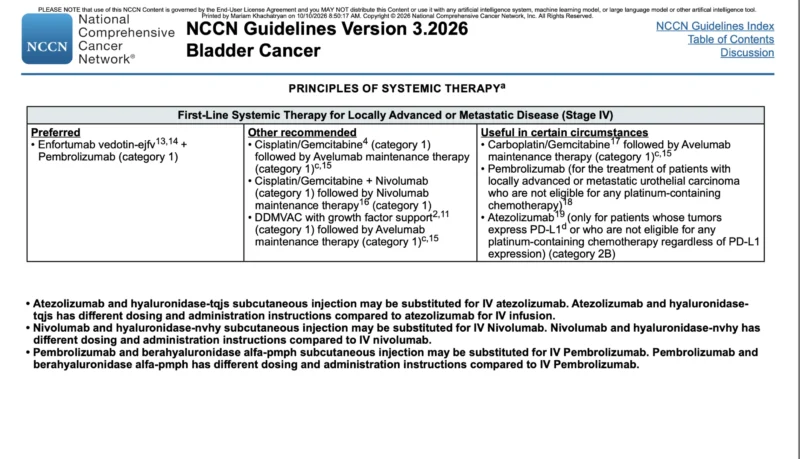
For patients with locally advanced or metastatic urothelial carcinoma who are not eligible for any platinum-containing chemotherapy, pembrolizumab monotherapy is listed as useful in certain circumstances. Atezolizumab monotherapy (Category 2B) is an option for patients whose tumors express PD-L1 or who are not eligible for any platinum-containing chemotherapy regardless of PD-L1 expression.
The 2026 European Association of Urology guidelines similarly recommend enfortumab vedotin plus pembrolizumab for patients eligible for combination therapy. When enfortumab vedotin is contraindicated or unavailable, alternatives include platinum-based chemotherapy followed by avelumab maintenance in patients with at least stable disease, or gemcitabine–cisplatin plus nivolumab in cisplatin-eligible patients. (EAU Guidelines on Muscle-Invasive and Metastatic Bladder Cancer, 2026)
These recommendations provide a treatment framework, but patient eligibility, contraindications and treatment availability remain important considerations when choosing a regimen.
HER2-Directed ADCs: Another First-Line Approach Emerges
The development of ADC-based first-line treatment is extending beyond nectin-4 to HER2-expressing urothelial carcinoma. In 2025, the phase 3 RC48-C016 trial evaluated disitamab vedotin, a HER2-directed ADC, combined with the PD-1 inhibitor toripalimab in patients with previously untreated locally advanced or metastatic urothelial carcinoma.
The study enrolled 484 patients in China with HER2 expression defined by an immunohistochemistry (IHC) score of 1+, 2+ or 3+. Patients were randomized to disitamab vedotin plus toripalimab or gemcitabine combined with cisplatin or carboplatin.
At a median follow-up of 18.2 months, median PFS was 13.1 months with the ADC–immunotherapy combination compared with 6.5 months with chemotherapy (HR 0.36; 95% CI 0.28–0.46; P<0.001). Median OS was 31.5 versus 16.9 months (HR 0.54; 95% CI 0.41–0.73; P<0.001), while objective response rates were 76.1% and 50.2%, respectively.
Grade 3 or higher treatment-related adverse events occurred in 55.1% of patients receiving disitamab vedotin plus toripalimab and 86.9% receiving chemotherapy. (Sheng et al., NEJM, 2025)
In May 2026, China’s National Medical Products Administration approved toripalimab in combination with disitamab vedotin for HER2-expressing locally advanced or metastatic urothelial carcinoma, according to an announcement from Junshi Biosciences. (Junshi Biosciences, 2026)
RC48-C016 provides randomized evidence supporting this approach compared with platinum-based chemotherapy in the studied HER2-expressing population. However, the trial was conducted in China and did not compare the regimen with enfortumab vedotin plus pembrolizumab. The results therefore do not establish which ADC–immunotherapy combination is more effective. Outside China, the clinical availability and regulatory status of disitamab vedotin plus toripalimab also need to be considered.
Patient Selection Is Becoming More Complex
The introduction of ADC–immunotherapy combinations has added new considerations to first-line treatment selection. Historically, cisplatin eligibility was a central factor, influenced by renal function, performance status, hearing impairment, peripheral neuropathy and other comorbidities.
With enfortumab vedotin plus pembrolizumab, baseline neuropathy, diabetes, dermatologic conditions and contraindications to immune checkpoint inhibition also influence treatment suitability. In the primary EV-302 analysis, grade 3 or higher treatment-related adverse events occurred in 55.9% of patients receiving enfortumab vedotin plus pembrolizumab and 69.5% receiving chemotherapy.
Grade 3 or higher treatment-related adverse events of special interest associated with enfortumab vedotin included skin reactions in 15.5% of patients, peripheral neuropathy in 6.8% and hyperglycemia in 6.1%. (Powles et al., NEJM, 2024) With additional follow-up in 2025, grade 3 or higher treatment-related adverse events were reported in 57.3% of patients in the combination arm and 69.5% in the chemotherapy arm. Treatment-related adverse events led to discontinuation of at least one study drug in 42.7% and 18.5% of patients, respectively. No new safety signals were identified. (Powles et al., Annals of Oncology, 2025)
Although severe treatment-related adverse events were less frequent overall with enfortumab vedotin plus pembrolizumab than with chemotherapy, the toxicity profiles differed.
Peripheral neuropathy, skin reactions and hyperglycemia require particular attention during enfortumab vedotin treatment, while pembrolizumab introduces the possibility of immune-related adverse events. Monitoring and timely treatment modifications are therefore important components of care. Patient selection can be especially challenging when individuals have pre-existing neuropathy, poorly controlled diabetes, autoimmune conditions or other comorbidities that may affect treatment tolerability.
Find more videos on OncoDaily YouTube TV.
Clinical Considerations and Remaining Evidence Gaps
Patient selection remains important in first-line advanced urothelial carcinoma. The 2026 EAU guidelines identify uncontrolled diabetes, grade ≥2 peripheral neuropathy and significant skin disorders as factors that may limit the use of enfortumab vedotin. Platinum-based regimens remain alternatives when the combination is unsuitable or unavailable, depending on patient eligibility. (EAU Guidelines, 2026)
No randomized head-to-head trial has directly compared enfortumab vedotin plus pembrolizumab with disitamab vedotin plus toripalimab. EV-302 and RC48-C016 evaluated different combinations against chemotherapy, but neither established their relative efficacy. (Powles et al., NEJM, 2024; Sheng et al., NEJM, 2025)
Treatment sequencing after progression on enfortumab vedotin plus pembrolizumab also remains an area of uncertainty, with limited prospective evidence to guide subsequent therapy. (EAU Guidelines, 2026)
From Clinical Trial Evidence to Practice: OncoDaily Grand Rounds at ESMO 2026
These questions reflect the broader clinical challenges that will be explored at OncoDaily Grand Rounds at ESMO 2026: Bladder Cancer Edition, taking place on October 25, 2026, from 2:00 PM to 6:00 PM, at Novotel Madrid Feria and Airport, Madrid, Spain. Chaired by Prof. Andrea Necchi, the in-person meeting will bring together specialists to discuss developments in bladder cancer care, treatment strategies and practical clinical decisions.
The first session, “Expert Perspectives: What Would You Do?” (14:00–16:00), will address treatment selection in localized bladder cancer, treatment selection and sequencing in advanced urothelial carcinoma, and the role of toxicity, patient preferences and multidisciplinary input in treatment decisions.
The session will include presentations by Andrea Necchi, Sara Coca Membribes and Sarah Scagliarini, followed by faculty discussion, audience questions and live polling.
The second session, “One Clinical Scenario, Different Countries” (16:00–18:00), will examine how treatment recommendations may differ across healthcare settings. A planned international faculty panel will bring perspectives from Brazil, India, China, Armenia, Algeria, Switzerland, the United Kingdom, the United States and Italy.
Through shared clinical scenarios, participants will explore how local guidelines, treatment access and available resources influence decisions in bladder cancer care. For medical oncologists, urologists, radiation oncologists, researchers and fellows, the meeting offers an opportunity to discuss emerging evidence, exchange clinical perspectives and examine treatment decisions with colleagues from different healthcare systems.
The evolving first-line landscape in advanced urothelial carcinoma illustrates why these discussions matter. Clinical trials have established new treatment options, but translating the evidence into patient care requires consideration of eligibility, toxicity and access.
Register for OncoDaily Grand Rounds at ESMO 2026: Bladder Cancer Edition
This event is supported by an independent medical education grant from Astellas and Pfizer via the Pfizer–Astellas Alliance.
Sources
- Powles T, et al. Enfortumab Vedotin and Pembrolizumab in Untreated Advanced Urothelial Cancer. New England Journal of Medicine. 2024;390:875–888.
- Powles T, et al. Enfortumab vedotin plus pembrolizumab in untreated locally advanced or metastatic urothelial carcinoma: 2.5-year median follow-up of the phase III EV-302/KEYNOTE-A39 trial. Annals of Oncology. 2025;36:1212–1219.
- Powles T, et al. Enfortumab vedotin plus pembrolizumab versus chemotherapy: 3.5-year follow-up and response analyses from EV-302. Journal of Clinical Oncology. 2026;44(suppl 16):4507. ASCO 2026 abstract.
- Van der Heijden MS, et al. Nivolumab plus Gemcitabine–Cisplatin in Advanced Urothelial Carcinoma. New England Journal of Medicine. 2023;389:1778–1789.
- Powles T, et al. Avelumab First-Line Maintenance for Advanced Urothelial Carcinoma: Results From JAVELIN Bladder 100 After ≥2 Years of Follow-Up. Journal of Clinical Oncology. 2023;41:3486–3492.
- Gupta S, et al. Avelumab first-line maintenance for advanced urothelial carcinoma: long-term outcomes from JAVELIN Bladder 100 in older patients. ESMO Open. 2025;10:104506.
- Aragon-Ching JB, et al. Avelumab first-line maintenance for advanced urothelial carcinoma: long-term outcomes in patients with high body mass index or diabetes mellitus. ESMO Open. 2026;11:107776.
- Sheng X, et al. Disitamab Vedotin plus Toripalimab in HER2-Expressing Advanced Urothelial Cancer. New England Journal of Medicine. Published online October 19, 2025;393:2324–2337.
- Powles T, et al. ESMO Clinical Practice Guideline interim update on first-line therapy in advanced urothelial carcinoma. Annals of Oncology. 2024;35:485–490.
- National Comprehensive Cancer Network. NCCN Clinical Practice Guidelines in Oncology: Bladder Cancer. Version 3.2026.
- European Association of Urology. EAU Guidelines on Muscle-Invasive and Metastatic Bladder Cancer — Metastatic Disease. 2026.
- Junshi Biosciences. Approval of toripalimab in combination with disitamab vedotin for HER2-expressing advanced urothelial carcinoma in China. May 21, 2026.
- OncoDaily. OncoDaily Grand Rounds at ESMO 2026: Bladder Cancer Edition. Official event information and scientific program.