Tumor budding in colorectal cancer is a microscopic feature that helps doctors understand how aggressively a tumor may behave. It describes individual cancer cells or small groups of cells that have separated from the main tumor, particularly at its invasive edge.
A higher degree of tumor budding has been associated with an increased risk of lymph node involvement, cancer recurrence, and poorer survival outcomes. Although tumor budding does not determine cancer stage, it provides additional information that may help doctors assess prognosis and make treatment decisions.
What Is Tumor Budding in Colorectal Cancer?
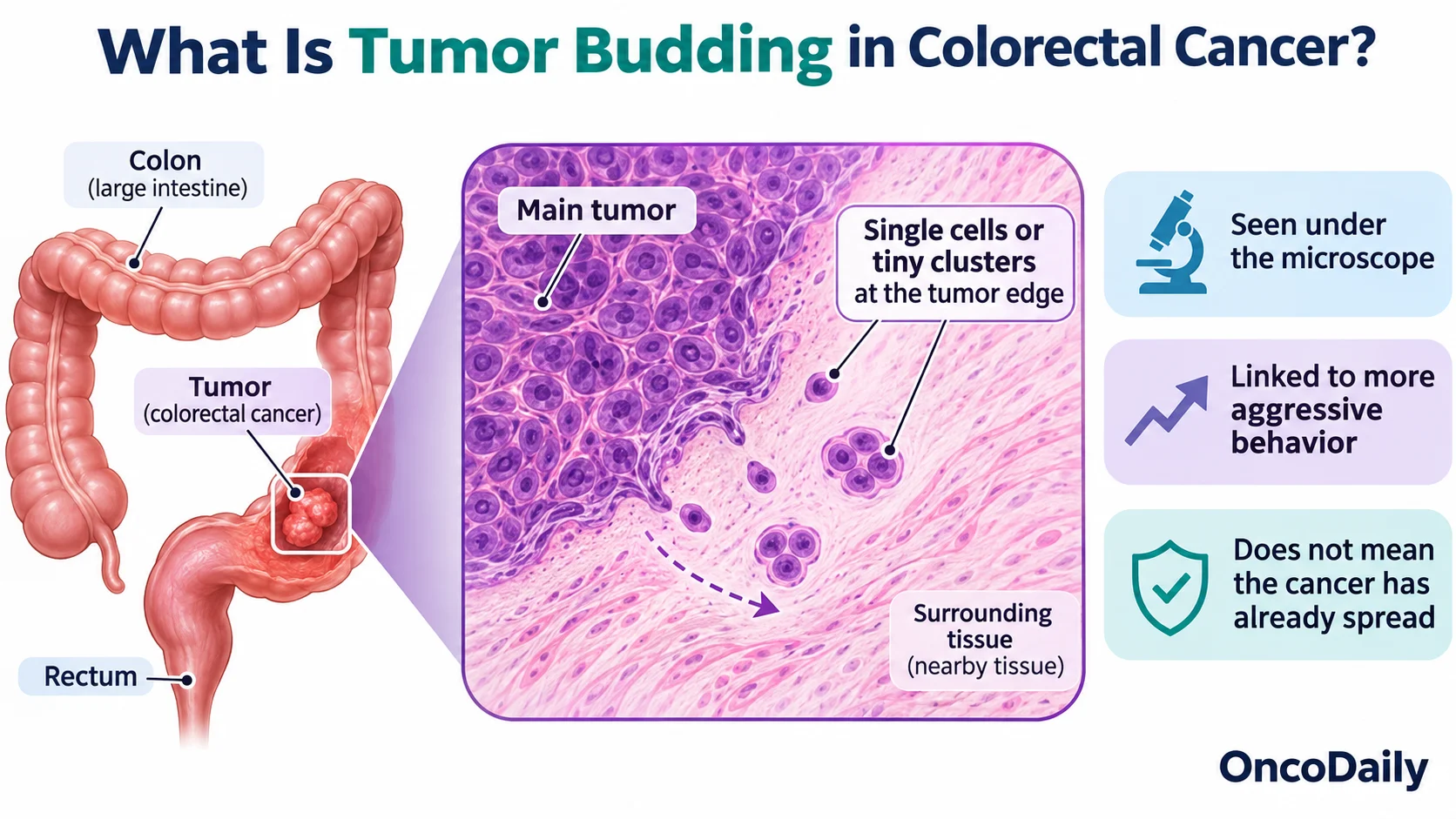
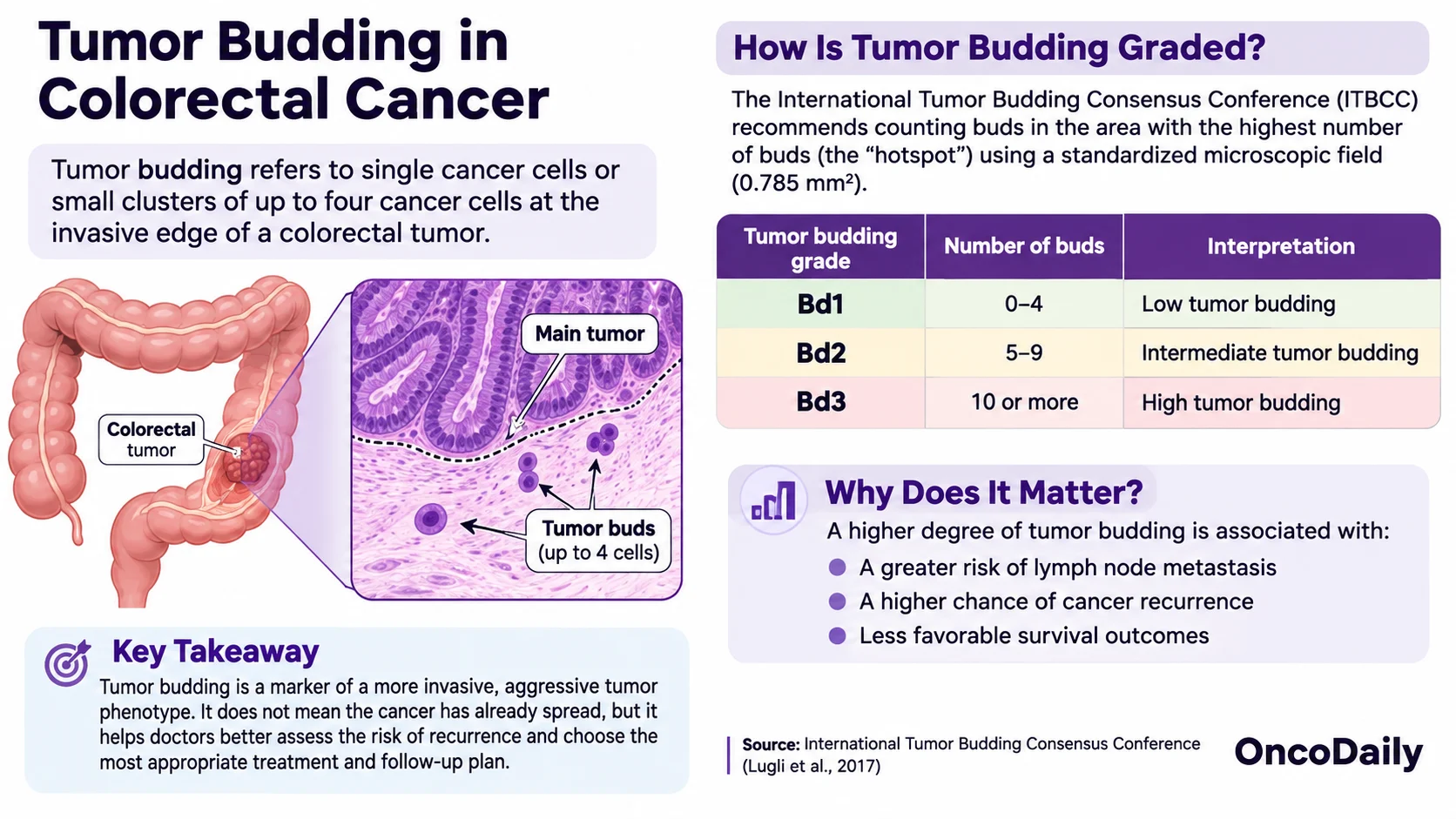
Tumor budding refers to single cancer cells or small clusters of up to four cancer cells found at the invasive edge of a colorectal tumor. These cells appear to separate from the main tumor and extend into the surrounding tissue, reflecting changes associated with the cancer’s ability to invade and spread.
Under normal conditions, cells remain connected to neighboring cells through specialized adhesion proteins. During cancer progression, some tumor cells may lose part of this connection and develop characteristics that allow them to move into nearby tissues. This process is associated with epithelial–mesenchymal transition (EMT), a biological mechanism involved in cancer invasion and metastasis.
Tumor budding is identified by a pathologist examining tissue obtained during surgery or, in selected circumstances, a biopsy. It cannot be detected through routine blood tests or directly measured by CT or MRI scans.
Its clinical importance comes from its association with aggressive tumor behavior. Studies have shown that tumors with extensive budding are more likely to demonstrate lymphovascular invasion, lymph node metastasis, and unfavorable clinical outcomes.
However, tumor budding is not the same as metastatic cancer. Finding budding cells does not mean the cancer has already spread to distant organs. Instead, it provides additional information about the tumor’s invasive potential (Lugli et al., 2017; Ciobănoiu et al., 2026).
How Is Tumor Budding Graded?
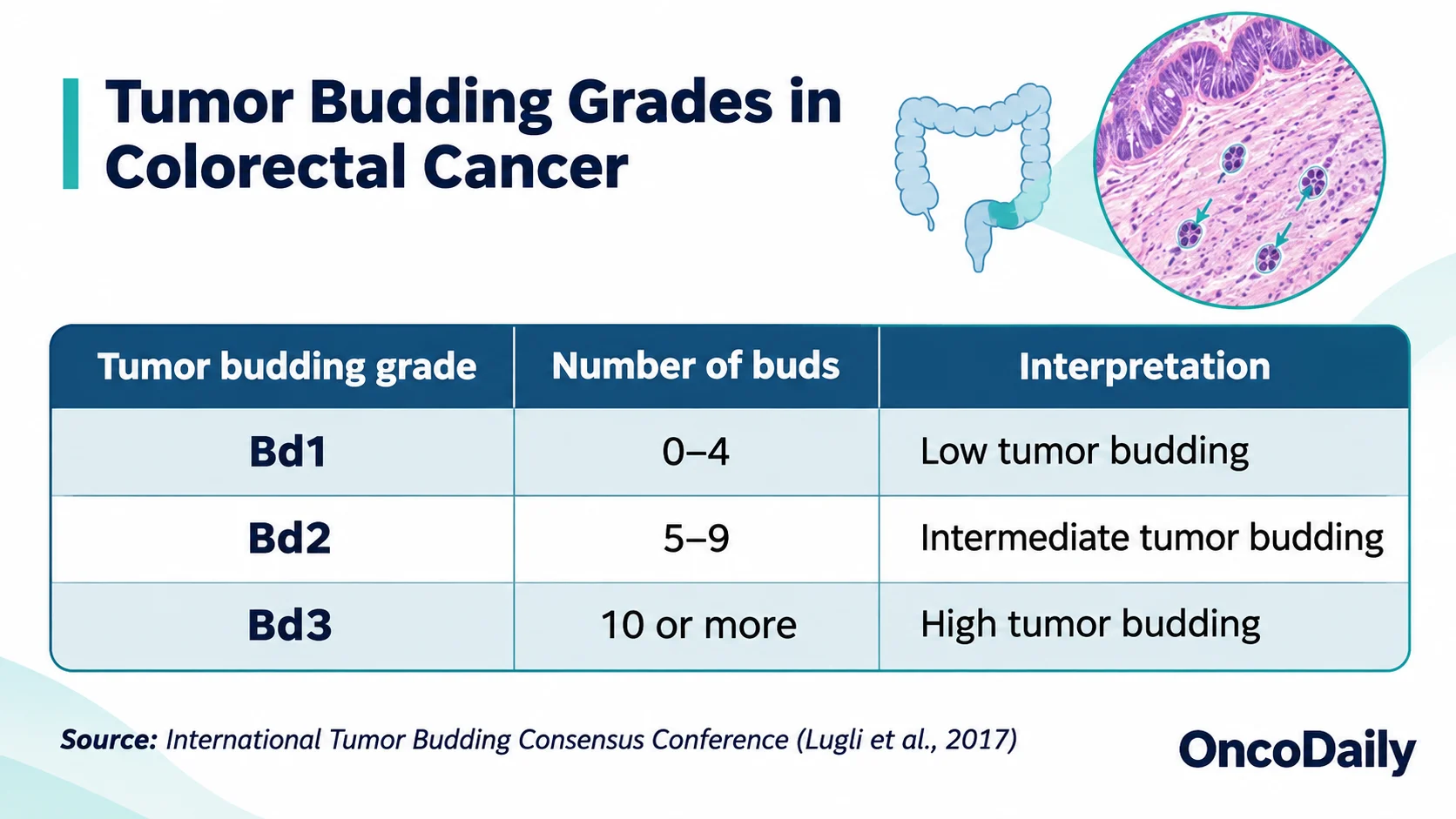
Tumor budding is graded according to the number of individual cancer cells or small cell clusters identified under a microscope. The internationally accepted grading system was established by the International Tumor Budding Consensus Conference (ITBCC) in 2016 and published in 2017.
To assess tumor budding, the pathologist examines the invasive front, where the tumor meets surrounding healthy tissue. The area containing the greatest concentration of budding cells, known as the hotspot, is selected for counting.
The ITBCC recommends counting buds within a standardized microscopic area of 0.785 mm². This ensures that results can be compared between laboratories using different microscopes.
This grading system is different from conventional tumor differentiation, which describes how closely cancer cells resemble normal colorectal tissue. A tumor described as moderately differentiated may still show high tumor budding.
Both characteristics provide useful information, but they assess different aspects of tumor biology. The ITBCC recommends reporting tumor budding separately from conventional histological grade to improve prognostic assessment (Lugli et al., 2017).
What Do Bd1, Bd2, and Bd3 Mean?
The Bd1, Bd2, and Bd3 categories indicate increasing amounts of tumor budding and help pathologists describe the tumor’s invasive characteristics.
Bd1, or low tumor budding, means that fewer than five buds are identified in the standardized microscopic field. This finding is generally associated with less aggressive tumor behavior compared with higher budding grades, although other pathological features remain important.
Bd2, or intermediate tumor budding, indicates the presence of five to nine buds. It represents an intermediate category in which the tumor shows more budding activity than Bd1. Its clinical significance depends on cancer stage and other risk factors, including lymphovascular invasion and lymph node involvement.
Bd3, or high tumor budding, is defined by ten or more buds within the assessed field. This category is associated with a greater likelihood of lymph node metastasis and unfavorable outcomes, particularly in patients with early-stage colorectal cancer.
Importantly, the budding grade does not correspond directly to the stage of colorectal cancer. For example, a patient with stage II disease can have Bd3 tumor budding without having lymph node metastases.
The grading system therefore provides information beyond conventional staging. Rather than predicting exactly how an individual cancer will behave, it helps doctors identify patients who may have a higher risk of recurrence or disease progression (Mehta et al., 2018; Lugli et al., 2017).
Does High Tumor Budding Increase Recurrence Risk?
High tumor budding is associated with an increased risk of colorectal cancer recurrence, distant metastasis, and reduced survival. This association has been observed across different stages of the disease, particularly stage II and III colorectal cancer.
A 2026 systematic review and meta-analysis by Shu and colleagues evaluated 43 studies involving 17,831 patients with stage II–III colorectal cancer. The analysis found that high-grade tumor budding was significantly associated with worse clinical outcomes.
Compared with lower-grade tumor budding, high-grade budding was associated with:
- Disease-free survival: HR 2.53, indicating a higher relative hazard of recurrence or death.
- Overall survival: HR 2.40, indicating a higher relative hazard of death from any cause.
- Cancer-specific survival: HR 3.37, indicating a higher relative hazard of cancer-related death.
These findings were statistically significant, and further analyses confirmed that tumor budding provided prognostic information beyond other clinical and pathological characteristics (Shu et al., 2026).
These hazard ratios describe differences between patient groups over time. They do not mean that every patient with high tumor budding has a two- or threefold probability of recurrence, nor can they predict an individual patient’s survival.
Tumor budding is particularly relevant in stage II colorectal cancer, where the tumor has extended into or through the bowel wall but has not spread to regional lymph nodes. Although many patients with stage II disease have favorable outcomes after surgery, those with high-grade budding may have a higher risk of recurrence.
The association is also important in stage III colorectal cancer, where regional lymph nodes are already involved. In these patients, tumor budding may provide additional prognostic information beyond lymph node status alone.
However, high tumor budding does not mean that recurrence is inevitable. Individual outcomes depend on cancer stage, surgical treatment, tumor biology, and several other clinical factors (Shu et al., 2026; Ciobănoiu et al., 2026).
How Does Tumor Budding Affect Treatment Decisions?
Tumor budding can influence colorectal cancer management by helping doctors identify patients who may have a higher risk of lymph node metastasis or recurrence. Its importance varies depending on cancer stage and the type of treatment already performed.
In early colorectal cancer, particularly pT1 tumors, cancer has invaded the submucosa but has not extended into the muscularis propria. Some of these tumors can be removed through endoscopic procedures, avoiding more extensive surgery.
However, if the pathology report identifies high-grade tumor budding, the risk of cancer cells being present in nearby lymph nodes may be higher. In this situation, doctors may recommend additional surgery to remove the affected bowel segment and regional lymph nodes, especially when other high-risk features are present.
Tumor budding is also relevant in stage II colon cancer. Patients with high-grade budding may have a greater risk of recurrence despite having no detected lymph node metastases. This information can contribute to discussions about postoperative chemotherapy, known as adjuvant chemotherapy.
Nevertheless, high tumor budding alone does not automatically mean that chemotherapy is necessary. Decisions about adjuvant treatment also depend on the tumor’s T stage, lymphovascular invasion, surgical margins, mismatch repair status, and the patient’s overall health.
For patients with stage III colorectal cancer, postoperative systemic treatment is generally guided by established clinical risk factors and treatment recommendations. Tumor budding may provide additional prognostic information, but it is not currently used on its own to select a specific chemotherapy regimen.
The ITBCC recommends considering tumor budding alongside other clinical and pathological findings during multidisciplinary treatment planning. Although its prognostic value is well established, further prospective research is needed to determine how best to use budding grades to guide individual treatment choices (Lugli et al., 2017; Shu et al., 2026).
What Other Pathology Findings Are Important in Colorectal Cancer?
Tumor budding is one of several pathological features used to assess colorectal cancer. Although a high budding grade may indicate more aggressive tumor behavior, it should not be interpreted independently of the complete pathology report.
The most important factor remains the pathological stage, which describes how deeply the cancer has invaded the bowel wall and whether regional lymph nodes or distant organs are involved.
Other important findings include:
- Tumor differentiation: Describes how closely cancer cells resemble normal colorectal tissue. Poorly differentiated tumors generally have more aggressive features.
- Lymphovascular invasion: Indicates that cancer cells have entered small blood vessels or lymphatic channels, potentially increasing the risk of spread.
- Perineural invasion: Refers to cancer cells growing around or along nerves and may be associated with less favorable outcomes.
- Lymph node involvement: Identifies whether cancer has spread to regional lymph nodes and is essential for pathological staging.
- Surgical margins: Indicate whether cancer cells are present at the edges of the removed tissue, helping assess whether the tumor was completely excised.
Molecular findings are also important. For example, mismatch repair (MMR) or microsatellite instability (MSI) status can provide prognostic information and influence treatment recommendations, particularly in stage II colon cancer.
Tumor budding adds another dimension to this assessment because it reflects the tumor’s invasive characteristics rather than simply its size or extent of spread.
In a 2018 study of 60 patients with colorectal cancer, Mehta and colleagues found significant associations between tumor budding, lymph node involvement, and pathological stage, supporting its role as an additional prognostic marker (Mehta et al., 2018).
For patients reviewing their pathology reports, a Bd3 result may raise concern, but it should always be discussed in the context of cancer stage and other findings. Tumor budding helps refine the assessment of risk; it does not independently determine prognosis or treatment.
FAQ
What does high tumor budding mean in colorectal cancer?
High tumor budding (Bd3) means that 10 or more tumor buds are identified in a standardized microscopic field. It is associated with more aggressive tumor behavior and a higher risk of recurrence.
Is tumor budding the same as cancer metastasis?
No. Tumor budding describes cancer cells separating from the main tumor. It does not mean the cancer has already spread to lymph nodes or distant organs.
Does Bd3 tumor budding mean a poor prognosis?
Not necessarily. Bd3 is associated with less favorable outcomes, but individual prognosis also depends on cancer stage, lymph node involvement, and other pathological findings.
Does high tumor budding require chemotherapy?
Not always. High tumor budding may influence treatment discussions, particularly in stage II colon cancer, but it does not independently determine whether chemotherapy is needed.
Can tumor budding be detected on a colonoscopy?
Tumor budding cannot be identified by visual inspection during colonoscopy. It is assessed microscopically by a pathologist, usually in tissue removed during surgery or endoscopic resection.