
CEA levels in colorectal cancer are commonly measured to monitor treatment response, assess prognosis, and detect possible cancer recurrence. Carcinoembryonic antigen (CEA) is a tumor marker that may increase when cancer is present or progresses, but elevated levels do not always indicate cancer.
CEA testing is particularly important after colorectal cancer treatment, when changes in blood levels can help doctors identify possible recurrence, sometimes before symptoms appear. However, normal CEA levels do not completely rule out cancer, and a single elevated result is not enough to confirm recurrence. Understanding what CEA levels mean and how they change over time can help patients better understand their treatment and follow-up care.
What Is CEA and Why Is It Important in Colorectal Cancer?
Carcinoembryonic antigen (CEA) is a glycoprotein that can be produced and released into the bloodstream by colorectal cancer cells. It belongs to a family of proteins involved in cell adhesion and is normally produced in higher amounts during fetal development. After birth, its concentration decreases considerably, leaving only small amounts detectable in healthy adults.
In colorectal cancer, malignant cells may produce additional CEA, leading to increased blood levels. However, not all colorectal tumors release measurable amounts of this protein, and elevated CEA can also occur in people without cancer.
The CEA blood test is therefore mainly used after a colorectal cancer diagnosis. Doctors often measure CEA before treatment to establish a baseline value, which can later be compared with results obtained during chemotherapy or after surgery.
CEA has several clinical applications, including assessing prognosis, monitoring treatment response, and identifying possible cancer recurrence. Higher pretreatment levels may be associated with more advanced disease or a greater risk of recurrence, although CEA alone cannot determine cancer stage or predict individual outcomes.
Because of its limited sensitivity and specificity, CEA is not recommended for routine colorectal cancer screening. Its greatest value comes from repeated measurements interpreted alongside imaging, pathology, and other clinical findings (Kankanala and Mukkamalla, 2024; Wang et al., 2023).

What Are Normal CEA Levels in Colorectal Cancer?
Normal CEA levels are generally below 3 ng/mL in non-smokers and below 5 ng/mL in smokers, although the exact reference ranges depend on the laboratory and testing method.
CEA concentrations are measured in nanograms per milliliter (ng/mL). Smoking can raise CEA levels even in otherwise healthy individuals, while liver disease, inflammation, and other medical conditions may also influence results.
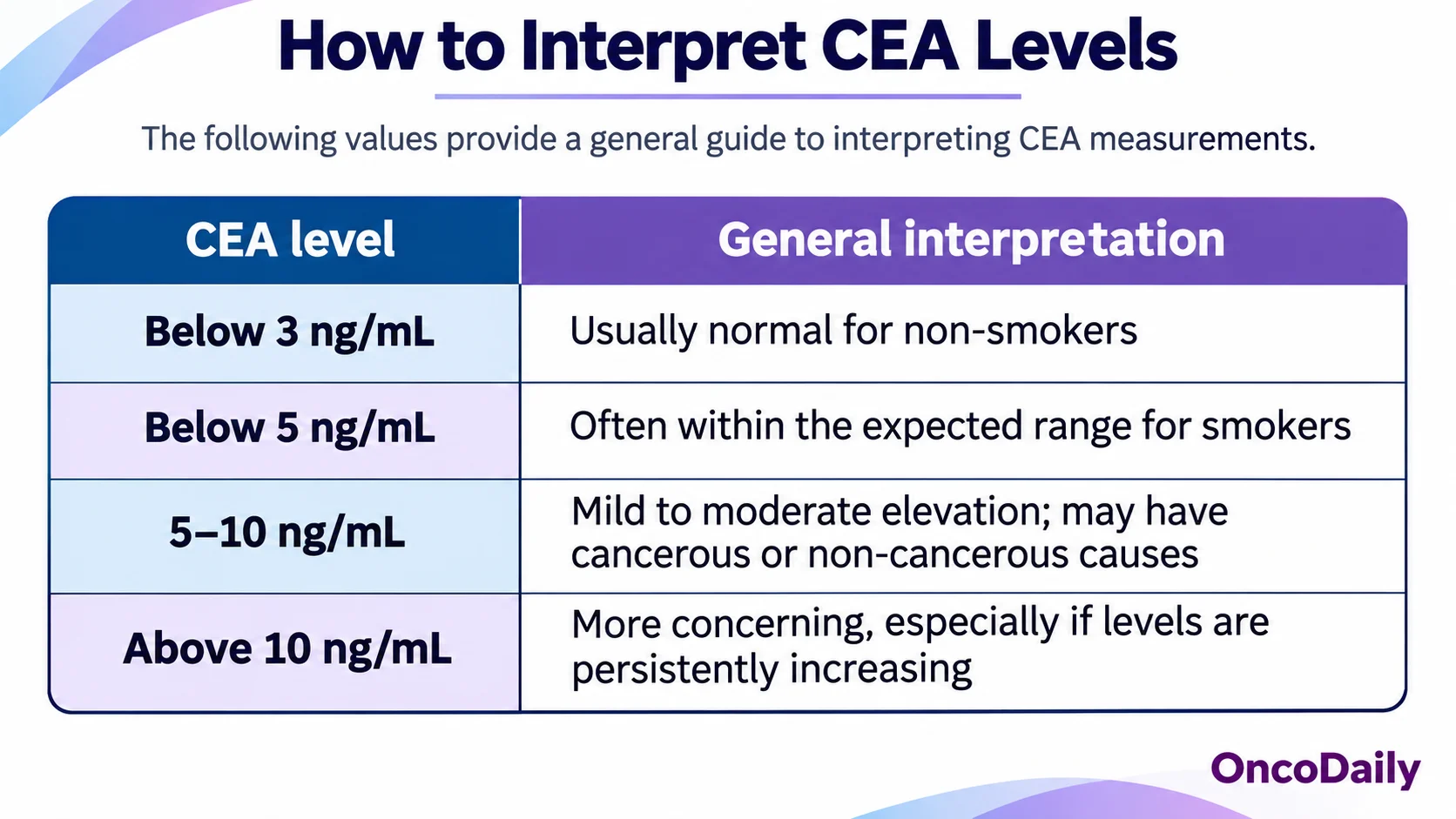
These values should not be interpreted as fixed diagnostic thresholds. A patient with colorectal cancer may have a normal CEA level, while someone without cancer may have an elevated result.
For example, a patient whose CEA increases gradually from 2 to 7 ng/mL during follow-up may require additional evaluation, even though the latest value is only moderately elevated. In contrast, a stable, mildly elevated result in a smoker may have a different clinical significance.
Changes over time are particularly important. Doctors usually compare current CEA results with previous measurements and prefer using the same laboratory when possible, as different testing methods can produce slightly different values (National Library of Medicine, n.d.; Kankanala and Mukkamalla, 2024).
What Causes High CEA Levels?
High CEA levels can occur when colorectal cancer grows, progresses, or returns after treatment. However, an elevated CEA result is not specific to cancer and does not automatically indicate disease progression.
In patients with colorectal cancer, higher CEA concentrations may reflect increased tumor activity or tumor burden. Levels can also rise when cancer spreads to distant organs, particularly the liver, although CEA cannot identify the location of metastases.
Several non-cancerous conditions can also increase CEA concentrations. These include liver cirrhosis, pancreatitis, inflammatory bowel disease, diverticulitis, and certain chronic respiratory conditions. Smoking is another well-established cause of mildly elevated CEA levels.
CEA can also be increased in other malignancies, including pancreatic, lung, breast, and thyroid cancers.
A mildly elevated result may therefore have several explanations. Doctors consider whether the increase is temporary or persistent, whether the patient has symptoms, and whether previous measurements show a similar pattern.
A single abnormal result often leads to repeat testing rather than an immediate conclusion. Persistently rising levels, especially after colorectal cancer treatment, generally require closer evaluation (National Library of Medicine, n.d.; Wang et al., 2023).
How Are CEA Levels Used to Monitor Colorectal Cancer Treatment?
CEA testing can help doctors evaluate the response to surgery, chemotherapy, and other systemic treatments. Its usefulness is greatest when CEA was elevated before treatment, providing a measurable marker to follow.
After surgery to remove colorectal cancer, CEA levels are expected to decrease if the tumor was the main source of the elevated marker. Because CEA remains in the bloodstream for several days, this decline is not immediate, and levels are generally reassessed after an appropriate postoperative interval.
If CEA remains elevated after surgery, further investigation may be needed. Persistent elevation can indicate residual cancer, but it may also be related to smoking, inflammation, or another medical condition.
During chemotherapy or targeted therapy, a decrease in previously elevated CEA levels may suggest that treatment is controlling the cancer. In contrast, a sustained increase may raise concern about disease progression.
However, CEA does not always follow changes in tumor size. Some patients may have stable CEA despite disease progression, while temporary increases can occasionally occur during treatment.
For this reason, CEA is a complementary monitoring tool rather than a replacement for imaging. Doctors assess treatment effectiveness using a combination of CT or MRI findings, symptoms, physical examination, and laboratory results. Treatment decisions should not be based solely on a change in CEA (National Library of Medicine, n.d.; Kankanala and Mukkamalla, 2024).

Can Rising CEA Levels Indicate Colorectal Cancer Recurrence?
A persistent rise in CEA levels after colorectal cancer treatment can be an early indication of recurrence, sometimes before symptoms develop. However, CEA testing cannot reliably detect every recurrence.
Following successful treatment, CEA levels may remain low or return to the normal range. If they subsequently begin to increase, doctors may investigate whether cancer has returned locally or spread to another organ.
The accuracy of CEA testing for detecting recurrence has been evaluated in several clinical studies.
A 2023 systematic review and meta-analysis by Wang and colleagues included 12 studies involving 3,223 patients who had undergone curative treatment for colorectal cancer. At a commonly used threshold of 5 ng/mL, CEA demonstrated a pooled sensitivity of approximately 59% for detecting recurrence.
This means that around four in ten recurrences could be missed by CEA testing alone at that threshold. The findings demonstrate why normal CEA levels cannot completely exclude recurrent colorectal cancer (Wang et al., 2023).
Recurrence may occur in the colon or rectum, nearby tissues, or distant organs, particularly the liver and lungs. CEA cannot determine where the cancer has returned or how extensive it is.
When CEA levels increase consistently, doctors may recommend repeat blood testing and imaging, usually with CT scans. Additional investigations depend on the patient’s symptoms, previous cancer stage, and treatment history.
CEA is therefore an important part of recurrence surveillance, but it must be combined with imaging and other follow-up examinations.

How Often Should CEA Levels Be Checked After Colorectal Cancer Treatment?
Regular CEA testing is recommended for selected patients following curative-intent treatment for colorectal cancer, particularly those with stage II or III disease who would be eligible for additional treatment if recurrence were detected.
The purpose of surveillance is to identify potentially treatable recurrence before it causes significant symptoms.
Many established follow-up guidelines recommend measuring CEA every 3–6 months during the first two years after treatment, followed by testing approximately every six months until five years have been completed.
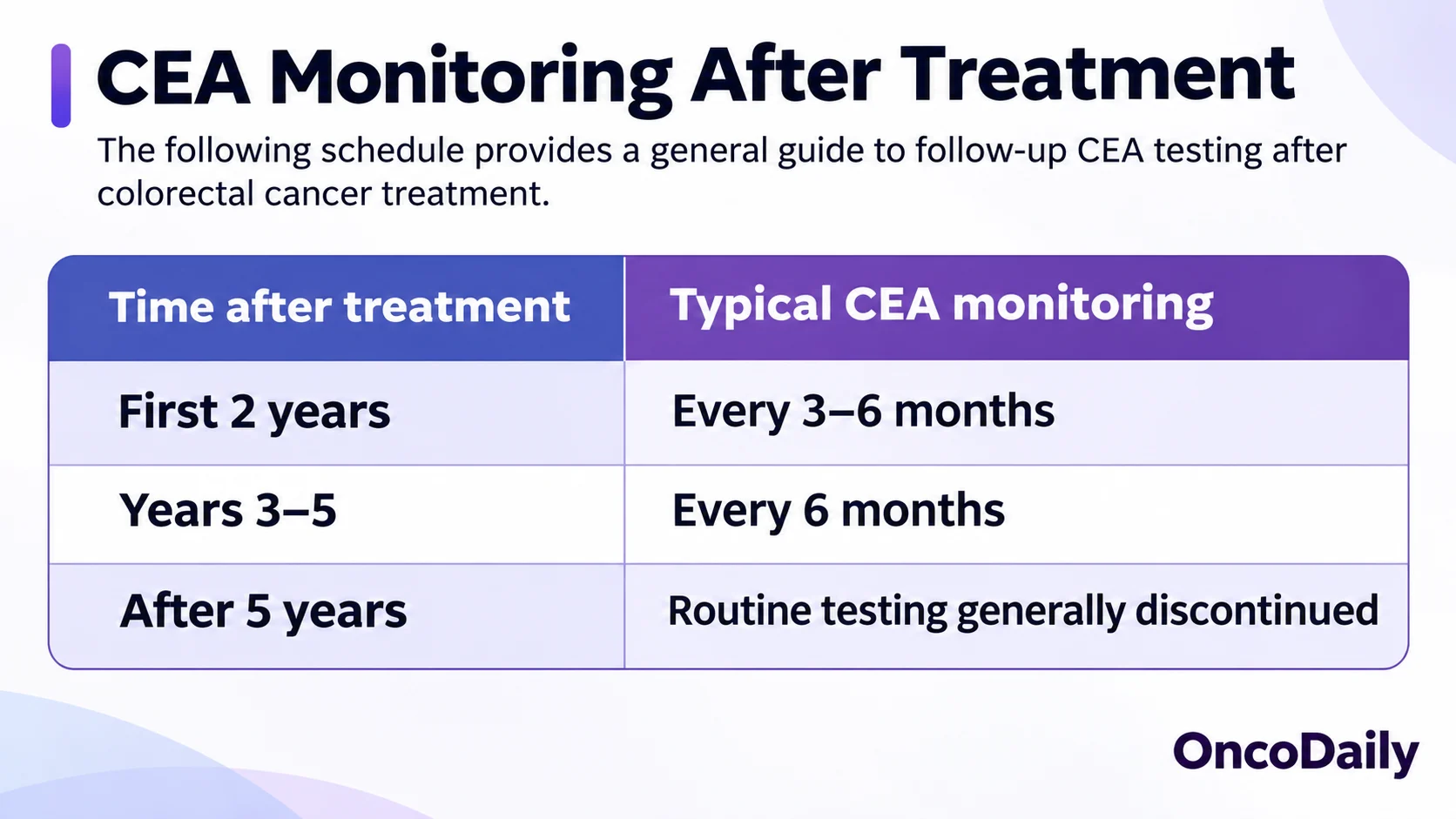
The first few years after treatment are particularly important because colorectal cancer recurrence is more likely to occur during this period.
However, surveillance schedules vary according to the original cancer stage, surgical findings, treatment history, and individual recurrence risk. Patients with stage I disease may not require the same CEA monitoring schedule, while those treated for metastatic colorectal cancer may need more individualized follow-up.
CEA testing is usually combined with CT imaging and colonoscopy. Colonoscopy is particularly important for detecting new colorectal tumors or polyps, which cannot be reliably identified through CEA testing.
Continued surveillance should be discussed with the treating oncology team, especially when other medical conditions or treatment-related factors influence the patient’s follow-up plan (American Cancer Society, 2015; Kankanala and Mukkamalla, 2024).
What Is the Relationship Between CEA Levels and Colorectal Cancer Prognosis?
CEA levels may provide information about colorectal cancer prognosis, particularly when measured before surgery or systemic treatment.
Higher pretreatment CEA concentrations have been associated with more advanced disease, increased tumor burden, and a greater likelihood of recurrence in some patient groups. For this reason, CEA is often considered alongside tumor stage, lymph node involvement, and other pathological findings when assessing prognosis.
However, an elevated CEA level does not necessarily mean that a patient will have a poor outcome. Some patients with high initial levels respond well to treatment, while others with normal CEA may still develop recurrence.
Changes after treatment can also provide useful information. For example, a patient whose CEA was elevated before surgery and subsequently returns to normal may have a more reassuring biochemical response than someone whose levels remain persistently high.
Nevertheless, CEA cannot independently predict survival, determine whether a treatment will be successful, or establish the risk of recurrence for an individual patient.
Cancer stage, tumor biology, treatment response, and overall clinical condition remain essential factors in determining prognosis (Kankanala and Mukkamalla, 2024; Wang et al., 2023).
What Tests Are Needed When CEA Levels Continue to Rise?
A rising CEA level during colorectal cancer follow-up usually requires further evaluation, particularly when the increase is persistent across multiple measurements.
Doctors may initially repeat the blood test to confirm the result and review previous values. This helps distinguish a consistent upward trend from temporary fluctuations or laboratory-related differences.
If CEA continues to increase, imaging is often recommended. CT scans of the chest, abdomen, and pelvis can help identify possible recurrence or metastatic disease, particularly in the liver and lungs.
Colonoscopy may also be considered depending on the patient’s surveillance history, symptoms, and clinical findings. In selected circumstances, MRI or PET/CT may be used when conventional examinations do not adequately explain the findings, although PET/CT is not recommended as a routine surveillance test.
Patients should inform their oncology team if they develop persistent abdominal pain, changes in bowel habits, unexplained weight loss, rectal bleeding, or unusual fatigue, even when their CEA results remain normal.
Importantly, an increasing CEA level alone is not sufficient reason to restart chemotherapy or change treatment.Additional investigations are necessary to establish whether cancer is present and determine the most appropriate next steps (National Library of Medicine, n.d.; Wang et al., 2023).
FAQ
What CEA level indicates colorectal cancer?
No specific CEA level confirms colorectal cancer. Levels above 5 ng/mL are often considered elevated, but cancer diagnosis requires additional tests, such as colonoscopy and biopsy.
Can CEA levels be high without cancer?
Yes. Smoking, liver disease, pancreatitis, and inflammatory conditions can increase CEA levels without cancer being present.
Can colorectal cancer return with normal CEA levels?
Yes. Some colorectal tumors produce little CEA, so recurrence can occur even when blood levels remain within the normal range.
How long does CEA take to return to normal after surgery?
CEA levels typically decrease within 4–6 weeks after successful surgery, particularly when they were elevated before treatment. Recovery patterns vary between patients.
Does rising CEA always mean colorectal cancer recurrence?
No. A rising CEA level may suggest recurrence, but temporary fluctuations and non-cancerous conditions can also cause increases. Repeat testing and imaging may be needed. give me very good focus key words For your OncoDaily article “CEA Levels in Colorectal Cancer: Monitoring and Recurrence,” I recommend keywords that target both patients searching for their CEA results and those looking for information about cancer recurrence. Best primary SEO focus keyword CEA levels in colorectal cancer Copy This matches your article's title, clinical focus, and overall content. Strong secondary keywords 1. High CEA levels 2. Normal CEA levels 3. CEA blood test 4. CEA levels after colon cancer surgery 5. Rising CEA levels 6. CEA and colorectal cancer recurrence 7. CEA tumor marker 8. CEA monitoring after cancer treatment 9. CEA levels and cancer prognosis 10. CEA levels during chemotherapy High-intent long-tail keywords - What CEA level indicates cancer? - What is a normal CEA level? - Does high CEA mean cancer recurrence? - Can CEA levels be high without cancer? - Can colon cancer return with normal CEA? - How often should CEA be checked after colon cancer? My SEO recommendation For Rank Math or Yoast, I'd prioritize these five focus phrases: CEA levels in colorectal cancer, high CEA levels, normal CEA levels, CEA blood test, colorectal cancer recurrence SEO title: CEA Levels in Colorectal Cancer: Monitoring and Recurrence Meta description: Learn what normal and high CEA levels mean in colorectal cancer, how doctors monitor treatment, and when rising levels may indicate recurrence. These keywords are closely aligned with the article's content. Actual search volume and keyword difficulty would need to be checked separately before ranking them by traffic potential. how can I do that cea will be the first word To make CEA the first word while keeping the title scientific, patient-friendly, and SEO-optimized, I'd suggest: My top recommendation: CEA Levels in Colorectal Cancer: What Do They Mean? Other strong options: 1. CEA Blood Test: Normal Levels, Cancer Risk, and Recurrence 2. CEA Levels: What Is Normal and When Should You Worry? 3. CEA in Colorectal Cancer: Treatment and Recurrence Monitoring 4. CEA Tumor Marker: Understanding Levels and Cancer Recurrence 5. CEA Levels After Colorectal Cancer Treatment: What to Know I'd choose “CEA Levels in Colorectal Cancer: What Do They Mean?” for OncoDaily. It keeps your main SEO keyword at the beginning, is under 60 characters, and sounds medical while remaining accessible to patients.