
At the ESMO Congress 2026, Changhoon Yoo (Seoul, Republic of Korea) presented results from the randomized Phase II OPTIMUM trial (NCT05222971), evaluating maintenance olaparib with or without durvalumab in patients with advanced biliary tract cancer (BTC) harbouring DNA damage repair (DDR) gene mutations.
The results, presented during the Rapid Oral session as Late-Breaking Abstract LBA22, included progression-free survival (PFS), overall survival (OS), objective response rate (ORR), safety, and exploratory biomarker findings.
Why Was OPTIMUM Conducted?
Platinum-containing chemotherapy is a standard treatment approach for advanced biliary tract cancer. However, no maintenance strategy has been validated for patients who achieve disease control following first-line platinum-based treatment.
DDR gene mutations occur in a subset of patients with advanced BTC, providing a rationale for investigating poly(ADP-ribose) polymerase (PARP) inhibitors in this population.
The Phase II OPTIMUM trial evaluated maintenance olaparib, alone or combined with durvalumab, in patients with DDR-mutated advanced BTC whose disease had not progressed following first-line platinum-based therapy.
OPTIMUM Study Design and Methods
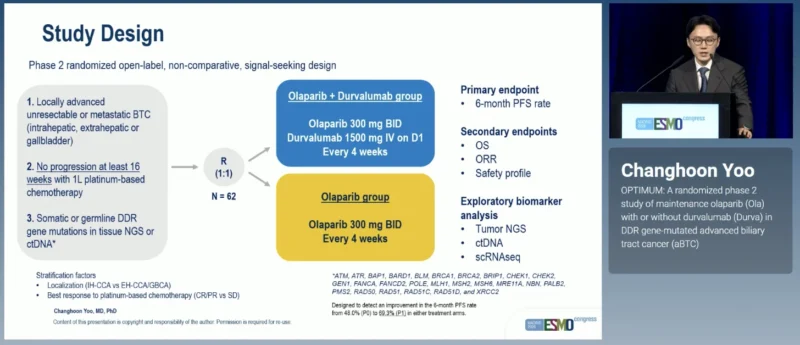
OPTIMUM was a randomized, open-label, non-comparative Phase II trial enrolling patients with advanced BTC, an ECOG performance status of 0–1, and at least one predefined somatic or germline DDR gene mutation. Eligible patients were required to have no disease progression following at least 16 weeks of first-line platinum-based therapy. Patients were randomized in a 1:1 ratio to receive one of two maintenance regimens:
- Arm A: Olaparib 300 mg twice daily plus durvalumab 1,500 mg intravenously every four weeks.
- Arm B: Olaparib 300 mg twice daily.
The primary endpoint was the six-month PFS rate in the full analysis set (FAS). The study was designed to evaluate an improvement in the six-month PFS rate from a historical benchmark of 48.0% to 69.3%, corresponding to a target hazard ratio of 0.5. The statistical design specified a one-sided significance level of 0.05 and 80% power, with 62 patients required.
As a non-comparative Phase II trial, OPTIMUM was not designed to establish the superiority of olaparib plus durvalumab over olaparib alone.
Key Findings from OPTIMUM
Between April 2022 and February 2026, a total of 63 patients were enrolled, of whom 61 were included in the full analysis set. Arm A included 32 patients receiving olaparib plus durvalumab, while Arm B included 29 patients receiving olaparib alone.
Baseline characteristics were well balanced between treatment groups. The most frequently identified DDR gene alterations were ATM (34%), BRCA2 (25%), and BAP1 (25%).
Progression-Free Survival
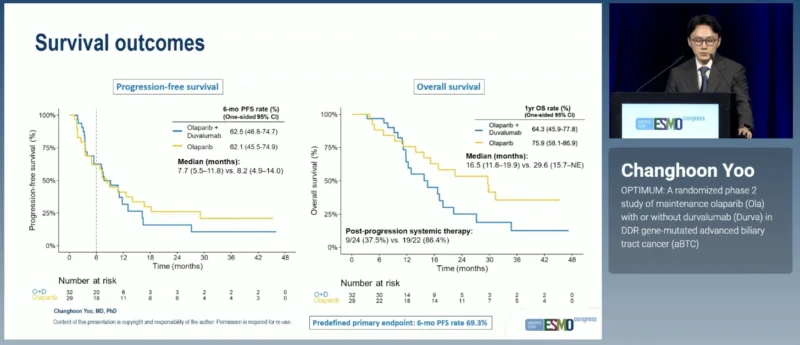
The six-month PFS rate, the study’s primary endpoint, was 62.5% (one-sided 95% CI 46.8–74.7) with olaparib plus durvalumab and 62.1% (one-sided 95% CI 45.5–74.9) with olaparib alone. Median PFS was 7.7 months (90% CI 5.5–11.8) in the olaparib plus durvalumab group and 8.2 months (90% CI 4.9–14.0) in the olaparib-alone group.
The observed six-month PFS rates were below the prespecified target of 69.3%. Therefore, the study did not meet its primary endpoint. As OPTIMUM was designed as a non-comparative Phase II trial, these findings do not establish the relative efficacy of the two maintenance regimens.
Overall Survival
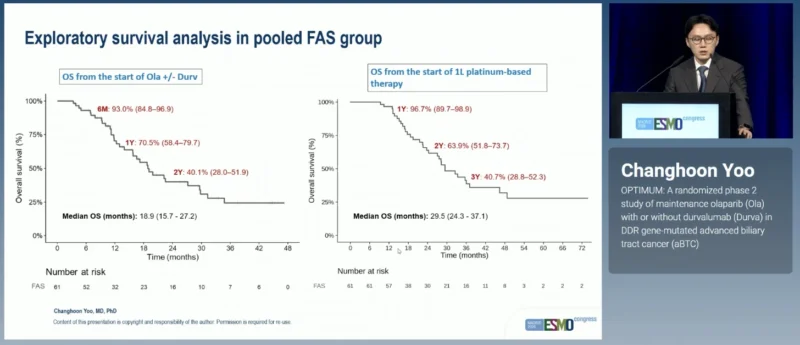
In the overall full analysis set, median OS was 18.9 months (reported CI 15.7–27.2). Median OS was 16.5 months (reported CI 11.8–19.9) with olaparib plus durvalumab and 29.6 months (reported CI 15.7–not estimable) with olaparib alone.
The one-year OS rate was 70.5% in the overall population, including 64.3% in Arm A and 75.9% in Arm B. At two years, the estimated OS rate was 40.1% (reported CI 28.0–51.9) in the overall full analysis set. The corresponding rates were 25.0% in Arm A and 53.6% in Arm B. These findings were descriptive and should be interpreted in the context of the study’s non-comparative design and limited sample size.
Objective Response Rate
The ORR was 27.5% in the overall full analysis set. Response rates were 30.0% with olaparib plus durvalumab and 25.0% with olaparib alone. The trial was not designed to establish a statistically significant difference in response rates between the two maintenance regimens.
Outcomes According to Homologous Recombination Deficiency
An exploratory analysis examined outcomes among patients with core homologous recombination deficiency (cHRD). The cHRD group included 18 patients, representing approximately 30% of the full analysis set. Patients with cHRD had significantly longer median PFS compared with those without cHRD:
- Median PFS: 20.5 versus 7.4 months (p=0.008).
- Overall survival was also longer in the cHRD group:
- Median OS: Not reached versus 16.5 months (p=0.007).
These findings identified cHRD as a potential marker associated with more favourable outcomes during olaparib-based maintenance therapy. However, the exploratory analysis does not establish that cHRD predicts benefit specifically from olaparib or the addition of durvalumab.
Circulating Tumour DNA Findings
Exploratory biomarker analyses also examined variant allele frequency (VAF) in circulating tumour DNA (ctDNA) at the start of study treatment. Higher ctDNA VAF was negatively correlated with both PFS and OS, indicating an association between higher baseline ctDNA VAF and less favourable survival outcomes. The abstract did not report numerical correlation coefficients or hazard ratios for these associations.
Safety Outcomes
In the safety population, treatment-emergent adverse events (TEAEs) of any grade occurred in 100.0% of patients receiving olaparib plus durvalumab (n=32) and 93.3% receiving olaparib alone (n=30). Grade 3 or higher TEAEs occurred in 59.4% and 46.7%, respectively.
Anaemia was reported in 50.0% versus 33.3% of patients, including Grade 3 or higher anaemia in 25.0% versus 13.3%. Fatigue occurred in 46.9% and 56.7% of patients, respectively.
Conclusions
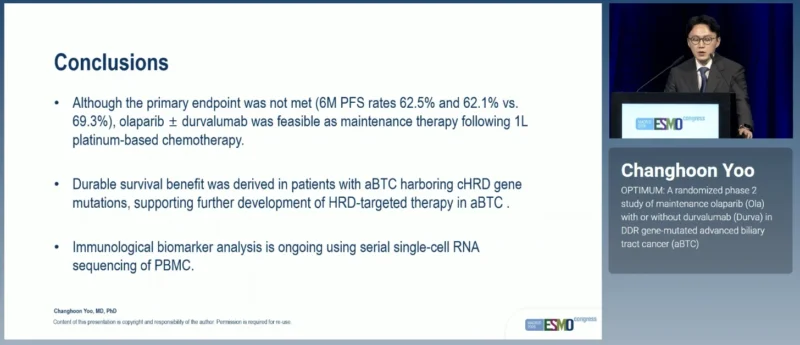
The randomized Phase II OPTIMUM trial evaluated maintenance olaparib with or without durvalumab in patients with DDR-mutated advanced biliary tract cancer following disease control with first-line platinum-based chemotherapy. The study did not meet its primary endpoint. Six-month PFS rates were 62.5% with olaparib plus durvalumab and 62.1% with olaparib alone, below the prespecified target of 69.3%. Median PFS was 7.7 and 8.2 months, respectively.
Exploratory biomarker analyses showed more favourable PFS outcomes in patients with core homologous recombination deficiency (cHRD) compared with those harbouring other DDR gene alterations. Six-month PFS rates were 83.3% versus 53.5%, respectively (p=0.008).
Similarly, patients without detectable circulating tumour DNA (ctDNA) at the start of maintenance therapy had a higher six-month PFS rate than those with detectable ctDNA (88.0% vs 44.1%; p=0.002).
The investigators concluded that olaparib with or without durvalumab was feasible as maintenance therapy following first-line platinum-based chemotherapy. The outcomes observed in patients with cHRD alterations support further investigation of HRD-targeted therapies in advanced BTC. These findings remain exploratory, and the non-comparative study design does not establish an additional benefit from durvalumab.
Source: ESMO Congress 2026 – LBA22, Phase II OPTIMUM

Read more about HARMONi-GI1 trial on OncoDaily.