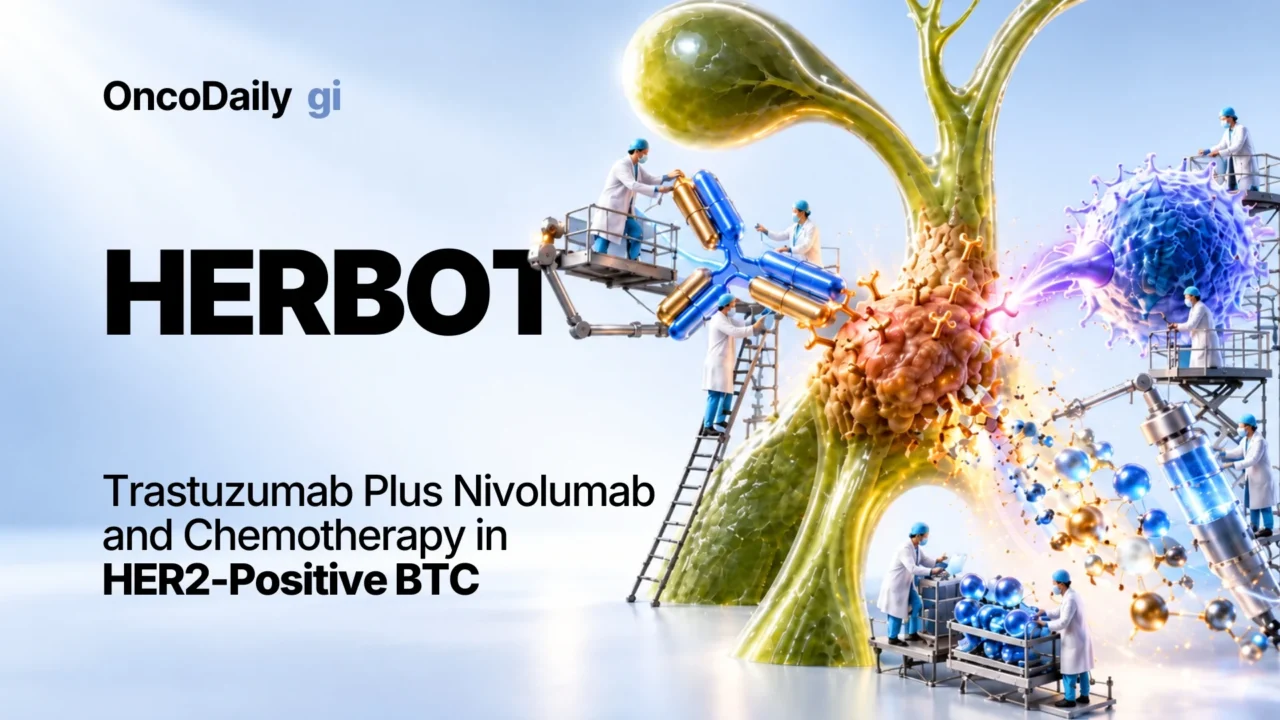
Despite the incorporation of immune checkpoint inhibitors into first-line chemotherapy, most patients with advanced biliary tract cancer (BTC) eventually experience disease progression. HER2 overexpression or amplification, observed in approximately 15% of BTCs, represents a potential therapeutic target, although its integration into first-line chemoimmunotherapy remains an area of investigation.
On September 22, 2026, Nature Medicine published the results of the phase 1b/2 HERBOT trial, titled “Trastuzumab plus nivolumab with gemcitabine and cisplatin as first-line therapy for HER2-positive unresectable biliary tract cancer: a phase 1b/2 trial.” The study evaluated the efficacy and safety of combining HER2-targeted therapy with chemotherapy and immune checkpoint inhibition in patients with HER2-positive advanced BTC.
Authors: Choong-kun Lee, Taek Chung, Il Hwan Kim, Hong Jae Chon, Jin Won Kim, Se Jun Park, Woo Kyun Bae, Junghun Kang, Changhoon Yoo, Dong-Hoe Koo, Sora Kang, Minsuk Kwon, Ju Won Kim, Beodeul Kang, Sejung Park, Woochan Hwang, Chang Ho Ahn, Chang Gon Kim, and Hye Jin Choi.
HER2-Targeted Therapy in Advanced Biliary Tract Cancer
Phase 3 trials have established durvalumab or pembrolizumab combined with gemcitabine and cisplatin as first-line treatment options for advanced BTC, but more effective strategies are still needed. Before HERBOT, HER2-directed therapies had demonstrated clinical activity in previously treated BTC, but their combination with standard first-line chemoimmunotherapy had not been prospectively evaluated.
The rationale for combining HER2-targeted therapy with chemoimmunotherapy is based partly on the potential immunomodulatory effects of HER2-directed antibodies. These agents can promote antibody-dependent cellular cytotoxicity and antigen presentation, providing a biological basis for combining trastuzumab with immune checkpoint inhibition. Against this background, the HERBOT trial (KCSG-HB23-05; NCT05749900) was designed to investigate the feasibility, safety, and antitumor activity of trastuzumab combined with nivolumab, gemcitabine, and cisplatin in previously untreated advanced HER2-positive BTC.
HERBOT Trial Design and Patient Characteristics
HERBOT was a multicenter, open-label, single-arm phase 1b/2 study conducted at 12 cancer centers in South Korea. Between May 2023 and December 2024, 49 patients were screened, of whom 40 were enrolled and included in the efficacy and safety analyses.
Eligible patients had HER2-positive unresectable locally advanced or metastatic BTC, including intrahepatic cholangiocarcinoma, extrahepatic cholangiocarcinoma, and gallbladder cancer. HER2 positivity was centrally confirmed, with enrolled patients having tumors classified as IHC 3+ or IHC 2+ with positive in situ hybridization.
The median age was 66 years, and 87.5% of patients had an Eastern Cooperative Oncology Group (ECOG) performance status of 1. Gallbladder cancer represented the largest subgroup, accounting for 72.5% of the study population. Overall, 62.5% of tumors were classified as HER2 IHC 3+.
Patients received trastuzumab and nivolumab with gemcitabine and cisplatin every three weeks. Chemotherapy was administered for up to nine cycles, although continuation beyond this period was permitted at the investigator’s discretion. Trastuzumab and nivolumab could be continued for up to two years.
The phase 1b component aimed to determine the recommended phase 2 dose, while the primary efficacy endpoint in phase 2 was objective response rate (ORR), assessed according to RECIST version 1.1. Secondary endpoints included progression-free survival (PFS), overall survival (OS), duration of response (DOR), disease control rate (DCR), and safety. No dose-limiting toxicities were observed during phase 1b, and the starting dose was selected for phase 2.
Clinical Activity and Survival Outcomes
The HERBOT study met its primary efficacy endpoint, with an ORR of 55% (22 of 40 patients; 95% CI, 38.5–70.7%). Among the treated patients, one achieved a complete response (2.5%) and 21 achieved partial responses (52.5%). The disease control rate reached 95.0% (95% CI, 83.5–99.4%).
Responses were also durable, with a median DOR of 12.6 months (95% CI, 5.7–not reached). The median time to response was 2.1 months. Two patients (5.0%) experienced sufficient tumor shrinkage to undergo conversion surgery with curative intent, at 4.54 and 6.97 months after treatment initiation.
At the December 23, 2025, data cutoff, the median follow-up was 17.0 months. Median PFS was 10.6 months (95% CI, 7.8–17.4), while the estimated six-month PFS rate was 80.0% (95% CI, 64.0–89.5%). Overall survival data remained immature. Median OS had not been reached, and the estimated 12-month OS rate was 72.7% (95% CI, 55.0–84.4%). In post hoc subgroup analyses, ORR was 65.5% in patients with gallbladder cancer, compared with 28.6% in extrahepatic and 25.0% in intrahepatic cholangiocarcinoma. These differences were not statistically significant (P = 0.1085).
Safety Profile of the HERBOT Regimen
Treatment-related adverse events were reported in 36 patients (90.0%). Most grade 3 or higher events were hematologic, consistent with the known toxicity profiles of the individual agents. The most common grade 3 or higher treatment-related adverse events were neutropenia (57.5%), anemia (30.0%), and thrombocytopenia (22.5%).
Nonhematologic adverse events were predominantly grade 1 or 2. Grade 3 fatigue occurred in 5.0% of patients, while grade 3 asthenia, vomiting, and constipation were each reported in 2.5%. Cardiac adverse events associated with trastuzumab were infrequent. One patient developed a grade 2 reduction in left ventricular ejection fraction after the sixth treatment cycle.
Two patients discontinued treatment because of adverse events, including drug-unrelated pneumonia and nivolumab-related arthralgia. At the data cutoff, 12 patients (30.0%) remained on trastuzumab and nivolumab. No new safety signals were identified.
AI-Based HER2 Assessment and Treatment Response
An additional component of HERBOT involved preplanned exploratory analyses using artificial intelligence (AI)-powered whole-slide image analysis to examine whether quantitative HER2 expression and tumor immune characteristics were associated with clinical outcomes. Investigators evaluated the proportion of HER2 IHC 3+ tumor cells across whole-slide images, using a threshold of 10% to distinguish between higher and lower proportions of strongly HER2-expressing cells.
Fifteen patients (37.5%) had a whole-slide HER2 3+ tumor cell proportion of at least 10%, while 25 patients had a proportion below this threshold. The ORR was significantly higher among patients with a HER2 3+ tumor cell proportion of at least 10%, reaching 80.0%, compared with 40.0% among those below the threshold (P = 0.0138).
Median PFS was also numerically longer in the higher-expression group, at 17.4 months compared with 10.5 months (HR 0.57; 95% CI, 0.23–1.34). In a post hoc exploratory analysis, higher whole-slide HER2 3+ tumor cell proportions were significantly associated with deeper tumor reduction. In contrast, the HER2/CEP17 ratio measured by silver in situ hybridization was not significantly associated with the greatest reduction in tumor size.
Notably, conventional HER2 IHC classification did not show a statistically significant difference in ORR between the IHC 3+ and IHC 2+/ISH-positive groups. These findings suggest that quantitative assessment of HER2 expression across tumor tissue may provide information beyond conventional categorical HER2 scoring.
The investigators also examined tumor immune phenotypes using AI-based analysis. Tumors were classified as immune-inflamed, immune-excluded, or immune-desert. Although objective response rates did not differ significantly according to immune phenotype, patients with immune-excluded tumors had numerically longer PFS than those with immune-desert tumors. These biomarker findings remain exploratory and require validation in larger patient populations.
Clinical Implications and Future Directions
The HERBOT findings provide early prospective evidence supporting the investigation of HER2-targeted chemoimmunotherapy in the first-line management of advanced HER2-positive BTC. The observed ORR of 55%, median DOR of 12.6 months, and median PFS of 10.6 months suggest promising clinical activity. However, interpretation of these findings requires consideration of the study design.
HERBOT was a nonrandomized, single-arm trial without a chemotherapy or chemoimmunotherapy control group. Consequently, the results cannot establish whether adding trastuzumab improves outcomes compared with current standard first-line treatment.
The relatively small sample size and immature OS data also limit definitive conclusions regarding long-term benefit. Another important consideration is the predominance of gallbladder cancer, which accounted for nearly three-quarters of enrolled patients. The findings may therefore not be directly generalizable to patients with intrahepatic or extrahepatic cholangiocarcinoma.
Furthermore, the exploratory AI-based analyses suggested potential associations between HER2 expression patterns, immune phenotypes, and clinical outcomes. These observations were not externally validated and should be considered hypothesis-generating.
Ongoing randomized phase 3 studies, including HERIZON-BTC-302 (NCT06282575) and DESTINY-BTC01 (NCT06467357), are evaluating HER2-targeted first-line treatment strategies in BTC. These studies may help clarify the role of upfront HER2-directed therapy and the patient populations most likely to benefit.
Looking Ahead
The HERBOT phase 1b/2 trial demonstrated encouraging antitumor activity with trastuzumab, nivolumab, gemcitabine, and cisplatin in patients with HER2-positive unresectable biliary tract cancer, meeting its primary efficacy endpoint and showing a safety profile consistent with the known effects of the individual agents.
The exploratory biomarker findings also highlight the potential relevance of quantitative HER2 expression and tumor immune characteristics in understanding treatment response.
Although randomized evidence is needed before the clinical benefit of this approach over standard chemoimmunotherapy can be established, HERBOT provides a rationale for further evaluation of HER2-targeted chemoimmunotherapy as a first-line treatment strategy in HER2-positive advanced BTC.
The full article is available in Nature Medicine.
Find more videos on OncoDaily YouTube TV.