From October 12 to 18, the third week of October brought together important updates across GI oncology, with expert posts covering gastroesophageal cancer, colorectal cancer, hereditary gastric cancer, hepatocellular carcinoma, rectal cancer, pancreatic cancer, and organ preservation strategies.
This week’s selection includes updates on first-line zanidatamab-based therapy in advanced HER2-positive gastroesophageal cancer, mitomycin C versus oxaliplatin-based HIPEC for colorectal peritoneal metastases, personalized surveillance and prevention in CDH1 pathogenic variant carriers, the prognostic impact of liver function in unresectable hepatocellular carcinoma treated with atezolizumab plus bevacizumab, and the new ESMO Clinical Practice Guideline for gastric and oesophageal cancer.
Other posts highlight a Belgian consensus protocol for liver transplantation in unresectable colorectal liver metastases, 12-month results from the STAR-TREC trial investigating organ preservation in early rectal cancer, FDA labeling and treatment access considerations for daraxonrasib in metastatic pancreatic cancer, clonal heterogeneity and tumor progression in pancreatic ductal adenocarcinoma, and immunotherapy in operable gastric cancer with microsatellite instability, including ongoing organ preservation research from the DEWI study.
Together, these posts reflect the continued evolution of GI oncology across targeted therapy, surgical oncology, hereditary cancer prevention, liver transplantation, organ preservation, immunotherapy, precision medicine, clinical practice guidelines, tumor biology, and treatment access.
Tiago Cordeiro Felismino — Chief, Upper Gastrointestinal Oncology at A.C.Camargo Cancer Center | Brazil
“Pleased to share our meta-analysis published in the Journal of Gastrointestinal Cancer, evaluating first-line zanidatamab-based therapy in advanced HER2-positive gastroesophageal cancer.
3 trials | 685 patients
Median OS: 26.1 months
Median PFS: 12.6 months
Response rate: 70%
Grade ≥3 diarrhea: 26%
Promising efficacy, with relevant gastrointestinal toxicity.”
Niels Kok — Gastrointestinal Surgeon, MD, PhD, Netherlands Cancer Institute / Antoni van Leeuwenhoek | Netherlands
“We looked at our long-term results of CRS-HIPEC for colorectal peritoneal metastases at The Netherlands Cancer Institute with a specific focus on MMC vs. Oxaliplatin based HIPEC. Mitomycin C was associated with better peritoneal disease-free survival. Among patients treated with oxaliplatin-based HIPEC, prior systemic oxaliplatin exposure was associated with worse peritoneal disease-free and overall survival.
Oxaliplatin based HIPEC could only be considered in chemonaive patients or for a second HIPEC procedure..”
Mara Cruellas — MD, PhD; Medical Oncology, Hereditary Cancer Genetics Unit and Breast Cancer Unit, Hospital Clínico Universitario Lozano Blesa; University of Zaragoza | Spain
“Excited to share our newly published review!
‘CDH1 germline carriers and diffuse gastric Cancer: Are we ready for personalized surveillance and prevention?’
For decades, prophylactic total gastrectomy has been the cornerstone of gastric cancer prevention in CDH1 pathogenic variant carriers. However, emerging evidence is challenging the traditional one-size-fits-all approach.
In this review, we discuss evolving cancer risk estimates, advances in expert endoscopic surveillance, and the potential role of emerging biomarkers in guiding more individualized management.
Are we truly ready for personalized surveillance and prevention?
While recent advances are encouraging, important challenges remain. Reliable biomarkers for risk stratification are still lacking, and shared decision-making within multidisciplinary expert teams remains essential.
The key challenge is not only identifying individuals at risk, but determining how to tailor preventive strategies to each patient.
Delighted to contribute to this important discussion and to share our perspective on the future of hereditary gastric cancer management. ”
Changhoon Yoo — Medical Oncologist; Associate Professor, Asan Medical Center | South Korea
“Our Asia-Pacific Collaborative study is now available online.
Child–Pugh A in HCC patients is not one population.
In 836 patients with unresectable HCC treated with first-line atezolizumab–bevacizumab across Korea, Singapore, Taiwan, and Hong Kong:
CP score 5 vs 6: median OS 22.7 vs 11.3 months
ALBI 1 vs 2 within CP-A: median OS 23.0 vs 14.0 months
CP-B: median OS 5.4 months, with an overall safety profile comparable to CP-A
Pivotal phase III trials enrolled only CP-A patients. Our Asia-Pacific data define the real-world benchmarks for everyone else, and make clear that precise liver function assessment must guide first-line systemic therapy.”
Salah-Eddin Al-Batran, MD — Professor of Oncology, Chief Executive Frankfurt Institute of Clinical Cancer Research (IKF). Chief Physician, Krankenhaus Nordwest, Frankfurt | Germany
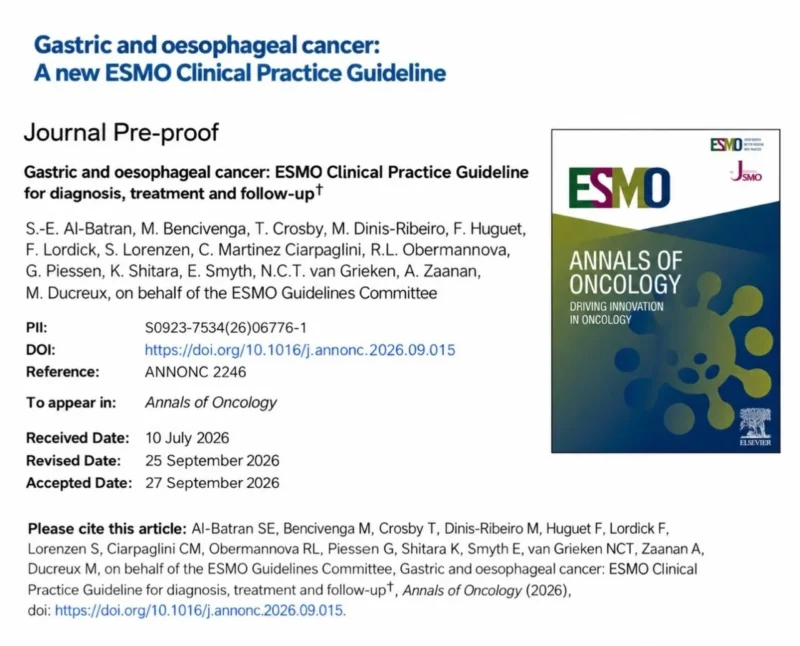
“Extremely proud to share our new ESMO Clinical Practice Guideline for gastric and oesophageal cancer, now published in Annals of Oncology!
A big team effort and a long journey. My heartfelt thanks to all co-authors and the ESMO Medical Writing Team and ESMO Guidelines Committee for their outstanding collaboration and dedication.
Together, we have developed comprehensive, evidence-based recommendations to support oncologists in delivering the best possible care for our patients.”
Gertjan Rasschaert — MD, Consultant GI Oncology, UZ Leuven | Colorectal Cancer research, Tejpar lab KU Leuven | Clinical Trials | Belgium
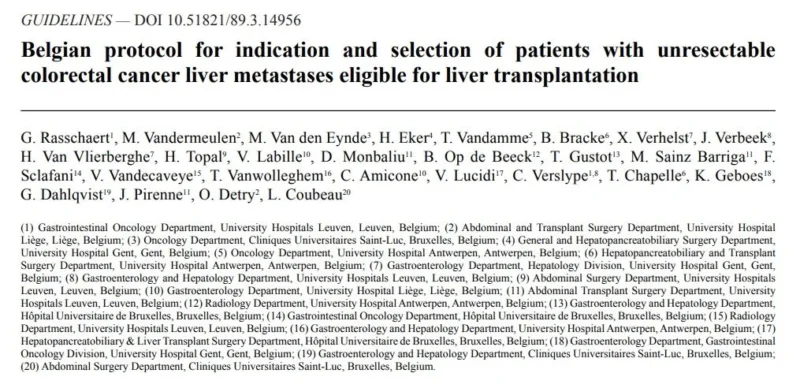
“Very pleased to see the publication of this Belgian consensus protocol for liver transplantation in unresectable colorectal liver metastases.
Translating the landmark data from TRANSMET, SECA and others into real-world practice is not a black-and-white exercise.
We therefore developed a Belgian protocol tailored to our own healthcare context and clinical practice. In some respects, it may be perceived as more stringent than the trial protocols above; in others, less so.
Two cardinal rules:
No current or previous extrahepatic disease
Unresectable colorectal liver metastases, as determined by expert review
Other key elements include:PR/SD for at least 6 months on the same treatment line
A mandatory 8-week treatment holiday
Therefore (among other reasons) no exclusion based on one specific point mutation
… and several other important details discussed in the article.I was genuinely surprised — and all the more proud — to learn that this is in fact the very first Belgian consensus protocol for a liver transplantation indication. L’Union fait la force.
I am also particularly pleased that all six Belgian liver transplant centres are now working together within a shared, transparent and openly discussed framework for this controversial and rare oncotransplant indication.
Many thanks to all co-authors and collaborators for this tour de force.”
Jeremy Meyer — Chirurgien digestif | Chirurgien colorectal | Chirurgien robotique | Coordinateur du Centre du cancer colorectal | Médecin adjoint agrégé | MD, PhD, PD, FMH, FMH, FEBS, FEBS | BJS Open associate editor | Switzerland
“The 12-month results of the STAR-TREC trial have been released
For early rectal cancer (mrT1-3b N0, <4cm), the trial compared long-course chemoradiotherapy (CRT) with short-course radiotherapy (SCRT) as the route to organ preservation, including 409 patients across 37 centres in five countries. Phase 2 randomised patients between CRT, SCRT and primary TME. In phase 3, patients chose between TME and organ preservation, and were then randomised between CRT and SCRT.
Complete responders went to surveillance, near-complete responders to transanal excision.
TME-free survival at 12 months was 78.5% with long-course chemoradiotherapy versus 60.6% with short-course radiotherapy (HR 1.90, 95% CI 1.29 to 2.81). Serious adverse events were half as frequent with organ preservation as with primary TME.
For a patient whose goal is to keep the rectum, long-course chemoradiotherapy now seems the better bet, pending oncological outcomes.”
Vivek Subbiah, MD — Oncologist; Drug Development, Precision Oncology, Tissue-Agnostic Precision Medicine, Phase I Clinical Trials | United States
“HOT OFF THE PRESS
Pleased to share our new commentary. Dr_R_Kurzrock & I love the Daraxonrasib FDA label, and we explain why.
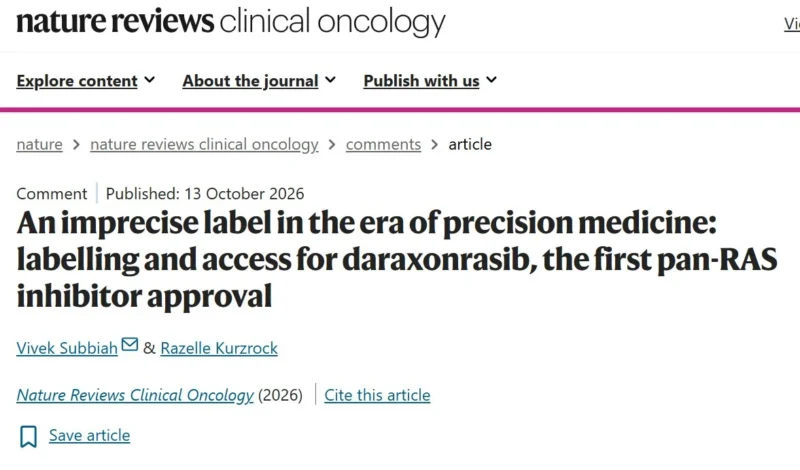
‘An imprecise label in the era of precision medicine: labelling and access for daraxonrasib, the first pan-RAS inhibitor approval’
The FDA recently approved daraxonrasib for patients with metastatic pancreatic adenocarcinoma who received at least one prior systemic therapy, OR who are not candidates for multiagent systemic therapy.
Critics have called that second clause non-evidence-based. We see it differently.
Clinical trials generally enroll only patients with good performance status. That does not reflect reality for most people with metastatic pancreatic cancer. Many never reach second-line therapy because their clinical condition deteriorates first. A label written strictly around trial eligibility would leave these patients with nothing.
Here, the imprecision enables access. It lets physicians offer an effective RAS-targeted drug to the patients who need it most, at the point in their illness when it can still help.
Real-world evidence should resolve any remaining uncertainty.
Precision medicine should mean the right drug reaching the right patient, not a label that excludes the sickest among them.”
Wafik El-Deiry, MD, PhD, FACP — Inaugural Associate Dean for Oncologic Sciences at Brown University (1-2-2019 to 6-30-2026) and Founding Director, Cancer Center at Brown University (March 2020 until 6-30-2026) | United States
“Clonal heterogeneity in human pancreatic ductal adenocarcinoma and its impact on tumor progression”
Dewi Vernerey — Senior Hospital Engineer (Epidemiologist/Statistician) at University Hospital of Besançon | Consultancy in Biostatistic | France
“A very important proof-of-concept study, sponsored by Gercor, demonstrates the benefits of immunotherapy for patients with microsatellite Instability operable gastric cancer.
The UMQVC team developed the methodology and lead the statistical analyses.
The story continues with the DEWI (thanks jean-baptiste bachet and Thierry André) organ preservation study, employing a watch-and-wait strategy, also sponsored by Gercor. The first interim analysis of teh DEWI study will be presented at ESMO 2026 by Professor Thierry André. A truly remarkable story for patients that continues.”
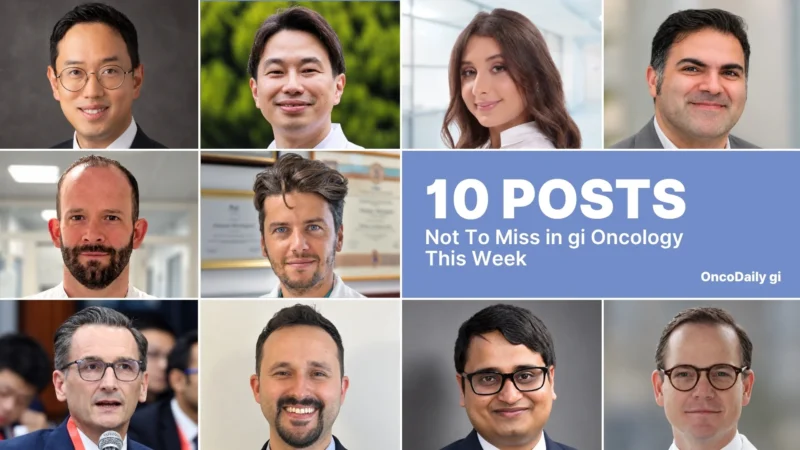
Find out 10 Must-Read Posts in GI Oncology from the October 12 to October 18 on OncoDaily.