
At the ESMO 2026 Congress, Michael Cecchini (New Haven, USA) presented updated results from a Phase I study (NCT05029882), evaluating telisotuzumab adizutecan (ABBV-400, Temab-A) plus bevacizumab compared with trifluridine/tipiracil (TAS-102) plus bevacizumab in patients with previously treated advanced colorectal cancer (CRC).
The analysis, presented in the Rapid Oral session (791RO), reported updated efficacy and safety outcomes in the third-line and later treatment setting, with an additional 11.5 months of follow-up compared with the previous analysis.
Why Was This Study Conducted?
The c-Met protein, also known as MET, is broadly expressed in metastatic colorectal cancer. Telisotuzumab adizutecan (Temab-A) is an antibody-drug conjugate targeting c-Met and delivering adizutecan, a topoisomerase I inhibitor payload.
Previous results from the Phase I study showed manageable safety and promising antitumour activity with Temab-A plus bevacizumab compared with TAS-102 plus bevacizumab in patients with previously treated CRC. The updated analysis evaluated efficacy and safety outcomes in the same patient cohorts with longer follow-up.
Study Design and Methods
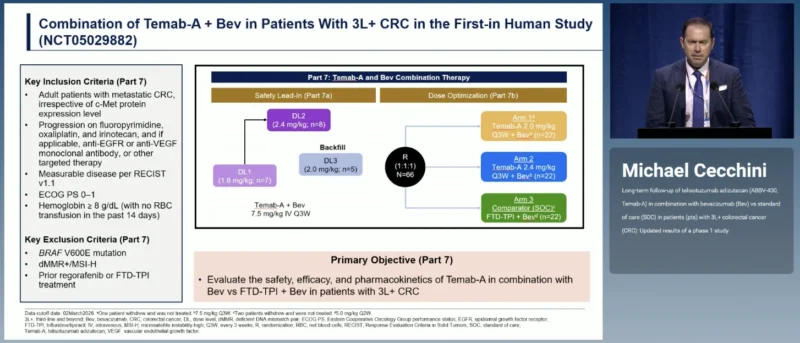
The Phase I study enrolled patients with advanced colorectal cancer without selection based on c-Met protein expression. The study included two parts: a safety lead-in and a dose-optimization phase.
During the safety lead-in, patients received Temab-A at 1.6 mg/kg (n=7) or 2.4 mg/kg (n=8), with an additional 2.0 mg/kg backfill cohort (n=5). All patients received Temab-A in combination with bevacizumab 7.5 mg/kg every three weeks. In the dose-optimization phase, 66 patients were randomized in a 1:1:1 ratio to Temab-A 2.0 mg/kg plus bevacizumab, Temab-A 2.4 mg/kg plus bevacizumab, or TAS-102 plus bevacizumab. Of these, 21, 22, and 20 patients, respectively, received treatment.
In the Temab-A arms, bevacizumab was administered at 7.5 mg/kg every three weeks. In the standard-of-care arm, TAS-102 was administered at 35 mg/m² on Days 1–5 and 8–12 of each four-week cycle, with bevacizumab 5 mg/kg every two weeks. The study’s primary objectives were to assess the safety, tolerability, pharmacokinetics, and efficacy of Temab-A plus bevacizumab.
Key Findings from the Phase I Study
A total of 83 patients received treatment, including 63 patients treated with Temab-A plus bevacizumab and 20 receiving TAS-102 plus bevacizumab. The median patient age was 57 years (range 25–82), and the median number of prior treatment lines was three (range 1–8). At the updated analysis, median follow-up was 18.2 months. Efficacy outcomes for the 2.0 mg/kg and 2.4 mg/kg Temab-A dose groups were pooled across the safety lead-in and dose-optimization cohorts, comprising 26 and 30 patients, respectively.
Objective Response Rate and Duration of Response
Among the evaluated doses, Temab-A 2.4 mg/kg plus bevacizumab (n=30) showed the highest antitumour activity.
The investigator-assessed confirmed objective response rate (cORR) was 30.0% (9/30) with Temab-A 2.4 mg/kg plus bevacizumab, compared with 19.2% (5/26) at the 2.0 mg/kg dose and 0% (0/20) with TAS-102 plus bevacizumab.
Median duration of response (DOR) was 5.6 months (range 2.9–not estimable) with Temab-A 2.4 mg/kg plus bevacizumab and 6.9 months (range 2.8–not estimable) with the 2.0 mg/kg combination.
Progression-Free Survival
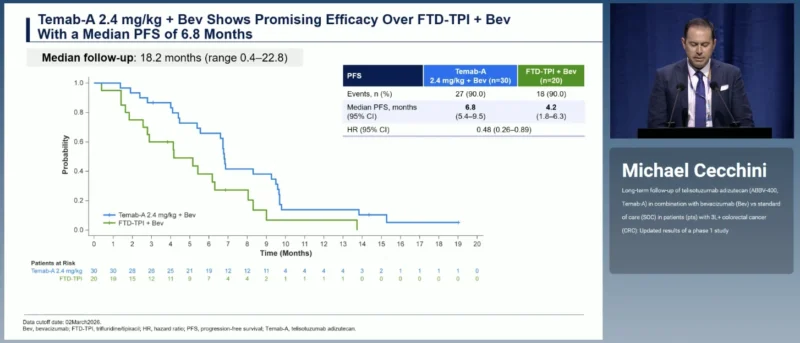
Median progression-free survival (PFS) was 6.8 months (95% CI 5.4–9.5) with Temab-A 2.4 mg/kg plus bevacizumab compared with 4.2 months (95% CI 1.8–6.3) with TAS-102 plus bevacizumab (HR 0.48; 95% CI 0.26–0.89). At the 2.0 mg/kg dose, median PFS was 5.6 months (95% CI 3.9–8.3).
Overall Survival
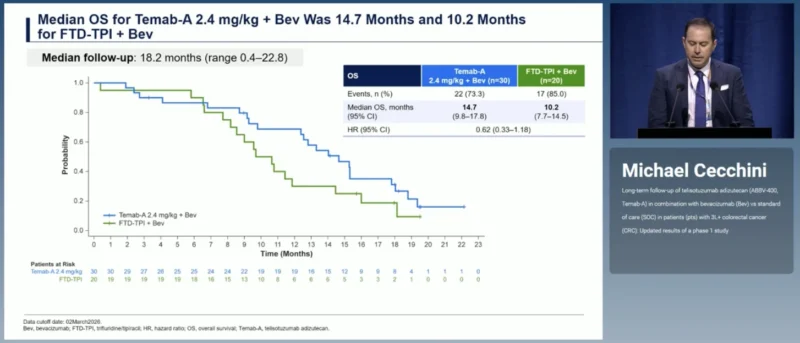
Median overall survival (OS) was 14.7 months (95% CI 9.8–17.8) with Temab-A 2.4 mg/kg plus bevacizumab compared with 10.2 months (95% CI 7.7–14.5) with TAS-102 plus bevacizumab (HR 0.62; 95% CI 0.33–1.18). At the 2.0 mg/kg dose, median OS was 11.2 months (95% CI 5.8–not estimable).
The estimated 15-month OS probabilities were:
- Temab-A 2.4 mg/kg plus bevacizumab: 50% (95% CI 30–60%).
- Temab-A 2.0 mg/kg plus bevacizumab: 40% (95% CI 20–60%).
- TAS-102 plus bevacizumab: 30% (95% CI 10–50%).
Treatment Duration and Safety
Median treatment duration was 6.1 months (range 1.4–19.8) with Temab-A 2.4 mg/kg plus bevacizumab and 3.9 months (range 1.4–20.0) with the 2.0 mg/kg combination. In the standard-of-care arm, median TAS-102 treatment duration was 4.9 months (range 0.9–14.0).
The investigators reported a manageable safety profile, with treatment-related adverse events primarily involving haematological and gastrointestinal toxicity. In the Temab-A 2.4 mg/kg plus bevacizumab group (n=30), Grade 3 or higher treatment-related anaemia, neutropenia, and thrombocytopenia occurred in 53%, 33%, and 10% of patients, respectively.
Treatment discontinuation occurred in one patient (3%), while dose reductions and dose interruptions were reported in 15 (50%) and 22 (73%) patients, respectively. In the TAS-102 plus bevacizumab group (n=20), treatment discontinuation occurred in one patient (5%), dose reductions in six (30%), and dose interruptions in nine (45%).
Adjudicated interstitial lung disease (ILD)/pneumonitis was reported in one patient (3%) receiving Temab-A 2.4 mg/kg plus bevacizumab and was Grade 3. No treatment-related adverse events leading to death were reported. No new safety signals were identified with the additional follow-up.
Conclusions
The updated Phase I analysis reported antitumour activity with telisotuzumab adizutecan (ABBV-400, Temab-A) plus bevacizumab in patients with previously treated advanced colorectal cancer.
At the 2.4 mg/kg dose, Temab-A plus bevacizumab achieved a confirmed objective response rate of 30.0%, median PFS of 6.8 months, and median OS of 14.7 months. In comparison, the TAS-102 plus bevacizumab group had a confirmed objective response rate of 0%, median PFS of 4.2 months, and median OS of 10.2 months.
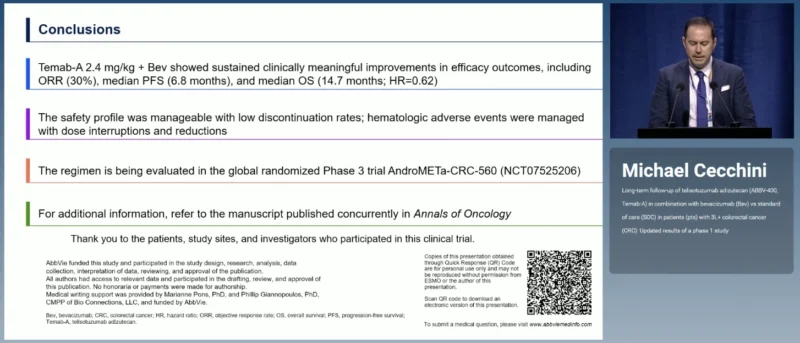
After a median follow-up of 18.2 months, no new safety signals were observed. The investigators described the overall survival findings with Temab-A 2.4 mg/kg plus bevacizumab as clinically meaningful compared with standard of care. However, the Phase I design, small treatment groups, and pooling of patients from the safety lead-in and randomized dose-optimization cohorts limit conclusions regarding comparative efficacy.
Further evaluation of Temab-A plus bevacizumab versus TAS-102 plus bevacizumab is being conducted in the global randomized Phase III AndroMETa-CRC-560 trial (NCT07525206).
Source: ESMO Congress 2026 – Abstract 791RO, Telisotuzumab Adizutecan Plus Bevacizumab
Read more about ECLYPse at ESMO 2026 on OncoDaily.