At the ESMO Congress 2026, Maria Alessandra Calegari (Rome, Italy) presented results from the Phase II ECLYPse trial (NCT06640166), evaluating the continuation of encorafenib plus cetuximab beyond progression in combination with FOLFIRI in patients with BRAF V600E-mutated metastatic colorectal cancer (mCRC).
The analysis, presented in the Rapid Oral session (788RO), assessed progression-free survival (PFS), overall survival (OS), and safety in patients whose disease had progressed on second-line encorafenib plus cetuximab.
Why Was ECLYPse Conducted?
Patients with BRAF V600E-mutated metastatic colorectal cancer who experience disease progression on targeted therapy have limited treatment options.
The ECLYPse trial was designed based on two considerations: the hypothesis that intratumoural heterogeneity at progression may allow a subset of the disease to remain sensitive to encorafenib plus cetuximab, and previous evidence of synergistic activity between targeted agents and chemotherapy in the first-line setting.
The study investigated whether continuing encorafenib plus cetuximab beyond progression, together with FOLFIRI, could provide disease control in this patient population.
ECLYPse Study Design and Methods
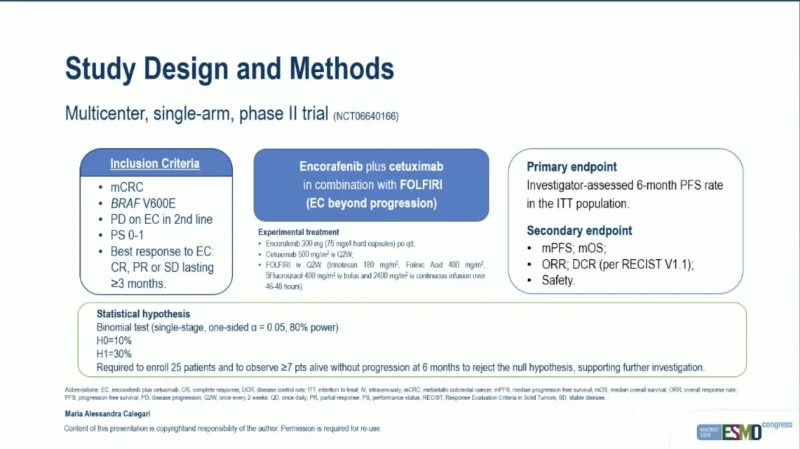
ECLYPse was a multicentre, single-arm Phase II trial enrolling patients with BRAF V600E-mutated mCRC who had progressed on second-line encorafenib plus cetuximab. Eligible patients had an ECOG performance status of 0–1 and a best response to prior encorafenib plus cetuximab of complete response, partial response, or stable disease lasting at least three months. Patients received continued encorafenib at 300 mg daily and cetuximab at 500 mg/m² intravenously every two weeks, in combination with FOLFIRI.
The primary endpoint was the investigator-assessed six-month PFS rate in the intention-to-treat (ITT) population. The single-stage study design, with a one-sided significance level of 0.05 and 80% power, required 25 patients and at least seven patients alive without progression at six months to reject the null hypothesis of a six-month PFS rate of 10% or less. Secondary endpoints included median PFS, median OS, objective response rate (ORR), disease control rate (DCR), and safety.
Key Findings from ECLYPse
Between June 12, 2024, and April 15, 2026, a total of 25 patients were enrolled. The median age was 65 years (range 37–84), and 68% were male. Most patients had an ECOG performance status of 0 (68%). Right-sided primary tumours were reported in 68% of patients, while 76% had synchronous metastases.
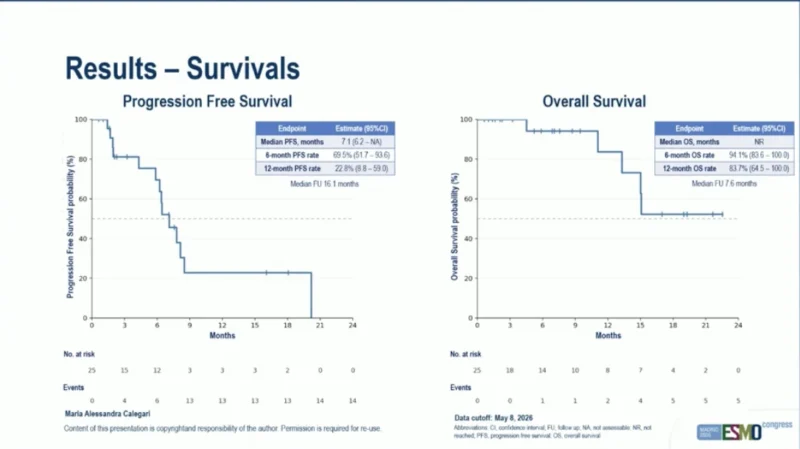
Liver metastases were present in 68% of patients and peritoneal metastases in 64%. Overall, 92% had mismatch repair-proficient (pMMR) tumours. At the May 8, 2026 data cutoff, 14 disease progression events had been observed. The presentation reported median follow-up of 16.1 months for the PFS analysis and 7.6 months for the OS analysis.
Progression-Free Survival
Among 18 patients evaluable for the primary endpoint, 12 (66.7%) were alive without disease progression at six months, exceeding the prespecified threshold of at least seven patients. The Kaplan–Meier estimated six-month PFS rate was 69.5% (95% CI 51.7–93.6%), while median PFS was 7.1 months (95% CI 6.2–not estimable). The estimated 12-month PFS rate was 22.8% (95% CI 8.8–59.0%). The trial met its prespecified primary endpoint.
Overall Survival
Median overall survival had not been reached at the time of analysis. The estimated OS rates were:
- Six-month OS: 94.1% (95% CI 83.6–100%).
- Twelve-month OS: 83.7% (95% CI 64.5–100%).
Objective Response and Disease Control
The objective response rate (ORR) was 15.0% (95% CI 3.2–37.9%), while the disease control rate (DCR) was 80.0% (95% CI 56.3–94.3%).
Safety Outcomes
No new safety signals were observed with encorafenib plus cetuximab and FOLFIRI. Treatment-emergent adverse events (TEAEs) of any grade occurred in all 25 patients, with Grade 3–4 TEAEs reported in eight patients (32%) and serious TEAEs in three patients (12%).
Grade 3–4 treatment-related adverse events occurred in five patients (20%), while one patient (4%) experienced a serious treatment-related adverse event. TEAEs led to permanent treatment discontinuation in two patients (8%), dose interruption in nine (36%), and dose reduction in 16 (64%).
The most frequently reported treatment-related adverse events were anaemia (72%), diarrhoea (56%), hypokalaemia (44%), oral mucositis (44%), and fatigue (44%).
Conclusions
The Phase II ECLYPse trial met its primary endpoint, with 12 of 18 evaluable patients (66.7%) alive without progression at six months, exceeding the prespecified threshold of seven patients. The Kaplan–Meier estimated six-month PFS rate was 69.5% (95% CI 51.7–93.6%), and median PFS was 7.1 months.
The objective response rate was 15.0%, while the disease control rate was 80.0%. Median overall survival had not been reached after a median follow-up of 7.6 months, and no new safety signals were identified.
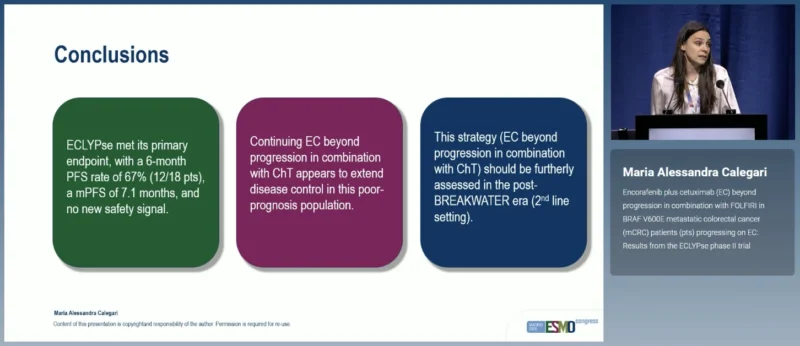
These findings suggest that continuing encorafenib plus cetuximab beyond progression in combination with FOLFIRI may provide disease control in this previously treated patient population.
However, the single-arm design and small sample size limit conclusions regarding comparative treatment efficacy. The investigators suggested that these findings could inform future research aimed at identifying optimal treatment strategies following progression on BRAF-targeted therapy in the post-BREAKWATER era.
Source: ESMO Congress 2026 – Abstract 788RO, ECLYPse
Read more about ACTICCA-1 at ESMO 2026 on OncoDaily.