At the ESMO Congress 2026, Sara Lonardi (Padua, Italy) presented the final overall survival (OS) results from the Phase III CheckMate 8HW trial (NCT04008030), evaluating nivolumab plus ipilimumab compared with nivolumab monotherapy or chemotherapy in patients with microsatellite instability-high and/or mismatch repair-deficient (MSI-H/dMMR) metastatic colorectal cancer (mCRC).
The analysis, presented as Late-Breaking Abstract LBA32 in the Rapid Oral session, reported prespecified final OS findings alongside updated progression-free survival (PFS), objective response rate (ORR), duration of response (DOR), and safety outcomes.
Why Was CheckMate 8HW Conducted?
The Phase III CheckMate 8HW trial previously demonstrated superior PFS with nivolumab plus ipilimumab compared with nivolumab monotherapy across all treatment lines and compared with chemotherapy in the first-line setting. The combination also showed a clinically meaningful PFS improvement over nivolumab monotherapy in the first-line population.
Previous interim analyses demonstrated a favourable OS trend with nivolumab plus ipilimumab compared with nivolumab monotherapy across treatment lines (HR 0.61). The prespecified final OS analysis evaluated whether these findings translated into a sustained overall survival benefit with longer follow-up.
CheckMate 8HW Study Design and Methods
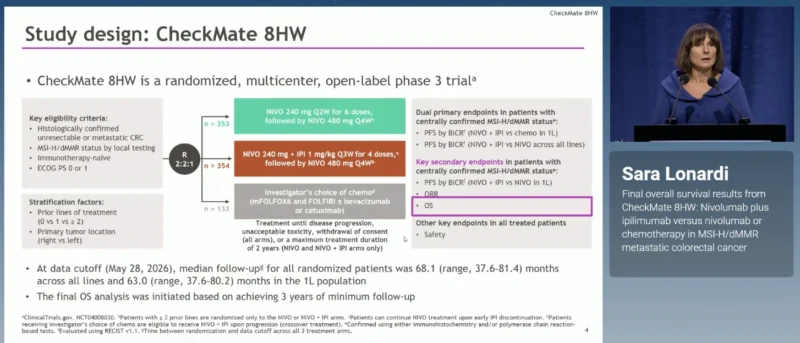
CheckMate 8HW was a randomized, multicentre, open-label Phase III trial enrolling patients with unresectable or metastatic colorectal cancer and MSI-H/dMMR status determined by local testing. Patients were randomized in a 2:2:1 ratio to nivolumab plus ipilimumab, nivolumab monotherapy, or investigator’s choice of chemotherapy with or without targeted therapy. Patients with two or more prior treatment lines were randomized only to nivolumab plus ipilimumab or nivolumab monotherapy.
The final analysis assessed overall survival, with updated efficacy outcomes including PFS, ORR, and DOR. Safety was also evaluated. The analysis included comparisons of nivolumab plus ipilimumab versus nivolumab across all treatment lines, as well as first-line comparisons with chemotherapy and nivolumab monotherapy.
Key Findings from CheckMate 8HW
At the May 28, 2026 data cutoff, median follow-up was 68.1 months (range 37.6–81.4) across all treatment lines and 63.0 months (range 37.6–80.2) in the first-line population.
Overall Survival Across All Treatment Lines
The centrally confirmed MSI-H/dMMR population included 296 patients assigned to nivolumab plus ipilimumab and 286 assigned to nivolumab monotherapy. Nivolumab plus ipilimumab demonstrated a statistically significant OS benefit compared with nivolumab monotherapy (HR 0.61; 95% CI 0.46–0.82; p=0.0009). Median OS was not reached in either treatment group. The estimated five-year OS rate was 74% with nivolumab plus ipilimumab compared with 62% with nivolumab monotherapy.
Nivolumab Plus Ipilimumab vs Chemotherapy
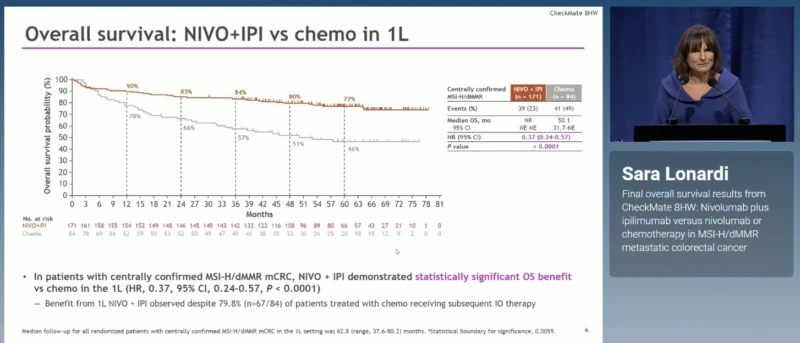
The first-line comparison included 171 patients assigned to nivolumab plus ipilimumab and 84 assigned to chemotherapy with or without targeted therapy. Nivolumab plus ipilimumab demonstrated a statistically significant improvement in OS compared with chemotherapy (HR 0.37; 95% CI 0.24–0.57; p<0.0001).
Median OS was not reached with nivolumab plus ipilimumab, compared with 50.1 months (95% CI 31.7–not estimable) with chemotherapy. The estimated five-year OS rate was 77% with nivolumab plus ipilimumab versus 46% with chemotherapy. The investigators reported that 79.8% (67/84) of patients in the chemotherapy group received subsequent immunotherapy.
Nivolumab Plus Ipilimumab vs Nivolumab
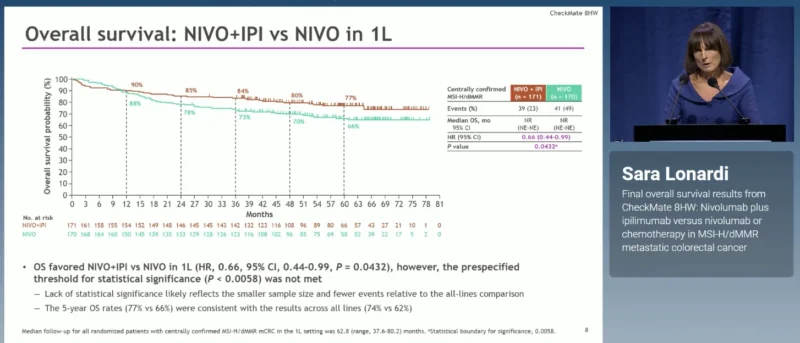
The first-line comparison of nivolumab plus ipilimumab (n=171) versus nivolumab monotherapy (n=170) also numerically favoured the combination. The OS hazard ratio was 0.66 (95% CI 0.44–0.99; p=0.0432). However, the comparison did not meet the prespecified statistical significance threshold of p=0.0058. Median OS was not reached in either group. The estimated five-year OS rate was 77% with nivolumab plus ipilimumab versus 66% with nivolumab monotherapy.
Although the results numerically favoured nivolumab plus ipilimumab, a statistically significant OS improvement over nivolumab monotherapy was not established in this first-line comparison.
Progression-Free Survival
Updated descriptive PFS analyses continued to favour nivolumab plus ipilimumab across the evaluated comparisons. Across all treatment lines, median PFS was not reached with nivolumab plus ipilimumab (95% CI 71.7 months–not estimable), compared with 39.3 months (95% CI 23.0–58.7) with nivolumab monotherapy (HR 0.60; 95% CI 0.47–0.77). In the first-line comparison with chemotherapy, median PFS was not reached with nivolumab plus ipilimumab (95% CI 64.3 months–not estimable), compared with 5.9 months (95% CI 4.4–7.8) with chemotherapy (HR 0.21; 95% CI 0.14–0.32).
In the first-line comparison with nivolumab monotherapy, median PFS was not reached with nivolumab plus ipilimumab (95% CI 64.3 months–not estimable), compared with 60.8 months (95% CI 32.8 months–not estimable) with nivolumab alone (HR 0.68; 95% CI 0.48–0.96). These updated PFS results were reported descriptively.
Objective Response Rate and Duration of Response
Across all treatment lines, the objective response rate (ORR) was 72% (213/296) with nivolumab plus ipilimumab compared with 58% (165/286) with nivolumab monotherapy. Complete response (CR) rates were 40% versus 31%, while disease control rates (DCR) were 84% versus 76%, respectively.
In the first-line setting, ORR was 74% (127/171) with nivolumab plus ipilimumab, compared with 61% (104/170) with nivolumab monotherapy and 27% with chemotherapy. Complete response rates were 41% with nivolumab plus ipilimumab versus 32% with nivolumab monotherapy and 7% with chemotherapy.
Median duration of response (DOR) was not reached with nivolumab plus ipilimumab or nivolumab monotherapy in the reported comparisons. In the first-line chemotherapy group, median DOR was 8.2 months (95% CI 5.9–17.6). These updated response outcomes were descriptive and showed durable responses with immunotherapy-based treatment.
Safety Outcomes
The safety profile of nivolumab plus ipilimumab remained consistent with previously reported findings, with no new safety signals or additional treatment-related deaths during extended follow-up. In the all-lines safety population, 352 patients received nivolumab plus ipilimumab, 351 received nivolumab monotherapy, and 115 received chemotherapy.
Treatment-related adverse events (TRAEs) of any grade occurred in 82% of patients receiving nivolumab plus ipilimumab, compared with 71% receiving nivolumab monotherapy and 96% receiving chemotherapy. Grade 3–4 TRAEs were reported in 22%, 14%, and 51% of patients, respectively.
Serious TRAEs occurred in 18% of patients receiving nivolumab plus ipilimumab, 8% receiving nivolumab monotherapy, and 19% receiving chemotherapy. TRAEs leading to treatment discontinuation occurred in 14%, 6%, and 34% of patients, respectively.
The most frequently reported treatment-related adverse events with nivolumab plus ipilimumab included pruritus (26%), diarrhoea (20%), asthenia (17%), and hypothyroidism (17%). Overall, two treatment-related deaths had been reported in the nivolumab plus ipilimumab group, one in the nivolumab monotherapy group, and none in the chemotherapy group. No additional treatment-related deaths were observed with longer follow-up.
Conclusions
The prespecified final overall survival analysis of the Phase III CheckMate 8HW trial demonstrated a statistically significant OS benefit with nivolumab plus ipilimumab compared with nivolumab monotherapy across all treatment lines (HR 0.61; 95% CI 0.46–0.82; p=0.0009) and compared with chemotherapy in the first-line setting (HR 0.37; 95% CI 0.24–0.57; p<0.0001). At five years, OS rates were 74% versus 62% for nivolumab plus ipilimumab versus nivolumab monotherapy across all treatment lines, and 77% versus 46% for nivolumab plus ipilimumab versus chemotherapy in the first-line setting.
In the first-line comparison with nivolumab monotherapy, OS numerically favoured nivolumab plus ipilimumab (HR 0.66; 95% CI 0.44–0.99; p=0.0432), with five-year OS rates of 77% versus 66%. However, this comparison did not meet the prespecified statistical significance threshold of p=0.0058.
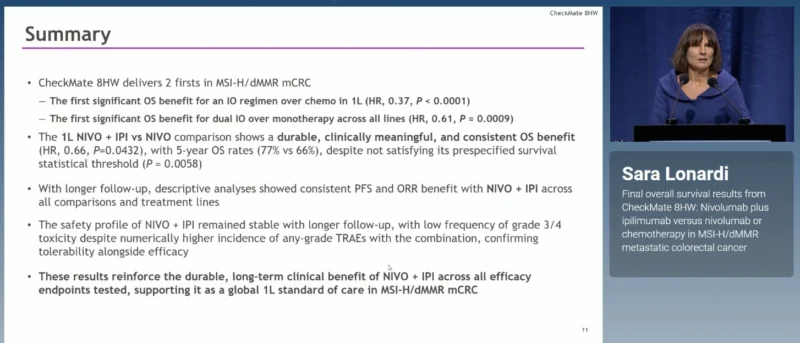
Updated descriptive analyses also showed sustained PFS and ORR findings favouring nivolumab plus ipilimumab across the evaluated comparisons. The safety profile remained consistent with previous reports, with no new safety signals or additional treatment-related deaths.
These findings reinforce the long-term clinical benefit of nivolumab plus ipilimumab in MSI-H/dMMR metastatic colorectal cancer and support its role as a first-line standard-of-care treatment option.
Source: ESMO Congress 2026 – LBA32, CheckMate 8HW
Read more about Temab-A + Bevacizumab at ESMO 2026 on OncoDaily.