
On October 8, 2026, Agenus announced that the Ministry of Health of the Republic of Armenia had granted marketing authorizations for Botvymo (botensilimab; BOT) and Evamplix (balstilimab; BAL), each approved for use in combination with the other for adults with microsatellite-stable (MSS) metastatic colorectal cancer (mCRC) without active liver metastases who have previously received available standard therapies.
The conditional authorizations, effective October 2, 2026, are the first marketing authorizations for either medicine worldwide. The decision follows several years of clinical development, including early-phase studies, randomized Phase 2 evaluation, peer-reviewed publications, and expanded patient access initiatives.
Garo H. Armen, PhD, Chairman and Chief Executive Officer of Agenus, stated:
“Armenia is the first country in the world to grant marketing approval for BOT+BAL. The evidence behind this decision has been published in peer-reviewed journals and presented at major cancer conferences, and it has consistently pointed to clinical benefit for patients with metastatic colorectal cancer. We thank Armenia’s health authorities for the depth and care of their review. Patients who have exhausted standard treatments now have a new option, and we are proud to bring it to them.”
Armenia’s First Marketing Authorizations
The Armenian regulatory authorities reviewed the complete registration dossiers for botensilimab and balstilimab, submitted in the international Common Technical Document format used under Eurasian Economic Union rules.
According to Agenus, the evaluation included product quality and manufacturing data, nonclinical findings, clinical efficacy and safety, pharmacovigilance, and risk management. BOT and BAL were submitted separately and received separate authorizations for use together as a combination regimen. Each authorization is conditional, valid for one year, and renewable based on annual clinical updates provided to the Armenian regulator.
Under the approved product information, Botvymo is administered at 75 mg intravenously every six weeks for up to four doses, in combination with Evamplix at 240 mg intravenously every two weeks for up to two years or until disease progression or unacceptable toxicity. The approved indication is specifically limited to previously treated MSS mCRC without active liver metastases.
The Journey of BOT+BAL in MSS Colorectal Cancer
The development of BOT+BAL has focused on extending immunotherapy benefits to tumors that historically respond poorly to conventional immune checkpoint inhibitors.
Patients with refractory MSS metastatic colorectal cancer have limited treatment options after progression on standard therapies, and conventional PD-1/PD-L1 blockade has generally demonstrated minimal activity in this population.
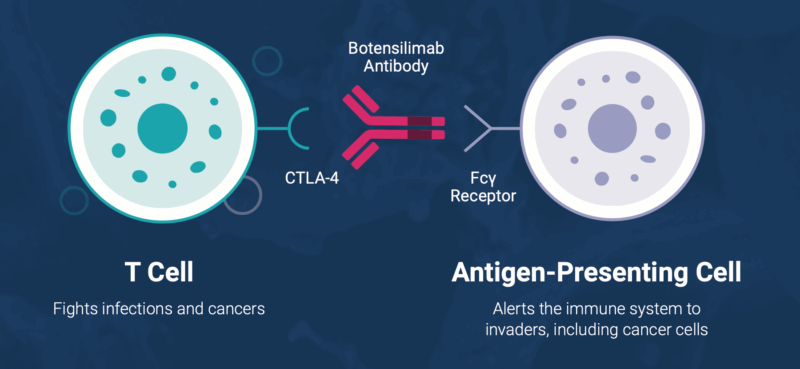
Botensilimab is a multifunctional, Fc-enhanced anti-CTLA-4 antibody designed to activate innate and adaptive antitumor immunity through mechanisms including T-cell priming, modulation of regulatory T cells, and myeloid cell activation.
Balstilimab is an anti-PD-1 monoclonal antibody that blocks the interaction of PD-1 with its ligands PD-L1 and PD-L2, supporting antitumor T-cell activity. Together, the agents are designed to promote immune responses in tumors considered immunologically “cold.”
Early Clinical Evidence: Phase 1 C-800-01
An important milestone came on June 13, 2024, when Nature Medicine published the study titled “Botensilimab plus balstilimab in relapsed/refractory microsatellite stable metastatic colorectal cancer: a phase 1 trial,” by Andrea J. Bullock, Benjamin L. Schlechter, Marwan G. Fakih, and colleagues.
The analysis included 148 heavily pretreated patients with MSS mCRC who received botensilimab plus balstilimab. Of these, 101 were considered response-evaluable with at least six months of follow-up.
Among response-evaluable patients, the confirmed objective response rate (ORR) was 17%, the disease control rate was 61%, and median duration of response was not reached. An exploratory analysis identified an important difference according to liver metastasis status. Among 77 patients without active liver metastases, the ORR was 22%, compared with 0% among 24 patients with active liver metastases.
These findings provided the rationale for focusing subsequent investigations on patients without active liver metastases, a group that could include patients with previously treated liver metastases but no active hepatic disease. However, the study was nonrandomized, and the findings required further evaluation in larger controlled trials.
Phase 2 Results and FDA Discussions
The next stage of development included the randomized, open-label Phase 2 C-800-25 study (NCT05608044), evaluating botensilimab alone or in combination with balstilimab, alongside an investigator’s choice standard-of-care arm, in patients with refractory MSS mCRC without active liver metastases.
On July 18, 2024, Agenus announced the outcomes of its end-of-Phase 2 meeting with the US Food and Drug Administration (FDA). The FDA and Agenus reached agreement on the proposed Phase 3 dosing regimen of botensilimab 75 mg every six weeks for up to four doses, combined with balstilimab 240 mg every two weeks for up to two years. However, the FDA advised against submitting the available data in support of accelerated approval, citing uncertainty about whether the observed objective response rates would translate into a survival benefit.
Updated Phase 2 findings were subsequently presented at the ASCO Gastrointestinal Cancers Symposium in January 2025. The trial enrolled 234 patients across 40 centers worldwide. In the botensilimab 75 mg plus balstilimab arm, the ORR was 19%, with a disease control rate of 55%.
In the July 2024 interim analysis, no objective responses were observed among 33 patients in the standard-of-care arm. At the January 2025 update, approximately 70% of responses in the BOT 75 mg plus BAL arm remained ongoing. The updated findings provided additional evidence of antitumor activity and supported continued development of the previously selected 75 mg botensilimab regimen. However, these findings do not establish an overall survival advantage over standard therapy.
France Expands Access to BOT+BAL
On September 9, 2025, Agenus announced that BOT+BAL had become available to eligible patients with refractory MSS mCRC without active liver metastases through France’s national Autorisation d’Accès Compassionnel (AAC) program.
Under the framework administered by France’s National Agency for Medicines and Health Products Safety (ANSM), eligible patients could receive treatment in hospitals with full reimbursement through the national health insurance system, Assurance Maladie. On January 12, 2026, France expanded the AAC protocol to include eligible patients with certain ovarian cancers and soft-tissue sarcomas.
These initiatives provided regulated treatment access before marketing authorization, although compassionate access remained distinct from formal regulatory approval.

BATTMAN: Moving Into Phase 3
On April 1, 2026, Agenus announced enrollment of the first patient in the global Phase 3 BATTMAN (CO.33) trial (NCT07152821). The randomized, controlled study was designed to evaluate botensilimab plus balstilimab versus best supportive care in patients with refractory, unresectable MSS or mismatch repair-proficient (pMMR) metastatic colorectal cancer. Led by the Canadian Cancer Trials Group (CCTG), the study involved international clinical research networks in Canada, France, Australia, and New Zealand.
BATTMAN was planned to enroll approximately 830 patients across more than 100 sites, with overall survival as its primary endpoint. Additional assessments included progression-free survival, tumor response, safety, quality of life, and exploratory biomarkers. The study was intended to provide randomized evidence of the regimen’s clinical benefit in refractory metastatic disease.
ESMO GI 2026: Three-Year Survival Results
On July 2, 2026, Benjamin L. Schlechter, MD, of Dana-Farber Cancer Institute, presented extended follow-up data from the Phase 1b C-800-01 study at the ESMO Gastrointestinal Cancers Congress in Munich, Germany (Poster 91P). The analysis included the fully enrolled cohort of 123 patients with refractory MSS metastatic colorectal cancer without active liver metastases.
Patients had received a median of three prior lines of therapy, and 67% had received at least three prior lines. With extended follow-up, the study reported a median overall survival (OS) of 21.2 months. The estimated 24-month and 36-month OS rates were 41% and 33%, respectively.
The confirmed ORR was 21%, including three complete responses and 23 partial responses. Median duration of response was not reached. The six-week disease control rate was 69%, and the clinical benefit rate at 24 weeks was 28%. At last follow-up, 21 patients (17%) were alive and off all systemic anticancer therapy, including 13 patients who had achieved an objective response.
In a post hoc subgroup of 37 patients previously exposed to later-line regimens, including regorafenib, trifluridine/tipiracil with or without bevacizumab, or fruquintinib, the ORR was 22%, median OS was 16.2 months, and the estimated three-year OS rate was 30%.
Peer-Reviewed Publication and Safety Findings
On August 28, 2026, the mature findings were published online ahead of print in Clinical Cancer Research under the title “Extended Follow-Up of Botensilimab Plus Balstilimab in an Expanded Cohort of Microsatellite-Stable Metastatic Colorectal Cancer Without Active Liver Metastases,” by Benjamin L. Schlechter, Marwan G. Fakih, Apostolia M. Tsimberidou, and colleagues. This publication presented mature findings from the same C-800-01 study previously reported in Nature Medicine in 2024, focusing on the fully enrolled 123-patient cohort without active liver metastases.
The publication reported a median follow-up of 20.2 months, median progression-free survival of 4.0 months, and median OS of 21.2 months (95% CI, 16.2–23.8). The estimated 36-month OS rate was 33% (95% CI, 24%–43%).
The most common treatment-related adverse events were diarrhea (39%; grade ≥3, 8%) and fatigue (37%; grade ≥3, 2%). Overall, grade ≥3 treatment-related adverse events occurred in 41% of patients, and treatment-related adverse events led to discontinuation of both botensilimab and balstilimab in 17%. In the extended ESMO GI safety analysis, immune-mediated diarrhea/colitis occurred in 42% of patients, including grade ≥3 events in 15%. According to Agenus, diarrhea/colitis resolved in 98% of affected patients, with a median time to resolution of 14 days from onset.
No new safety signals or treatment-related deaths were reported with extended follow-up. Although durable responses and long-term survival were observed in a subset of patients, overall survival was an exploratory endpoint in the single-arm Phase 1b cohort. Furthermore, only 37 of the 123 patients had received at least one of the specified later-line regimens. The results therefore cannot establish a comparative survival benefit over standard treatment.

From BATTMAN to ROBBIN: A New Development Strategy
In parallel with the reporting of mature C-800-01 results, Agenus revised its clinical development strategy. On July 13, 2026, the company announced that it would discontinue financial support for BATTMAN to prioritize the neoadjuvant Phase 3 ROBBIN program in MSS colon cancer.
In its August 6, 2026, corporate update, Agenus confirmed that following its funding decision, the Canadian Cancer Trials Group had formally terminated BATTMAN. According to the company, the decision reflected financing and development priorities and was not driven by enrollment performance, efficacy, safety findings, or an interim analysis. Agenus stated that it would continue supporting treatment for patients already enrolled in BATTMAN when medically appropriate and permitted under applicable requirements.
The company’s development priorities shifted toward ROBBIN, a planned global, randomized Phase 3 trial evaluating neoadjuvant BOT+BAL in approximately 850 patients with previously untreated, high-risk stage II–III MSS colon cancer.
The trial is designed to compare a short course of BOT+BAL before surgery, followed by standard management, against standard management alone, with event-free survival as the primary endpoint. The rationale for ROBBIN is supported by earlier neoadjuvant findings from the NEST and UNICORN studies, in which BOT+BAL demonstrated pathological responses in patients with MSS colorectal cancer. Agenus anticipates initiating ROBBIN and dosing the first patient in the first quarter of 2027.
Importantly, ROBBIN addresses a different clinical setting from the Armenian-approved indication. Its findings may help establish the role of BOT+BAL in earlier-stage colon cancer but will not directly confirm its comparative efficacy in previously treated metastatic colorectal cancer.

What Armenia’s Authorization Means
Armenia’s conditional marketing authorizations were supported by evidence from the Phase 1b C-800-01 and randomized Phase 2 C-800-25 studies, alongside quality, safety, and pharmacovigilance data. The decision establishes an approved treatment option for eligible adults with previously treated MSS metastatic colorectal cancer without active liver metastases, although a comparative survival benefit remains unestablished in the absence of completed Phase 3 confirmatory evidence.
The authorizations apply only within Armenia. Agenus expects the decision to benefit patients in the country and those traveling to Armenia for treatment under the care of Armenian oncologists. The company will also evaluate potential marketing authorizations in other Eurasian Economic Union countries.
Outside Armenia, BOT+BAL remains investigational, with access available through permitted compassionate and named-patient programs. The Armenian-approved product information includes warnings for immune-mediated adverse reactions, including colitis and diarrhea, hepatitis, pneumonitis, endocrinopathies, nephritis, myocarditis, and pancreatitis, as well as infusion-related reactions.
Looking Ahead
Armenia’s decision marks the first marketing authorizations worldwide for BOT+BAL, following several years of clinical development. While early-phase findings have shown durable responses in a subset of patients with MSS metastatic colorectal cancer without active liver metastases, further comparative evidence is needed to establish a survival benefit.
The full announcement is available on the official Agenus website.